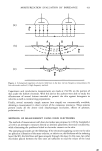
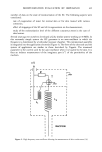
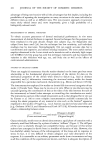
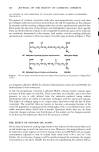
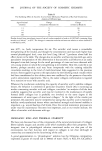
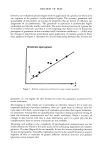
MOISTURIZATION EVALUATION BY IMPEDANCE 425 number of data on the state of moisturization of the SC. The following aspects were considered: rate of evaporation of water for normal skin or for skin treated with various cosmetics, effect of strippings of the SC and of its regeneration on the measurement, study of the moisturization level of the different cutaneous zones in the case of skin lesions. Several years ago we ourselves developed a fairly similar system working at 45 MHz. In this extremely simple system the HF generator is an auto-oscillator in which the frequency is determined by a helicoidal resonant chamber. This miniaturized assembly is integrated into the application electrode (Figure 5). The form of the electrode and the system of application are similar to those described by Tagami. The measured parameter is the current used by the auto-oscillator when it is loaded by the skin. It is thus an indirect measurement of the imaginary part (6") of the permittivity of the medium. +v L 1 1 I I I I I Electrode I I I Figure 5. High frequency auto-oscillator allowing the measurement of skin conductance (19).

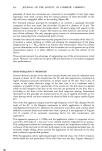
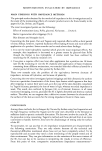
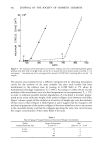
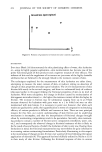
426 JOURNAL OF THE SOCIETY OF COSMETIC CHEMISTS Unlike low-frequency techniques, these two methods are especially sensitive to the water content of the skin surface. We cannot exclude the possibility, however, that by using different configurations of electrodes, we could measure in depth the impedance of the SC. VERY HIGH FREQUENCY METHODS It looks possible as well to measure in vivo the dielectric properties of the skin at very high frequencies, i.e., at several GHz (109 Hz). Two principal techniques have been proposed in this field. The first is based on the study of the reflection of electromagnetic waves on an obstacle which can be the skin. Figure 6 illustrates the principle of this measurement. The wave range is produced by a step generator (rising STEP GEN. TRIGGER ß i , Figure 6. Principle of measurement by the "Time Domain Refiectometry" technique. time: 25.10 -•2 s). This signal can be decomposed using Fourier transform techniques into a stream of waves (10 MHz-12 GHz) it propagates in a guide and is reflected on the obstacle constituted by the skin. An analysis of the reflected signal enables one to obtain the dielectric parameters of the sample as a function of the frequency. This relatively new technique has been described by Felner-Feldeg (14) and applied to the skin by Clar (15). Another method using an interdigitated electrode which enables one to maintain the electric field at a distance of 3/am from the electrode has recently been proposed by Jacques (16). The dielectric parameters can thus be determined at 1 GHz. To our knowledge neither of these two methods has been used to study the moisturizing efficacy of cosmetic preparations. These two methods are of interest because they provide a new experimental approach to the question of impedance. They are useful for the study of the skin since they operate at frequencies where bound water molecules and free water molecules have important zones of dispersion (respectively, at 400 MHz and --• 10 GHz).
Purchased for the exclusive use of nofirst nolast (unknown)
From: SCC Media Library & Resource Center (library.scconline.org)