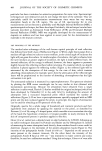
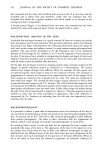
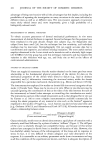
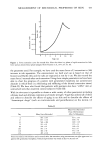
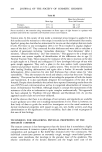
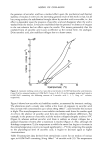
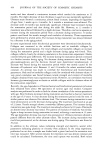
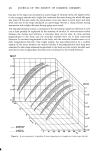
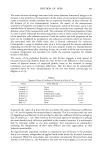
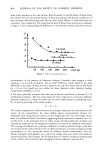
468 JOURNAL OF THE SOCIETY OF COSMETIC CHEMISTS what is the situation in the case of skin. Both Comaish (1) and E1-Shimi (4) found that the friction force is not related linearly to the load and that the friction coefficient of skin increases with decreasing load. On the other hand, Naylor (7) concluded that the constancy of •t is observed. The experimental data of these three authors are compared in Figure 3. Even disregarding the differences in the absolute values of •t, there is some .8 ./4 Naylor ----C C) c. o--0--- 50 100 150 200 250 Load (g) Figure 3. Effect of varying load on 3t. inconsistency in the pattern of observed changes. Comaish's data suggest a clear upswing in •t at loads of approx. 200 g, while E1-Shimi's results point to the load threshold in the range of 50 g and only a gentle rise in •t. His values of •t at low loads (•t • 0.3 at 20 g loads) are very similar to those obtained under identical loading conditions by Highley et al. (9). It has been generally accepted that two major factors contribute to friction (Ft) of unlubricated surfaces. The first arises from the force required to overcome adhesion between surfaces (Fa), while the other, the so-called deformation or ploughing term, (Fd) is due to grooving of the softer surface. The relative importance of these two terms is strongly influenced by such factors as the nature of the counterfaces, the load, sliding speed, environmental factors, etc. Although some disagreement exists as to the magnitude of Fa for non-metals (10,11) there is a substantial body of evidence suggesting that for polymeric materials (•t = 0.2 to 0.8) the F a is the dominant term. In other words, frictional behavior of elastic and viscoelastic materials can be adequately explained in terms of an adhesion mechanism. The concept of adhesion as a primary constraint to relative motion brings to the fore two factors which seem relevant to the invoked mechanism: a) surface energetics of the counterfaces, i.e., the molecular nature of adhesive bonds--electrostatic, Van der Waals, hydrogen, hydrophobic, etc., and b) the surface area over which such adhesive bonds are formed. Accordingly, the frictional force F• between surfaces is proportional to the contact area A and the shear strength (S) of the adhesive contacts, thus,

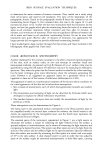
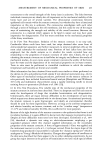
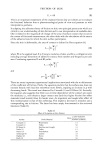
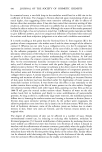
FRICTION OF SKIN 469 F t = AS (II) This is an important restatement of the classical friction law as it allows us to evaluate the frictional behavior from a phenomenological point of view and presents us with interpretative guidance. In adapting the adhesion theory of friction to skin, two principal points arise which are critical to our understanding of skin friction and to our interpretation of available data. One is related to the magnitude of change of the area of surface contact that occurs in the course of frictional measurement the other deals with the elucidation of the nature of the adhesive bond in which the skin surface participates. Since the skin is deformable, the area of contact is defined by Herz equation (9), W )2/• ^ = (K (iii) where W is the applied load, E is Young's modulus of skin, and K is a colligative term including average dimension of adhesive contact, their number and frequency per unit area. Combining equations II and III yields, W )•/• L = s (iv) and Ft = S W •/3 (V) -- •to• W There are some important experimental implications associated with the re-definement of the coefficient of friction. Firstly, the equation predicts that the surface area does not increase linearly with load but somewhat more slowly, implying an increase in/x with decreasing loads. This trend was observed by Comaish (1) and E1-Shimi (4). Secondly, the equation also suggests that there is an inverse dependence of the contact area upon the modulus i.e., one obtains a larger contact area (and thus higher friction) for softer materials (small moduli) than for harder ones. An important and sought after effect of skin moisturization is that of skin softening. This implies a decrease in modulus and a corresponding rise in friction. The latter has been amply documented in the reviewed literature (Table II). Table II Effect of Hydration on Skin Friction Ratio after hydration Author Probe Material /.t before hydration Comaish (1) Wool Fabric 1.5 Comaish (1) Teflon 5.0 EI-Shimi (4) Stainless steel (rough) 2.3 Nacht (5) Teflon 1.5 Naylot (7) Polyethylene 2.0 Sulzberger (8) Leather 2.5 Highley (9) Nylon 7.O Prall (13) Glass 3.0
Purchased for the exclusive use of nofirst nolast (unknown)
From: SCC Media Library & Resource Center (library.scconline.org)