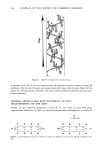
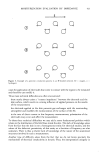
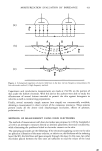
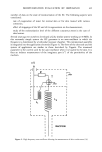
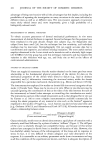
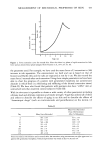
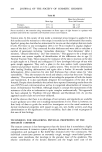
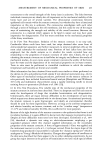
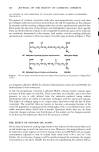
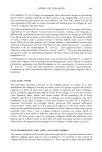
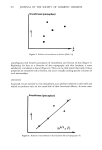
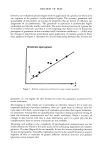
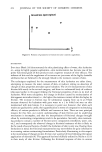
MOISTURIZATION EVALUATION BY IMPEDANCE 423 I 1 I I I I I I I I I I I I I I I I I I Ii I I I (c) Figure 4. Schematized repartition of electric field lines in the skin: (a) low frequency measurement, (b) four electrodes method, (c) high frequency method. Capacitance and conductance measurements are made at 1592 Hz on the portion of skin under the hollow electrode. With this device the authors were able to study the effectiveness of several lotions intended to protect the skin against detergents or solvents as well as moisturizing preparations. Finally, several extremely simple systems (too simple) are commercially available, allowing a measurement in direct current of the cutaneous resistance. These systems present nearly all the above cited disadvantages (occlusion, effects of pressure, polarization, etc.). METHODS OF MEASUREMENT USING FOUR ELECTRODES The method of measurement with four electrodes was proposed in 1976 by Campbell et al. (10) in an attempt to measure directly an intrinsic parameter, electrical conductivity, while eliminating the problems linked to electrode contact on the skin. The operating principles are the following: if the electrodes applying current to the skin are placed at a distance of the same order as, or inferior to, the thickness of the isolating layer (the SC), the field lines will pass uniquely through this layer. In this case, two other electrodes placed between the first ones are sufficient to read the values of the local

424 JOURNAL OF THE SOCIETY OF COSMETIC CHEMISTS 'potentials. If these two electrodes are connected to an amplifier of very high input impedance (very weak current), then the contact pressure of these electrodes on the skin will have a negligible effect on the reading (Figure 4B). The technical solution provided by Campbell et al. involves a quadruple electrode composed of four very small, fine electrodes (25 /am) at a distance of 35 /am. The distance between the extreme electrodes (about 150/am) is large with respect to the thickness of a normal SC (-15/am). This system can then hardly be used except in the case of foot callouses. The only examples given concern in vitro measurements which are very interesting from a fundamental point of view. Another four electrode system was recently proposed for in vivo studies of the skin (11). It involves a system working at 2 KHz and allowing the measurement of the phase displacement tg q/ = RCw which is an intrinsic skin characteristic. Since the authors give no information on the distances of the electrodes nor on the general set-up of the measurement system, it is rather difficult to comment on the real interest of the device. These systems present the advantage of suppressing one of the inconveniences noted above. However, we could not rely upon sufficient data from in vivo studies to appraise their performances. HIGH-FREQUENCY METHODS General dielectric studies of the skin have already shown that only the relaxation zone located at about 10-10 2 nz characterizes the SC and that experiments conducted at higher frequencies provide information on deeper layers of the skin. This is due, of course, to the classic dielectric image of the skin, that is, as a condenser with a resistance in parallel. In fact, penetration of the waves into the skin does not depend solely on their frequency but also on the way they are generated on the skin, that is, according to the form of the electrodes and their respective spacing. Instruments developed on this principle are characterized by the use of applied electrodes at very close spacing which can thus maintain the electrical field in the region nearby (Figure 4C). One of the first apparatus using a relatively high frequency (15.10 3 Hz), designed for the study of the SC, is the Bingmer instrument in which application is effected by interdigitated electrodes (12). However, the instrument most often used, and for which sufficient technical details and results have been reported, is the apparatus of Tagami (13). It consists of an automatic measuring device for skin conductance and capacitance. This apparatus operates at 3.5 MHz, and the application system is composed of two concentric electrodes of 1 mm and 4 mm external diameter separated by an isolator. This configuration allows the investigators to minimize the impediment caused by the occlusion of the electrode on the skin with respect to the transepidermal water loss. An extremely simple sliding device permits the application of the electrode on the skin with a relatively reproducible pressure. With this apparatus, whose operating principle is relatively clear, even if there remains a doubt about the real penetration of the field lines into the skin, Tagami obtained a
Purchased for the exclusive use of nofirst nolast (unknown)
From: SCC Media Library & Resource Center (library.scconline.org)