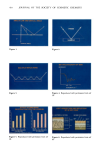
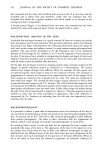
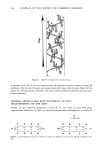
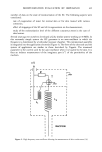
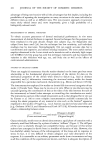
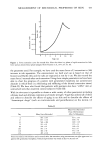
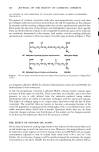
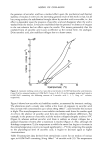
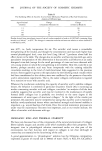
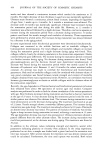
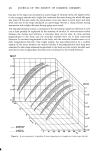
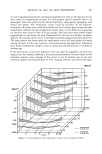
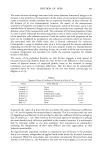
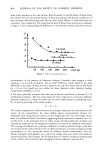
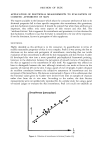
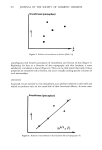
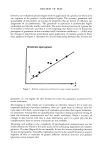
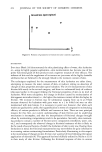
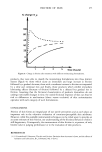
466 JOURNAL OF THE SOCIETY OF COSMETIC CHEMISTS Figure 1. A simple design for measurement of skin friction. yet effective. A roller of weight G is placed on the dorsum of the hand and connected via string and pulley to either a strain gauge A or to a pan B to which weights are added to initiate movement of the roller. The coefficient of friction (/x) is computed from the minimal force (strain gauge A) or minimal weight (pan B) required to maintain the movement of the roller G. Approaches 2 and 3 employ somewhat more sophisticated instrumentation. An example is a rotational skin friction meter (9), a schematic presentation of which is illustrated in Figure 2. It consists of a motor driven wheel which generates a lateral Side View: BALL BEARING PIVOT • LAMP SLIT - HORIZONTAL BAR _ -- _ ] SYNCHRONOUS I DUAL ELEMENTr• PHOTOCELL L• I MOTOR F• ROTATING SHAFT ' ' COUPLING BALL BEARING LINK BETWEEN b a c HORIZONTAL BAR AND TO PHOTOCELL ROTATING SHAFT BRIDGE CIRCUIT Figure 2. Schematic diagram of rotating friction apparatus. [Reproduced with permission from (9)]. force as it rotates on the skin surface. The wheel and drive shaft are connected to the motor through a flexible rubber coupling in such a way that frictional resistance encountered by the wheel produces a lateral displacement of the drive shaft, which in turn controls the proportion of illumination transmitted by two halves of a dual element photocell. An electrical signal is produced which is proportioned to the frictional resistance of skin and is recorded by means of a strip chart recorder.

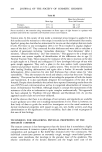
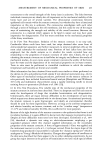
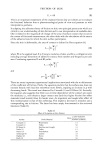
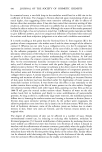
FRICTION OF SKIN 467 The most obvious advantage associated with more elaborate instrument designs is an increase in the sensitivity of measurement. In the realm of conventional measurements, a gain in sensitivity usually translates into an improved reliability of data collection. In the domain of in vivo measurements, however, the aspect of the measurement sensitivity is frequently overridden by the biodynamic nature of the tissue, and it is the reproducibility of observed changes and trends that becomes more important than the absolute value of the measurement itself. The evaluation of frictional properties of skin is a case in point. Although the measuring probe is only in direct contact with the layer of the dead skin cells (stratum corneum), both the surface and bulk properties of the latter can be modulated by perspiration and sebaceous secretions which are function- ally associated with the viable tissue that is located underneath the corneum. Consequently, a range in absolute value of/x is to be expected for various individuals depending on whether they have oily or dry skin, perspire readily, etc. Standardization of the testing procedure (skin cleansing, drying, etc.) as well as of the test environment (constant temperature and humidity) are clearly the essential requisites for reliable studies in this field. The survey of the published literature on skin friction suggests a wide spread of measured values of/x (Table I). Some of it may be due to the difference in the chemical nature of physical texture of employed probes, some to the variation in testing conditions, and some to individual differences. That the latter can be substantially narrowed down by strict standardization of the test was shown convincingly by Highley et al. (9). Table I Reported Values of Coefficient of Friction (30 in Skin In Vivo Author Probe Material (30 Comaish (1) Nylon 0.4 Comaish (1) Teflon 0.2 Comaish (1) Polyethylene 0.3-1.3 E1-Shimi (4) Stainless steel (rough) 0.20-0.45 E1-Shimi (4) Stainless steel (smooth) 1.0 Naylor (7) Polyethylene 0.5-0.6 Highley (9) Nylon 0.2-0.3 Prall (13) Glass 40.4 In general, the values of/x found for skin are within the range of frictional coefficients (/x = 0.1 to 0.6) reported for most polymeric materials. This is at variance with the view of Appeldoorn and Barnett (3) who ascribed to skin the coefficient of friction as high as that of rubber (/x = 2.0). Their work on the frictional aspects of emollience is perhaps the most detailed study of friction published in the cosmetic literature. It is unfortunate that by selecting rubber as the skin substitute, they introduced an intermediary rendering the interpretation of their data difficult and their applicability to skin behavior questionable. An experimentally important corollary to Amontons' law of friction is the postulate that/x is a constant, independent of applied loads under which the frictional resistance is measured. While for most elastic and viscoelastic materials the frictional force-load relation is non-linear (i.e., the Amontons' law does not strictly apply), it is not yet clear
Purchased for the exclusive use of nofirst nolast (unknown)
From: SCC Media Library & Resource Center (library.scconline.org)