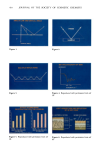
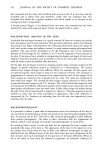
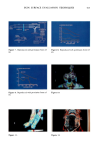
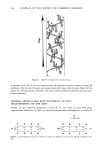
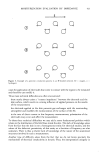
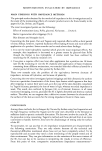
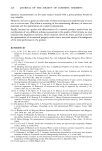
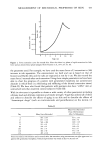
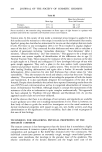
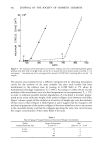
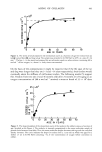
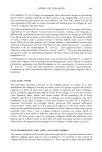
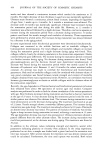
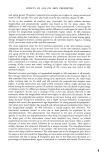
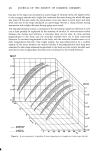
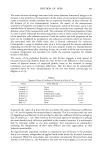
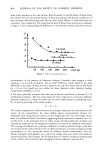
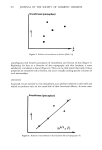
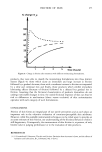
472 JOURNAL OF THE SOCIETY OF COSMETIC CHEMISTS Smoothness (perception) Figure 5. Relation of smoothness to friction [Prall (13)]. unambiguous link between perception of smoothness and friction of skin (Figure 5). Replotting his data as a function of skin topography and skin hardness, a more satisfactory correlation is found (Figure 6). There can be little doubt that both of these properties are somehow tied to friction, but as yet virtually nothing specific is known of such relationships. GREASINESS In general, we are inclined to view smoothness as an attribute inherent to skin itself and related to products only via the causal link of their functional efficacy. In most cases, Smoothness (perception) 0 0 Figure 6. Relation of smoothness to skin hardness (H) and topography (T).

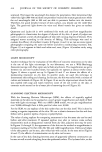
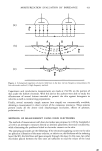
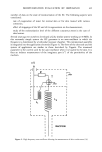
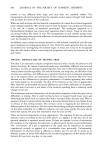
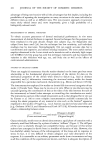
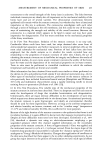
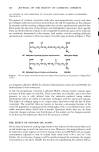
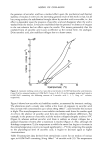
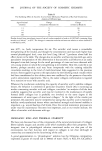
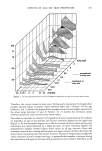
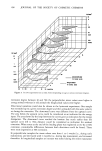
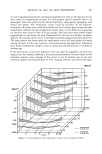
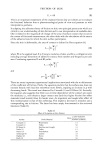
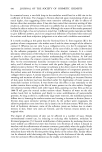
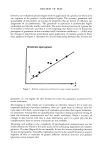
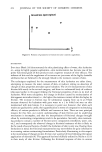
FRICTION OF SKIN 473 however, our evaluation process begins with the application of a product at which time our exposure to the product's tactile aesthetics begins. The viscosity, greasiness, and spreadability of the product are among the properties that are bound to influence our judgement of its performance. The greasiness in particular is aesthetically highly undesirable and thereby readily noticeable. The most obvious function of a grease lies in its ability to lubricate, and thus it is not surprising that Nacht et al. (5) found that perception of greasiness on skin correlated well (correlation coe•cient = -0.995) with the changes in skin friction immediately upon application of cosmetic products. Their data, replotted in Figure 7, illustrates the inverse relationship between skin friction and Greasiness (perception) Figure 7. Relation of greasiness to friction for some cosmetic products. greasiness, i.e., the higher the skin friction the lower the greasiness as perceived by tactile evaluation. Encouraging as these results are in providing an objective measure for at least one important attribute of product aesthetics, there are--apart from an obvious need for more data in this field--several aspects of evaluation procedure that require fundamen- tal assessment. Among these are quantification of product dosing and precise timing of both the frictional measurements and the tactile evaluation. Nacht's account of changes in skin friction with time is most informative, and it is a great pity that the complementary data on sensory evaluation are not available. Intriguing, and adding to the complexity of psychophysical measurements, are the results obtained by Nacht in the same study on the lubricating ingredients of cosmetic products. The data (Figure 8) do not smoothly fit into the inverse rdlationship between friction and greasiness. A possible explanation may be in the varied frictional or sensory response of skin to materials of greatly different chemical structure and polarity (glycerine versus mineral oils).
Purchased for the exclusive use of nofirst nolast (unknown)
From: SCC Media Library & Resource Center (library.scconline.org)