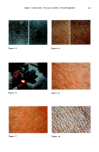
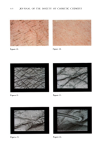
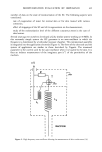
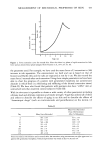
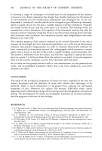
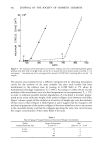
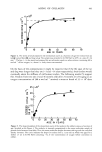
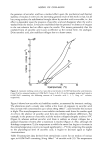
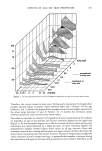
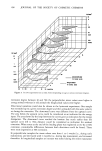
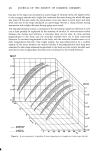
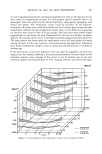
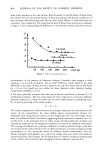
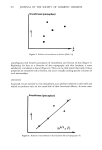
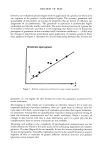
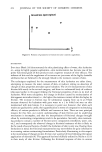
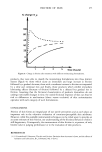
EFFECTS OF AGE ON SKIN PROPERTIES 461 In recent experimental series the mechanical properties not only in vitro but also in vivo were tested in anaesthetized animals. For this purpose special methods had to be developed. Tabs were glued on the shaved back skin, using special equipment with thread and wheels. The stress-strain curves could be recorded on the Instron ©- instrument. Of course, they could be recorded only for the lower part, because the tabs would break off from the skin at high stress values. Also, in vivo differences depending on direction were noted in rats of all age groups. The load values were always higher perpendicular to the body axis than longitudinal for the low and medium extension degrees. No crossing of the curves at the higher extension degrees had been observed. The same pattern was found when the stress-strain curves had been plotted for stress instead of load. In this case, however, more pronounced age-dependent differences were found, indicated by steeper curves in young and old animals than in animals of medium age. If the stress-strain curves were depicted in the way that the logarithm of stress was depicted on the ordinate, allowing a more precise presentation of stress values at low extension degrees, some crossing of the curves in rats of medium age at very low extension degrees was found (Figure 4). This crossing, however, occurred under quite 0.5 [Nlmm 2] 1 0.5 o.1 0.05- OOl 0.005 0.001 1 .0.1 0.05 0.01 0.005 0.001 6O •0 30 perpendicular ' to body axla IO longitudinal 2 4 6 12 24 30 to body axle montha Figure 5. In vivo experiment. Stress depending on age at various elongation degrees.

462 JOURNAL OF THE SOCIETY OF COSMETIC CHEMISTS different conditions and had nothing to do with the crossing observed in skin strips in vitro. The age-dependence of stress values in vivo showed a crossing of both directions depending on age at 5 and 10% extension. From 20% up to 70% extension the situation was similar for all age groups. The perpendicular values were always higher than the longitudinal ones. If stress values were depicted depending on logarithm of age (Figure 5) they decreased in both directions during maturation, achieved a minimum at 4 months, and increased again thereafter. Only at low extension degrees was a crossing of the curves noted. SUMMARY 1. The effects of maturation and aging can be measured in excised skin specimens, both with biochemical and biomechanical methods. 2. In rat skin as well as in human skin the parameters' ultimate load, tensile strength, and ultimate modulus of elasticity show a sharp increase during maturation and a slight but significant decrease during aging. In both species ultimate strain shows a similar pattern. However, the increase of strain during maturation is much less in the other parameters. 3. The parameters indicating strength of rat skin can be correlated with the content of insoluble collagen, but not with elastin or glycosaminoglycans. 4. Other parameters such as the creep experiment in rat skin can be taken as indicator for plasticity. The parameters, e.g. time until rupture and ultimate extension rate, are changed in the same direction during maturation and aging, showing no maximum or minimum at adulthood. 5. Likewise, the values of the relaxation coefficient and of mechanical recovery in the relaxation experiment can be also taken as indicators for viscosity. They are changed during maturation and aging in the same direction in contrast to parameters indicating ultimate strength. 6. The mechanical parameters of rat skin depending on age are considerably influenced by the anisotropic behavior of skin. A crossing of curves has been found for stress-strain curves as well as for ultimate values. 7. Hysteresis experiments show the directional variations even more clearly. 8. The step-phenomenon can be found in perpendicular samples of rat skin but not in longitudinal samples. The presence of the muscular layer in skin gives a partial explanation for this phenomenon as well as for the directional variations observed in vitro. 9. Changes of mechanical behavior due to maturation and aging can also be found in in vivo experiments. Likewise, differences depending on direction are found in vivo. REFERENCES (1) H. G. Vogel, D. KobeIt, G. W. Korting, and H. Holzmann, Priifung der Festigkeitseigenschaften yon Rattenhaut in Abhiingigkeit yon Lebensalter und Geschlecht, Arch. klin. exp. Derm., 239, 296-306 (1970).
Purchased for the exclusive use of nofirst nolast (unknown)
From: SCC Media Library & Resource Center (library.scconline.org)