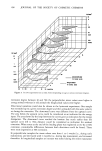
EFFECTS OF AGE ON SKIN PROPERTIES 455 were measured in animals of various ages. Ultimate extension rate decreased tremen- dously during the maturation period. Also, during the aging period a slight decrease was noted. Time until break increased during the whole life-span. The creep experiment or retardation experiment therefore delivered parameters which were changing during the whole life-span in the same direction. In another experiment stress relaxation and mechanical recovery were measured. A skin strip was extended to a given extension degree and kept in this position. In another experiment stress relaxation and mechanical recovery were measured. A skin strip was extended to a given extension degree and kept in this position. The measured load decreased with the logarithm of time. After 5 minutes a more or less steady state was achieved. The sample was then unstretched to 90% of its original elongation. The decrease of load was followed by a slight but measurable increase. This increase was called mechanical recovery. These values had been measured depending on the age of the animals. The decrease of stress due to relaxation depending exponentially on time can be measured by the relaxation coefficient. This coefficient decreased during maturation and showed a further decrease during aging. Likewise, mechanical recovery increased during maturation and showed a further increase during aging. These parameters which indicate plasticity were changing in the same direction during maturation and aging. As known for a long time for human skin, quite important directional variations could also be found in rat skin. In human skin the directional variations are related to Langer's lines. Stress-strain curves in skin of rats of the same age, punched either perpendicular or 1ongidutinal to body axis, were recorded. With increasing extension the stress values of perpendicular samples were first higher, then considerably lower than those of longitudinal samples. Ultimate stress was almost the same in both directions however, perpendicular samples showed much higher ultimate extension than longitudinal samples. In an extensive study the mechanical properties of rat skin longitudinal and perpendicular to the body axis were compared. Again a decrease of thickness of rat skin during the early maturation period, an increase during the late maturation period, a maximum at 12 months, and a decrease at senescence were found. Body weight increased during early and late maturation also, a decrease due to aging was found. Ultimate load showed significant differences between direction versus body axis in young animals. Between 1 and 4 weeks, the perpendicular samples showed the higher values. The maximum was found for both directions at an age of 4 months. The decrease until 24 months was significant for both directions. Tensile strength showed a similar pattern. During the maturation period (between 1 and 4 weeks) the perpendicu- lar samples showed the higher values. After the maximum at 4 months a significant decrease until 24 months was noted for both directions. The pattern of ultimate modulus of elasticity was similar to the values of ultimate stress. Again perpendicular samples were higher during maturation. During adulthood longitudinal samples were slightly higher. The most striking differences were seen for ultimate extension. Perpendicular to the body axis the values rose during early and late maturation, achieving a maximum at 4 months, and decreased significantly until 24 months. Surprisingly enough, longitudinal samples showed a quite different pattern. There was only a slight increase during early maturation. Afterwards the values remained rather constant. To evaluate the differences between longitudinal and perpendicular samples the complete stress-strain curves were compared for rats at various ages. At higher

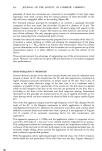
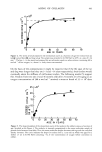
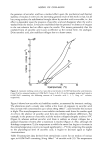
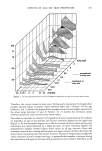
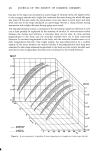
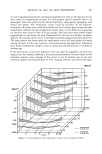
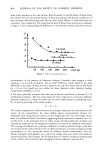
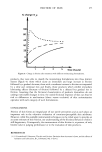
456 JOURNAL OF THE SOCIETY OF COSMETIC CHEMISTS extension degrees the stress values were considerably higher in longitudinal samples, or in other words, at the same stress values much higher extension was observed in perpendicular samples. However, in the stress-strain curves at low extension degrees the reverse relation was observed, resulting in a crossing of the curves. This phenomenon was particularly evident when the logarithm of stress instead of linear stress was depicted on the ordinate (Figure 1). The crossing of the curves occurred at an extension 10- 5 I 0.5 0.1 0.05--- (101 0.005 lO o.ool, 30' 5 24 -1 -0.5 - o.1 ß 0.05 -0.01 • • -- •0.005 longitudinal I -0.001 0 10 20 30 40 50 60 70 80 90 100 Figure 1. In vitro experiment. Logarithm of a stress depending on elongation at various age intervals. of about 40% elongation. It was not found in very young (below 1 month) and very old (at 30 months) animals. This phenomenon was even more evident (13) when elongation was depicted in a linear scale on the ordinate, age in a logarithmic scale on the abscissa, and the various stress degrees on the depth axis in a logarithmic scale (Figure 2). At low stress values the elongation decreased during early maturation for both directions. Afterwards a slight increase was noted, reaching a maximum at 4 months and a slight decrease thereafter. For stress values up to 0.2 N/mm 2 the elongation values were higher for the longitudinal samples than for the perpendicular values. From 0.5 N/mm 2 onwards only the perpendicular samples followed the same age-dependence, i.e., a decrease of elongation during early maturation, an increase during late maturation, and a decrease during aging. Longitudinal samples showed only the decrease during early maturation and almost constant values during late maturation and senescence.
Purchased for the exclusive use of nofirst nolast (unknown)
From: SCC Media Library & Resource Center (library.scconline.org)