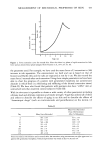
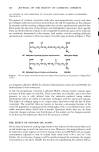
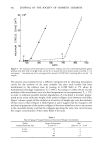
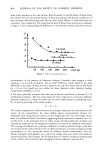
444 JOURNAL OF THE SOCIETY OF COSMETIC CHEMISTS cm -2, shown as the dashed line in Figure 4. The modulus also increased to the value reached by "old" (40 years) human tendon. But human tendon of age greater than 30 years showed no further increases in stress or modulus when given the same in vitro treatment as the rat tendon. Earlier work (4) using the isometric melting technique gave similar results human tendon of age greater than 30 years showed no significant increase in thermal stability after in vitro aging with 300 n mol ml -• of oxygen, whereas 5 and 20 year old tendon did. The same applied to tendon in the rubbery state the rubber modulus could not be increased beyond the limiting (50 years) human tendon value by oxygen treatment of either young human or rat tendon (10). All these experiments suggest that these three mammalian tendons do (or would) reach their potential (with respect to the mechanical properties we have discussed) after about 30 years at the oxygen concentration encountered in vivo. Clearly, oxygen is intimately involved with the in vitro transformation of tendon to more stable forms, and it is probable that the mechanism must be similar to that operating in the in vivo state. But, as others (8) have pointed out, the oxidation of the reducible cross-links would not be sufficient to account for all changes in mechanical and thermal stability. These may also involve addition reactions in which the reducible cross-links react with groups on other molecules to form tri- and tetra-functional cross-links which are then thought to be oxidized to stable forms. However, since in vitro aging can be halted by storing the tendon under nitrogen (12), it would appear that oxygen is required to initiate the addition reactions. Removal of the pituitary and thyroid glands and continuous food restriction, all of which inhibit the development of certain diseases of old age and significantly prolong the duration of life in rats, also retard the rate of aging of the tail tendon (13-17). In all cases there is a reduction in food intake and consequently oxygen consumption (18). Whether the reduction in oxygen consumption causes a corresponding decrease in oxygen concentration in the tissue fluid is not known, but should this be the case it could explain the retardation of collagen aging. ASCORBIC ACID AND TISSUE STABILITY Although L-ascorbic acid is known to be essential to the normal functioning of animals, there is surprisingly little precise knowledge as to the details of its action (19). Its part in the synthesis of collagen is understood in principle it is one of the co-factors of the enzymes responsible for the hydroxylation of specific prolyl and lysyl residues in pro-collagen chains during synthesis within the connective tissue cell (19). The modification of lysine is required for the subsequent extracellular formation of aldimine cross-links which was discussed earlier, while hydroxylation of proline is required to secure the necessary thermal stability (maximum body temperature) of collagen molecules. If ascorbic acid is not present at the required levels at the appropriate time, weak malformed tissues may result. Apart from these cellular involvements, ascorbic acid is thought to have a role in the maintenance of connective tissues where it has a normal plasma concentration of 1-2mg 100ml -• in man and rat. The evidence is highly circumstantial, although in the special situation of wound- healing-tissue the case is strong (20,21). Using the same experimental techniques as were described in the previous section, namely stress/strain and isometric melting in 0.15M NaC1, it can be demonstrated that

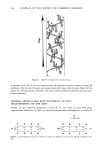
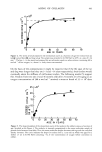
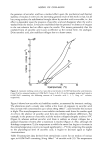
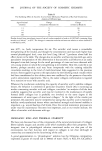
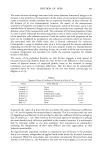
AGING OF COLLAGEN 445 the presence of ascorbic acid has a marked effect upon the mechanical and thermal stability of tendon in vitro (22). An interesting general result of this work is that, for all but young tendon, the stabilization brought about by ascorbic acid is reversible, i.e., the effect is dependent upon the presence of ascorbic acid and disappears when the acid is washed from the tissues. It was also established that the presence or absence of oxygen in the test solution had no effect upon the results. This means presumably that the oxidized form of ascorbic acid is just as effective as the normal form. An analogue, D-iso-ascorbic acid, also stabilizes collagen but to a lesser extent. 14•-•10 6 12 D C O/ • 50 60 70 80 TEMPERATURE (øC) Figure 6. Isometric melting curves of a 2 year old rat tail tendon in 0.15M NaCl/ascorbic acid mixtures. Curve O is for untreated tendon in 0.15M NaC1. Curves A, B, C, D are for samples soaked and tested in 0.15M NaC1 containing the following amount of L-ascorbic acid: 1, 2, 5, 11mg ml -• solution, respectively. Figure 6 shows how ascorbic acid stabilizes tendon, as measured by isometric melting. The alterations reach a steady state within a few hours of exposure to ascorbic acid they increase with concentration up to about 10mg 100ml -•, and thereafter the increase is slight. The stress/temperature curves exhibit similarities with those for tendon aged in vitro in the absence of ascorbic acid they also exhibit significant differences. For example, in the presence of ascorbic acid the tendon collapses abruptly at about 75øC (Figure 6), whereas without ascorbic acid there is seldom an abrupt collapse but a gradual relaxation of stress after a maximum is reached (Figure 2). Also, although the shrinkage temperature T s (the temperature at which the stress first begins to increase in the stress/temperature curve) is increased significantly (-5øC) by subjecting the sample to the physiological level of ascorbic acid, it begins to decrease again at higher concentrations. Table II summarizes data derived from stress/strain curves for rat tendon of various ages, in 0.15M NaC1 containing 20 mg 100ml -• of ascorbic acid (22). The temperature
Purchased for the exclusive use of nofirst nolast (unknown)
From: SCC Media Library & Resource Center (library.scconline.org)