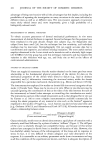
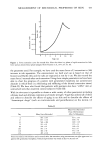
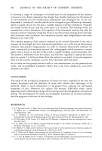
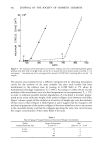
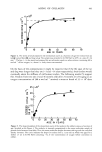
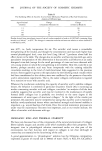
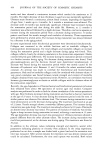
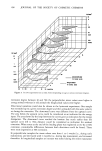
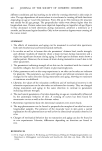
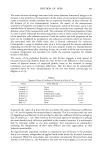
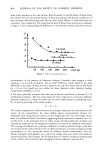
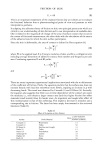
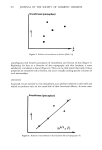
442 JOURNAL OF THE SOCIETY OF COSMETIC CHEMISTS 30 -x10 6 / •' 10 / x •' • ß ........ x.. / 0 _ _.,.•.•_z"__•- ---r--- F-- • • • • 100 300 500 700 DAYS I i i 900 1100 Figure 3. The maximum stress developed in an isometric melting curve for rat tail tendon plotted against absolute time after birth of rat. ß, 50 day old rat X, 23 month old rat K denotes death of animal. (---) in vivo aging, (--) increased rate of in vitro aging when stored in O.15M NaC1 containing 300 n mol ml • of oxygen. The process was examined from a different viewpoint (10) by obtaining stress/strain curves for the tendons of the same animals, but after each tendon had been transformed to the rubbery state by heating in 0.15M NaCI at 5øC above its hydrothermal shrinkage temperature T s (-60øC). According to rubber theory (11) the modulus of the stress/strain curve at a fixed temperature (in our experiments, T s q- 5øC, in order to minimize possible thermal degradation of cross-links) is inversely propor- tional to the mean molecular weight of the melted collagen chain between cross-links. Figure 5 shows a graph of this modulus as a function of sample age note the similarity of this curve to that of Figure 4. Both Figures 4 and 5 suggest that the changes in the mechanical properties of the tendon collagen of the three animals are due to an increase in the cross-link density, and that the collagens age along the same time curve because the oxygen concentration of their tissue fluids is the same. Table I Rate of Aging of Young Tendon as a Function of Oxygen Concentration Tendon Oxygen Concentration Rate Human Flexor Rat Tail (n tool ml -•) (dyne cm-2yr-•)x 106 in vivo - 50 • 1 in vitro 0 0 50 -1 300 •25

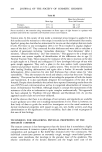
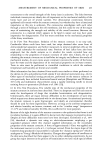
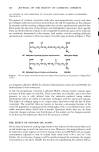
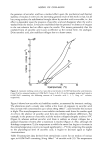
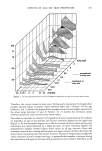
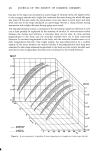
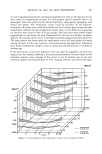
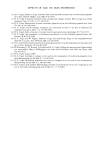
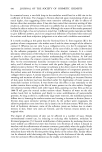
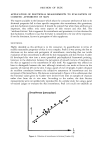
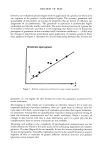
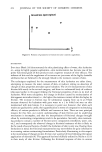
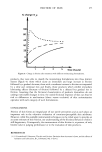
AGING OF COLLAGEN 443 7 xlO 8 . o io s'o AGE IN YEARS Figure 4. The stress at break attained in the stress/strain curve as a function of age for tendon from rat tail •, human flexor I, and dog tail a,. The sample was extended in O.15M NaC1 at 36øC, at a rate of 1.2% min -•. The line (---) is the stress level attained for rat tail tendon aged in a saline solution containing 300 n mol ml-• of free oxygen, i.e., about 6 x body tissue concentration. On the basis of this interpretation it might be expected that if the life span of the rat and dog were longer than they are (--•3 and --•14 years respectively), their tendon would eventually attain the stiffness of old human tendon. The following results (5) support this. Tendon from two rats (3 and 36 months old) after 24 months in vitro aging at an oxygen concentration of 300 n tool ml -• attained a stress at break of 3.5 x 10⁸ dyne 0 10 20 30 40 50 AGE IN YEARS Figure 5. The slope (modulus) of the stress/strain curve of the tendon in the rubbery state as a function of age. Symbols as for Figure 4. The modulus is inversely proportional to the mean molecular weight of protein chain between cross-links. Thus, the mean molecular weight decreases with age and the cross-link density increases. The circle indicates the slope for tendon from a 2 year old rat which was aged for a further 1.5 yrs in O.15M NaC1 containing -5x in vivo concentration of oxygen before conversion to rubber. 0 I I I I I I I •0 70
Purchased for the exclusive use of nofirst nolast (unknown)
From: SCC Media Library & Resource Center (library.scconline.org)