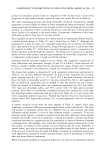
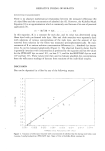
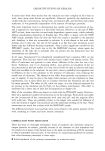
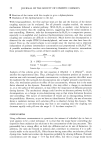
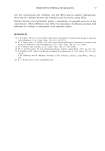
j. Soc. Cosmet. Chem., 36, 1-16 (January/February 1985) Diffusion of semipermanent dyestuffs in human hair S. K. HAN, Y. K. KAMATH, and H.-D. WEIGMANN, Textile Research Institute, P.O. Box 625, Princeton, NJ 08542. Received October 31, 1984. Presented at the Annual Meeting of the Society of Cosmetic Chemists, New York, December 6-7, 1984. Synopsis The diffusion of semipermanent hair dyes into human hair fibers was investigated, with emphasis on the effects of pH, concentration, temperature, and solvent composition of the dyebath. The apparent diffusion coefficient and the activation energy of diffusion were determined using both a dye extraction method and microspectrophotometry. Thermodynamic parameters describing the equilibrium between the hair fiber and the dyebath, such as the dye partition coefficient and dye affinity, were also determined. It was found that the diffusion coefficients are generally independent of concentration but depend on the pH of the dyebath. The solvent composition of the dyebath plays a critical role in the thermodynamic equilibrium such that the value of the partition coefficient for the dye studied in this paper increases by almost an order of magnitude when the solvent is changed from 50 volume percent aqueous ethanol to pure water. INTRODUCTION The desired coloration effects of the class of hair dyes called "semipermanent" last through only about five to six shampoo washings. To achieve this behavior, the dye molecules are generally low molecular weight, nonionic in nature, and should penetrate the cortex of the hair fiber under mild dyeing conditions (1). Since semipermanent hair dyes are transferred directly from the dyebath to the hair fiber, without chemical changes of the dye during the dyeing process, the most important factor that controls dyeing with semipermanent dyes is the diffusion of these dyes under various dyeing conditions. Despite the importance.of dye diffusivity, very few, if any, data are available in the literature concerning the diffusion coefficients of these dyes in hair fibers. The purpose of this paper is to describe the results of an ongoing research program to •r,,dv the dioefi•ivirv of semit•ermanent dyes in hair. Four experimental factors that .... J ........... ./ x control the diffusion process, i.e., pH, temperature, and the concentration and solvent composition of the dyebath, were investigated. Various experimental approaches were employed to determine the rate of dyeing. All these methods, i.e., the absorption- extraction method, the microspectrophotometric method, and the desorption method, would be expected to give similar results. THEORETICAL SOLUTION OF DIFFUSION EQUATION Generally, two types of experimental data are collected to determine the diffusion

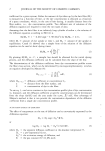
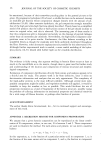
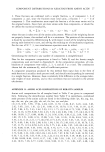
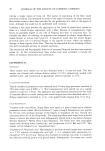
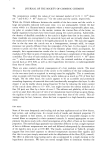
2 JOURNAL OF THE SOCIETY OF COSMETIC CHEMISTS coefficient for a given system. Either the amount of dye taken up by the hair fiber (Mr) is measured as a function of time, or the dye concentration is obtained as a function of a space coordinate, which, in the case of hair dyeing, is usually distance from the fiber surface, i.e., dye concentration profile. Two different sets of solutions of the diffusion equation are required to treat the two types of data. Assuming that the hair fiber is an infinitely long cylinder of radius r, the solution of the diffusion equation according to Hill (2) is Mr/Moo • 1 - 0.692 exp[-5.785 Dt/r 2] for Mr/Moo 0.31, (1) where M• = amount of dye uptake at time t, and M• = amount of dye uptake at equilibrium. Crank (3) showed that a simple form of the solution of the diffusion equation can be used at short dyeing times: M•/Mo• •5-r2 j . (2) By plotting M•/M• vs. t¾2, a straight line should be obtained for the initial dyeing process, and the diffusion coefficient can be calculated from the slope of the line. The determination of the diffusion coefficient from dye concentration profiles across the fiber cross section, which can be determined by microspectrophotometry, involves an equation developed by Matano (4): 1 dx •c• D(c=c•) - 2t dC xdC, (3) where D c=c•) = diffusion coefficient at concentration C•, x = distance from the fiber surface, and C = concentration of dye in the fiber. To use eq. 3, one has to construct a dye concentration profile (plot of dye concentration vs. distance), and the diffusion coefficient at specific concentrations can be determined from the slope (dx/dC) and the area under the curve, j'0 % xdC. One advantage of Matano's method is that it can provide the concentration dependence of the diffusion coefficient from a single dye concentration profile. ACTIVATION ENERGY OF DIFFUSION The effect of temperature on the rate of diffusion can be conveniently expressed by the Arrhenius equation: DT = Do exp(- ED•/RT), (4) or log D T = log D O - ED•/2.303 RT, where D T = the apparent diffusion coefficient at the absolute temperature T, D O = a pre-exponential factor, ED •= the activation energy of diffusion, and R = the gas constant (8.314 J/K.mol). (5)
Purchased for the exclusive use of nofirst nolast (unknown)
From: SCC Media Library & Resource Center (library.scconline.org)