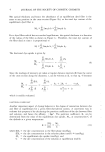
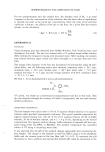
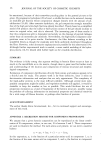
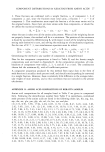
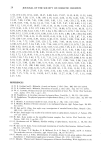
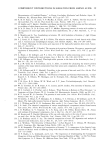
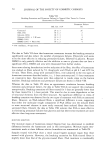
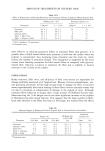
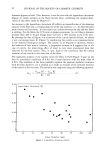
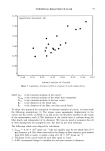
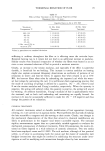
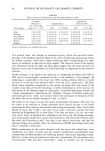
SEMIPERMANENT DYE DIFFUSION IN HAIR 5 For the semipermanent hair dye studied here, the absolute value of Ms is so small compared to the dye concentration of the solutions, that the latter value at equilibrium is virtually the same as the initial dye concentration. Once the value of the partition coefficient is known, the affinity of the dye to the fiber, for a given fiber-dye-solvent system, can be calculated: -A• ø = RTlnK = RTln-- [D]f (12) ß [D]• EXPERIMENTAL MATERIALS Virgin European gray hair (obtained from DeMeo Brothers, New York) has been used throughout this work. The hair was cleaned with a 1% sodium lauryl sulfate solution (SLS), followed by exhaustive rinsing with deionized water. After washing, the samples were blotted between paper towels and dried overnight in a vacuum desiccator over P205 ß The average fiber diameter of the hair was determined microscopically using 20 indi- vidual fibers, and the following results were obtained: maximum value = 96.7 •m minimum value = 48.7 •m median value = 68.7 •m mean value = 70.2 •m standard deviation = 11.3 •m and the average diameter with 95% confidence limit = 70.2 ñ 5.3 HC Red 3, Nt-(2-hydroxyethyl)-2-nitro-p-phenylenediamine, H% N- 0-NH2 HOCH2CH2 NO2 197 g/tool, was chosen as a representative semipermanent hair dye in this work. This dye was obtained through the courtesy of Clairol, Incorporated, and was used without further purification. ABSORPTION EXPERIMENTS The hair samples were dyed either in 50 vol. % aqueous ethanol solution or in aqueous solution under specified experimental conditions. The typical dyebath composition for aqueous ethanol dyeing was: 160 ml of 50 vol.% aqueous ethanol, 20 ml of buffer solution, 20 ml of absolute ethanol, and 0.2-1.0 g of dye, depending on the desired concentration. For aqueous solution dyeing, buffer solutions of required pH were pre- pared using either Na2HPO4 or KH2PO4. The dyebath temperature was controlled within +__ IøC using a circulating water bath. It was observed that the pH of the dyebath changes appreciably after introducing dry hair samples. The change in pH depends on both the buffer capacity of the phosphate buffer and the isoionic point of the hair fiber (pH 5.6-6.2). To minimize the pH fluctuation so that a uniform and reproducible dyebath pH could be maintained in the

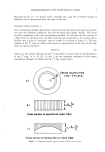
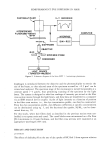
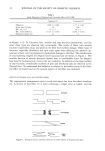
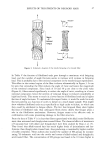
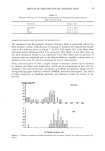
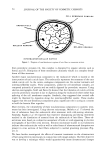
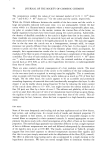
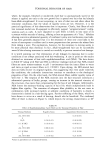
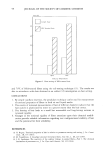
6 JOURNAL OF THE SOCIETY OF COSMETIC CHEMISTS course of dyeing, the hair samples were pretreated by immersing the hair samples in about 300 ml of buffer solution of appropriate pH overnight, prior to dyeing. In addition to maintaining a uniform pH during dyeing, pretreatment was found to improve the reproducibility of the dyeing kinetics, since the fibers have reached equi- librium swelling prior to dyeing. This pretreatment, however, was performed only in the case of the aqueous dyeing experiments. To establish the effbct of stirring the dye solution on the rate of diffusion, experiments were performed with and without stirring under otherwise identical conditions (HC Red 3, C = 1.0 g/l, 50 vol.% aqueous ethanol, pH = 10.8, and T = 42øC). It was found that stirring the dyebath did not produce any significant differences in either D or M•. Consequently all dyeing experiments were performed without stirring in order to avoid felting of the hair. Dyeing was performed by immersing about 1.0 g of the hair sample (--2-3 inches in length) in the dyebath (liquor-to-hair ratio 200:1) and removing aliquots of the hair sample at given time intervals. The dyed hair was rinsed well, blotted between layers of filter paper, and immediately dried in a vacuum desiccator. The weight of the dried dyed hair was determined, and the sample was then placed in a 50-ml groundglass stoppered Erlenmeyer flask for extraction. The dyestuff was extracted either at room temperature or at 60øC using 50 vol.% aqueous ethanol as the extracting medium. Two to four successive extractions were carried out using 5.0 ml of fresh solvent for each extraction lasting about 2 h. The solvent fractions were combined and their absorbance measured with a Beckman DU- 6 UV-visible spectrophotometer. The amount of dye uptake was calculated from the absorbance values. Linear relationships according to Beer's law were found between absorbance and concentration for HC Red 3 in this solvent (½)491 = 4950. DESORPTION EXPERIMENTS Dye desorption experiments were carried out using a flow cell system attached to the Beckmann DU-6 UV-visible spectrophotometer. This arrangement permits continuous monitoring of solution absorbance and thus has the advantage of covering the important early stages of dye desorption. The hair samples used for desorption experiments were dyed at specified conditions for 24 h to ensure that equilibrium sorption conditions were attained, and were then dried and stored as described previously. These samples were immersed in a specified volume of solvent to desorb the dye at a given temperature, and the absorbance of the solution was monitored as a function of time. Desorption equilibrium measurements were used to determine the partition coefficients of the dye between the hair fiber and the dyebath solution. MICROSPECTROPHOTOMETRY A Leitz MPV 1.1 microscope photometer equipped with an interference filter for spectroscopic measurements was used in this study (Figure 2). This instrument is basically a microscope fitted with a photomultiplier to measure the intensity of the light transmitted through microscopic specimens at selected wavelengths. A variable
Purchased for the exclusive use of nofirst nolast (unknown)
From: SCC Media Library & Resource Center (library.scconline.org)