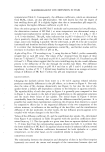
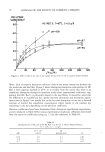
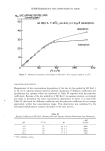
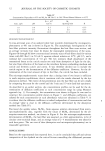
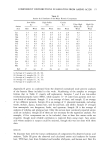
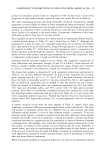
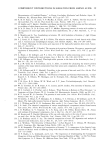
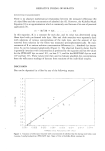
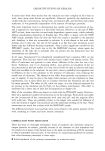
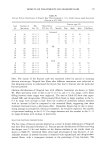
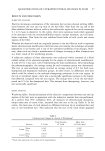
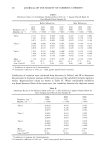
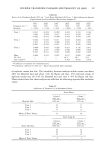
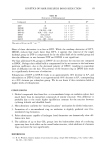
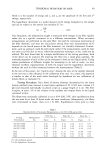
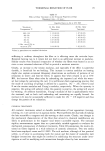
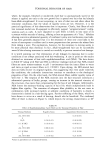
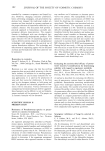
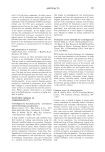
COMPONENT DISTRIBUTIONS IN KERATINS FROM AMINO ACIDS 23 Table IV Observed and Calculated Amino Acid Analyses for Various Animal Keratins Placental Wool Mammals Marsupials Monotremes Turkey Quill Amino Acid Obs Calc Obs Calc Obs Calc Obs Calc Obs Calc Lys 2.8 2.7 2.7 2.7 3.5 2.7 2.9 2.2 .7 2.6 His .8 .7 .9 .8 1.2 .8 .8 .8 .4 .8 Arg 7.1 7.0 6.8 6.9 5.9 6.2 5.8 5.7 4.0 5.6 Hcy 10.7 10.8 12.5 12.6 12.1 12.1 15.3 15.1 7.1 11.3 Asp 6.5 6.6 6.1 6.1 7.1 6.9 5.5 5.5 5.5 4.9 Thr 6.3 6.3 6.4 6.3 5.7 5.9 5.6 6.4 4.1 4.3 Ser 10.3 10.3 10.8 10.6 9.4 10.5 9.4 I 1.2 14.9 12.2 Glu 12.3 12.2 12.5 12.1 13.0 12.8 10.9 10.9 6.2 8.8 Pro 6.7 6.8 7.1 7.2 6.7 6.1 8.7 7.6 9.9 7.8 Gly 8.1 8.1 8.1 7.7 8.6 8.1 9.8 9.2 13.3 12.4 Ala 5.4 5.4 5.3 5.4 5.8 5.5 5.4 4.7 8.3 5.2 Val 5.7 5.6 5.4 5.4 5.2 5.8 5.6 5.6 7.5 5.7 Ile 3.2 3.2 3.0 3.0 3.1 2.8 2.1 2.4 3.1 2.3 Leu 7.7 7.9 7.0 7.4 7.4 7.9 6.5 6.5 9.1 7.0 Tyr 3.7 3.8 3.0 3.5 3.1 3.4 3.3 3.5 2.3 5.6 Phe 2.7 2.7 2.4 2.4 2.2 2.6 2.5 2.7 3.6 3.7 % L 62 57 62 4 l (27) % H + X 28 26 16 29 (0) % C 4 12 12 16 (13) % G 6 5 10 14 (22) RMS dev: 0.10 0.26 0.48 0.66 2.13 Wool, av. of 6 Lincoln and Merino samples (42, 43, 44, 45, 46) Placental mammals, av. of 11 samples (35) Marsupials, av. of 4 samples (35) Monotremes, av. of 2 samples (35) Turkey feather calamus (48). All percentages are mole percent, rounded to one place without normalizing. Figures in parentheses are considered unreliable because of the magnitude of R. Hcy is the sum of half-cystine or S-carboxymethyl cysteine, plus cysteic acid. which is in fact the clinical observation that led to identification of this hair disorder (28), since it was noticed that the easily broken hair could not reach a length on the head of much more than a centimeter. If verified further, the present mathematical component analysis method might be of some diagnostic value in such cases. The two ichthyosis hair samples in Table III are quite different from TTD hair, though the size of R tends to render their interpretation less clear. Both seem to have larger proportions of L, and less sulfur, though in X-linked ichthyosis the sulfur seems to come only from a cuticle-like component, whereas in the lamellar ichthyosis the cuticle component is nearly absent. The X-linked ichthyosis hair seems to have a component with an excess of serine and glutamic acid, and a deficiency of valine the lamellar hair variations are similar in general but much smaller. The summary information of Table V suggests from the close similarity of the component proportions for four of the samples (Nos. 11, 12, 13 and 14) that they may originate from similar mechanisms. The apparent excess of serine and threonine may indicate that intramolecular cross- linking greatly predominates over intermolecular crosslinking, leading to roughly the same physical behavior as a low sulfur (trichothiodystrophic) hair, though this conclu- sion should be regarded as entirely speculative.

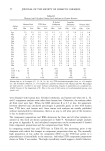
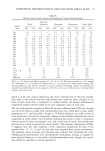
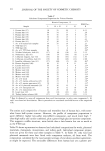
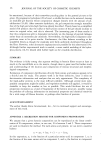
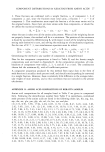
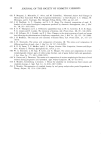
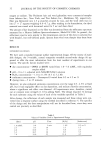
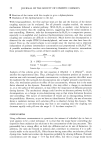
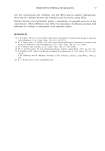
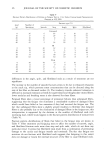
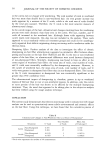
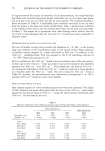
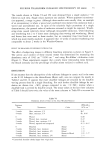
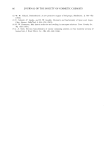
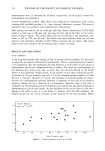
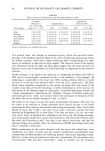
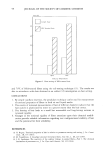
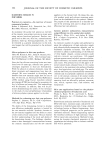
24 JOURNAL OF THE SOCIETY OF COSMETIC CHEMISTS Table V Calculated Component Proportions for Various Keratins Keratin Components, % Sample L H + X C G RMS Dev., R 1. Human hair (27) 38 35 26 1 2. Human hair (35) 48 34 17 1 3. Human hair (38) 45 36 19 0 4. Human hair (39) 38 45 15 2 5. Human hair (40) 49 33 16 2 6. Human hair (41) 47 38 15 0 7. Av. of 6 human hair samples 44 35 19 2 8. TTD hair (27) 80 5 15 0 9. TTD hair (28) 91 3 6 0 10. Av. of 2 TTD hair samples 86 4 10 0 11. X-linked ichthyosis, hair (41) (57) (0) (38) (5) 12. Netherton's, hair (41) (38) (7) (49) (6) 13. Ichthyosis vulgaris, hair (41) (43) (0) (45) (12) 14. Ichthyosis circumflexa, hair (41) (39) (0) (49) (12) 15. Lamellar ichthyosis, hair (41) (57) (38) (5) (0) 16. Human fingernail (40) 69 12 8 11 17. Lincoln wool (42) 66 30 4 0 18. Lincoln•wool (43) 70 28 2 0 19. Merino wool (44) 53 21 14 12 20. Merino wool (42) 63 26 2 9 21. Merino wool (45) 65 25 4 6 22. Merino wool (46) 58 34 0 8 23. Av. of 6 wools 62 28 4 6 24. Av. of 5 merino orthocortex (45) 63 23 8 6 25. Av. of 5 merino paracortex (45) 59 33 7 1 26. Av. of 11 placental mammals (35) 57 26 12 5 27. Av. of 4 marsupials (35) 62 16 12 10 28. Av. of 2 monotremes (35) 41 29 16 14 29. Lizard claw (47) (0) (13) (23) (64) 30. Turkey feather calamus (48) (27) (0) (51) (22) 0.13 .28 .29 .33 .44 .47* .23 .46* .62* .50* 2.35 2.11' 1.95 2.08 .84* .49 .23* 32* 25* 24* 23* 29* 10' 20* 33* 24* .48 .66 3.22 2.13 * Best fit ogtained by using all components from wool fractionations in other cases components L, H, and C were from hair fractionation. Data in parenthesis are considered unreliable because of the magnitude of R. The amino acid composition of human nail resembles that of human hair, with some- what lower half-cystine content. However, the profile of component porportions is quite different: higher low-sulfur (microfibril) component, and much lower high + ultra-high sulfur and cuticle combined, plus a greater high glycine-tyrosine component. This suggests a stiffer structure, more brittle than a hair keratin but not so much so as the TTD hair. Table IV shows representative observed and calculated compositions for wools, placental mammals, marsupials, monotremes, and turkey quill. Individual component propor- tions are given for these and other samples in Table V. In Table IV, only wool and placental mammals were best fitted with component analyses, all from wool. The composition calculated for the wool sample (average of six) shows excellent agreement, as might be expected. The noticeable differences from human hair are a greater pro-
Purchased for the exclusive use of nofirst nolast (unknown)
From: SCC Media Library & Resource Center (library.scconline.org)