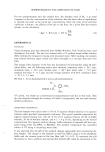
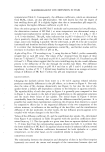
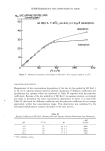
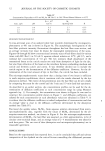
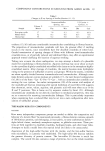
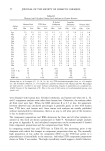
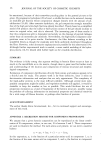
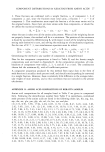
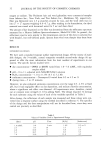
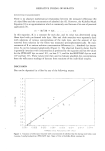
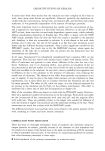
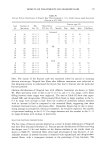
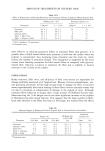
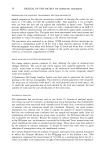
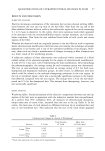
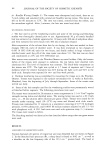
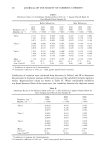
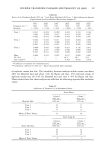
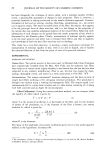
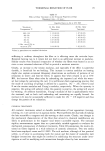
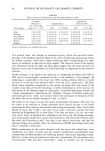
TORSIONAL BEHAVIOR OF HAIR 95 Table II Effect of Heat Treatment on the Torsional Properties of Hair (Treatment time--30 min.) Rigidity Ratio in Air at 65% RH Treatment 24 Hrs. After 48 Hrs. After Temperature øC Treatment Treatment lOO-lOl 1, 12 (0.02) 1.07 (0.02) 88-90 1. ll (0.02) 1.06 (0.03) 74-76 1.10 (0.02) 1.05 (0.02) 60-6l 1.07 (0.04) 1.02 (0.03) 45-46 1.06 (0.02) 1.03 (0.02) 6 Hrs. over P205 in vacuo at 25øC 1.04 (0.01) 1.03 (0.02) Values in parentheses are standard deviations. stiffening is uniform throughout the fiber or is affecting more the cuticular layer. Repeated heating (up to 4 times) did not lead to an additional increase in modulus. Similar results were obtained irrespective of whether the fibers were heated in an air oven or over saturated solutions of NaI to provide a moisture reservoir. Clearly, an increase in the torsion modulus, and especially if the effect is somewhat durable, is beneficial for set holding. This increase in torsion modulus on heating might also explain occasional laboratory observations on aesthetics of patterns of set relaxation in water- and heat-set fibers. It appears that when relaxed in air at 65% RH, the heat-set fibers often relax by unbending the imparted curl while the water- set hair relaxes by untwisting the curl. It is well known from engineering practice that the mode of uncoiling of springs is defined by a quantity, 1/G - 2/E, where G and E are the torsion modulus and Young's modulus, respectively. When the quantity is negative, the spring will unbend when the quantity is positive, the spring will uncoil by twisting. At ambient humidities, Young's modulus of hair is approximately twice the torsional, and so both curl unbending and untwisting are equally favored. An increase in G may be occasionally sufficient to make the 1/G - 2/E negative and thus change the pattern of set relaxation. CHEMICAL TREATMENTS All cosmetic treatments aimed at durable modification of hair appearance (waving, coloring, etc.) are carried out in aqueous media. Water performs the dual task of making the hair accessible to reagents and also serving as their carrier. Clearly, any changes in the mechanical characteristics of the fiber that attend its chemical modification are likely to predominate in the reagent- (and water-) accessible regions. The torsional rigidity measurements appear thus as a particularly suitable approach to evaluate the mechanical consequences of chemical treatments. Table III summarizes the results ob- tained on fibers exposed to a wide selection of cosmetic alterations. Two test media have been employed: water and 0. ! HC1. The acid medium, although of less practical utility, is of value in ascertaining both the nature and the extent of coulombic (salt bridges) interactions that might be involved in stabilizing the structure under inves- tigation as well as modifying such interactions brought about by hair treatments.

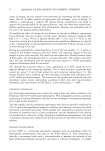
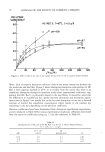
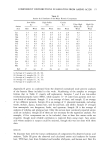
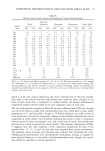
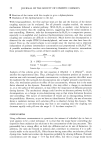
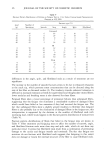
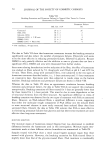
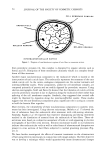
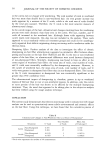
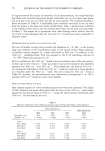
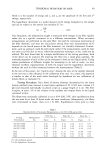
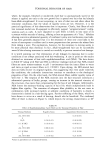
96 JOURNAL OF THE SOCIETY OF COSMETIC CHEMISTS Table III Effect of Cosmetic Treatments on the Torsional Properties of Hair Torsional Logarithmic Modulus in Rigidity Ratio Decrement (8) Air at 65% RH Hair Sample dyne cm -2 ) 10 •ø H20 0.1 N HC1 H20 0.1 N HCI Intact 1.02 (0.09) 0.26 (0.01) 0.16 (0.01) 0.40 (0.05) 0.44 (0. Bleached 1.05 (0.05) 0.14 (0.01) 0.11 (0.01) 0.44 (0.03) 0.49 (0.06) Dyed (Blond) 1.07 (0.05) 0.23 (0.01) -- 0.42 (0.02) Dyed (Black) 1.08 (0.13) 0.23 (0.01) 0.15 (0.01) 0.45 (0.04) 0.44 (0.02) Waved 1.01 (0.04) 0.09 (0.01) 0.06 (0.01) 0.56 (0.05) 0.47 (0.03) Relaxed 0.91 (0.11) 0.06 (0.02) -- 0.65 (0.04) -- Values in parentheses are standard deviations. In a general sense, the changes in torsional rigidity follow the expected course. Cleavage of the disulfide bonds by H202 in the course of bleaching substantially lowers the torsion modulus, while only a slight weakening effect (corresponding to a lesser degree of oxidation) is observed for dyed samples. The identical values of the rigidity ratio obtained for both the light and dark shades suggest that the more extensive dye deposits, in the case of dark shades, do little if anything to compensate for the oxidative cleavage. Further decrease in the rigidity ratio observed on transferring the fibers from H20 to HCI can be conventionally interpreted as due to the breaking of salt linkages the weakening is considerable in the intact hair (38% modulus decrease relative to water) and less so in the dyed and bleached fibers (34% and 21%, respectively). The latter result seems somewhat unexpected as one would anticipate that with many of the covalent cross links severed by bleaching, a further destabilization of the structure by elimination of salt linkages might be catastrophic. A possible explanation involves the "charge rearrangement" phenomenon (8). Oxidative cleavage of disulfide bonds gen- erates strongly acidic cysteic acid residues which then participate in formation of new salt links that are not readily disrupted at pH 1 or above. Of interest in this respect are also the results of logarithmic decrement. The latter can be viewed as an indicator of torque relaxation which should decrease as the bonds sustaining the shear stress are eliminated in the testing environment. Thus, the 8 values should be much less at pH 1 than they are in water, and such a pattern has been observed by Feughelman (9) in wool fibers. This does not seem to be the case either with intact, dyed, or bleached hair, although in the latter case, the charge rearrange- ment phenomenon might have caused some interference. The waved hair behaves more like wool the 8 decreases at pH 1 but only to the value of intact hair, and thus the observed change may possibly reflect the elimination of SS-SH interchange rather than that of coulombic interactions. Before commenting on the results obtained with the waved and relaxed hair, some clarification is in order. In both cases the cosmetic modification was performed using commercially available products and following product instructions regarding timing. However, a large excess of reagents was used and, consequently, the hair samples were over-processed. This was done intentionally, trying to simulate real life situations
Purchased for the exclusive use of nofirst nolast (unknown)
From: SCC Media Library & Resource Center (library.scconline.org)