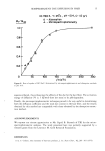
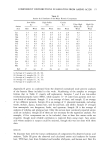
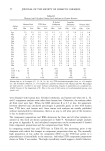
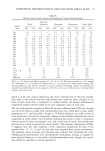
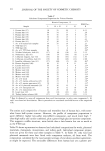
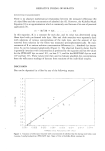
OXIDATIVE DYEING OF KERATIN 37 over dye concentration and, therefore, any real effects may be masked. Alternatively, there may be a balance between dye formation and dye loss by excess H20 2. Solution kinetics and mechanisms predict a dependence on peroxide and not on dye concentration. These differences may reflect the importance of diffusion processes with substrates or a change in mechanism at the substrate surface. REFERENCES (1) J. F.Corbett, The role of meta difunctional benzene derivatives in oxidation hair dyeing. I. Reaction with p-diamines, J. Soc. Cosmet. Chem., 24, 103-134 (1973). (2) K. C. Brown and J. F. Corbett, The role of meta difunctional benzene derivatives in oxidative hair dyeing. II. Reactions with p-aminophenols, J.Soc. Cosmet. Chem., 30, 191-211 (1979). (3) K. C. Brown, Hair colorants, J. Soc. Cosmet. Chem., 33, 375-383 (1982). (4) W. G. Cochran and G. M. Cox, Experimental Designs, 2nd Ed., 0ohn Wiley, 1957), pp 335-375. (5) P. Kubelka and F. Munk, Ein Beltrag zur Optik der Farbanstriche, Z. Tech. Physik, 12, 593-601 (1931). F. W. Billmeyer and M. Saltzman, Principles of Color Technology, 2nd Ed., (John Wiley, 1981), p 140. (6) K. C. Brown and A. Chan, unpublished data.

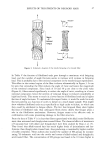
j. Soc. Cosmet. Chem., 36, 39-52 (January/February 1985) Effect of chemical and hurnectant treatments on the mechanical and fractographic behavior of Negroid hair Y. K. KAMATH, S. B. HORNBY, and H.-D. WEIGMANN, Textile Research Institute, P.O. Box 625, Princeton, NJ 08542. Received October 31, 1984. Presented at the Annual Meeting of the Society of Cosmetic Chemists, New York, December 6-7, 1984. Synopsis The fracture behavior of Negroid hair, both untreated and treated with relaxers and humectants, was studied to clarify the causes of fiber breakage at low levels of extension. Microscopic observation of the fiber reveals frequent twists, with random reversals in direction along the length, and high ellipticity. Measurements of the effect of tensile load on axial angle of untwisting of specimens with a single twist indicate that failure at low extensions is due to the initiation of cracks at flaws near the twists, which relieves torsional stresses in these regions. Extension at failure is higher in wet fibers, probably because plasticization relaxes these stresses. Treatment of fibers with solutions of humectants such as polyacrylic acid or glycerin has been found to reduce premature failure significantly. However, pretreatment with relaxers and thioglycolic acid eliminates the beneficial effects of the humectant treatment. Scanning electron microscopy of fracture ends reveals a predominance of step fractures and fibrillated ends, indicating a large number of flaws. Fatiguing hair fibers seems to accentuate fiber damage, leading to a predominance of fibrillated fracture ends. INTRODUCTION Negroid hair presents severe problems in manageability because of its kinky structure. The highly entangled hair mass is difficult to comb (1) and requires much higher forces in grooming procedures than straight hair, so that it is subjected to higher degrees of mechanical damage. The widely used practice of "hot combing" to detangle the hair mass, especially in combination with the use of relaxers, seems to introduce extensive damage to the hair fiber. This is reflected in the tensile mechanical properties, a significantly higher fraction of fibers breaking at low elongations (premature failures) than hair fibers of other ethnic origin. In some cases the extent of damage is so severe that even manual squeezing and rubbing results in the breakage of fibers in half wavelength sections. This observation suggests that combing and stretching probably damages the fibers in the regions of twist. Microscopic examination of the fiber shows frequent twists along its length with no preferred directionality (2). Subjecting such a fiber to tensile deformation involves development of torsional stresses in the regions of twist, the magnitude of which will depend on the angle of twist and the applied tensile force. In earlier work a method was developed to study torsional effects in the tensile loading of such specimens in- 39
Purchased for the exclusive use of nofirst nolast (unknown)
From: SCC Media Library & Resource Center (library.scconline.org)