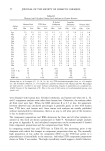
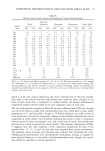
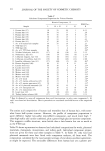
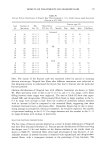
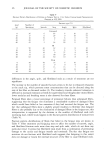
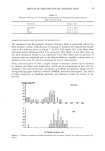
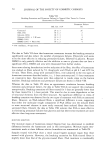
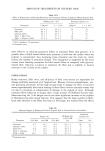
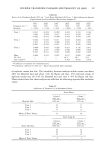
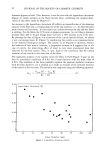
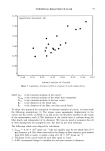
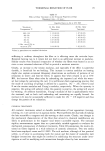
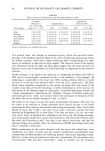
OXIDATIVE DYEING OF KERATIN 35 It seems clear from these results that the reactions are more complex on hair than on wool, since many more factors are significant. However, generally dye deposition in- creases with dye concentration, dyeing time, and solution pH, and decreases with added surfactant. It was generally independent of the amount of hydrogen peroxide. The most important factor in determining dye uptake was the concentration of dye, and it appeared to vary largely as a first-order function. However, in the case of PPD/ AHT on hair, there was also a second-order dependence (square term), which probably reflects simultaneous deposition of finished dye. This effect is absent with the BHP/ NAP couple, probably since the indo dye from this couple is unstable to the peroxide and, therefore, it does not accumulate in solution. It is also absent in the wool cloth dyeings, but in this case, the rate of dye uptake is so fast that color saturation occurs before indo dye diffusion becomes important. Time is also a significant variable for the PPD/AHT couple, but much less so for the BHP/NAP reaction, where again the instability of the indo dye to peroxide does not permit any dye deposition once the intermediates are exhausted. In all cases, Nonoxynol-9 (an ethoxylated nonylphenol) had a negative effect on dye deposition. This was also tested with sodium lauryl sulfate with similar results. The effect of surfactant was greatest in cases where diffusion of the indo dye was a key factor. Surfactant, due to its cleansing ability, may prevent accumulation of dye (or dye precursors) at the hair surface or it may tend to hold the dyes in solution and make them less available to the substrate. In any event, there is probably lower apparent rate of diffusion of dye to the substrate in the presence of surfactant, thus reducing the overall rate of coloration. The absence of any effect from peroxide concentration is not easy to explain. It may be due to the large molar excesses over dye employed in these experiments, but is more likely due to a balance between dye formation and dye loss by excess peroxide. The effect of pH, while not large, is in the direction expected for an increase in the oxidation rate by H202 on the primary intermediate. This effect is moderated by a faster rate of indo dye decomposition at higher pH. Most of the secondary effects are absent on cloth with the PPD/AHT couple. However, there are a significant number of interactions in the hair dyeings. Particularly noticeable are the interactions of dye concentration with time and pH, and the negative effect with surfactant. These are probably related to the longer time needed for diffusion of indo dye formed at higher concentrations and the additional swelling of the hair. These interactions are much less evident with the BHP/NAP couple. The differences between wool and hair seem to be related to the greater porosity of the wool, resulting in a faster and more intense coloration. CORRELATION WITH MECHANISM There has been no thorough mechanistic study of oxidation dye chemistry using hy- drogen peroxide as oxidant, partially because of the slowness of color formation and the sensitivity of many of the formed dyes to the high concentrations of H202 necessary to obtain reasonable reaction rates. It was shown (1), using hexacyanoferrate as oxidant, that color formation proceeded in three steps: © Initial oxidation of the primary intermediate to a reactive imine

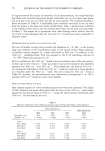
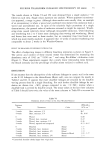
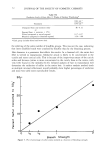
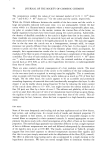
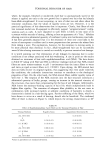
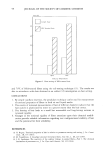
36 JOURNAL OF THE SOCIETY OF COSMETIC CHEMISTS ß Reaction of the imine with the coupler to give a diphenylamine ß Oxidation of the diphenylamine to the dye. With hexacyanoferrate, the first and last steps are fast and the kinetics of the slower coupling reaction can be evaluated. For all phenolic couplers studied, the reaction mechanisms followed a similar pathway. With H202 as oxidant, color formation is many times slower than the coupling reaction, suggesting that the initial oxidation is rate-controlling. However, indo dye decomposition by H20• is a competitive process, especially in ot-naphthol and 4-amino-2-hydroxytoluene reactions, and thus accurate coupling rate constants are difficult to determine. Much slower dye decomposition is observed for the couple PPD/2,6-dimethylphenol, and some rate data have been ob- tained. Even so, the overall scheme is not simple since the reaction rate is relatively independent of primary intermediate concentration and proportional to [H•O•] ø'5 (6). A possible mechanism involves rate-determining formation of reactive intermediate from peroxide followed by a series of faster oxidative and coupling steps, i.e., slow H202 k 2X X + PPD ,Imine Imine + Coupler , Leuco dye Leuco dye -Dye. Analysis of this scheme gives the rate equation d [Dye]/dt = k [H•O2] ø'5, which satisfies the experimental data. Thus, although this mechanism predicts an increase in reaction rate with increased peroxide concentration, in dyeing practice this effect must be moderated by the increased dye decomposition rate at higher peroxide concentration. Also, this mechanism predicts no effect of dye concentration, whereas this is the main factor observed in the dyeouts. Presumably, this may reflect a change in mechanism in, or at the surface of the substrate, or may reflect the importance of diffusion processes during dyeouts. The mechanistic change could involve an alternate pathway for H•O• decomposition, or a change in rate-determining step so that imine formation becomes rate-controlling. The nature of intermediate X would aid in distinguishing between the possibilities. However, as yet we have no identification. Finally, the rate of reaction shows a moderate increase with solution pH as is observed during the dyeouts. This clearly points to a rate-determining step that is not coupling since the coupling rate decreases rapidly with pH over the range 9-11 for these couplers (1). CONCLUSIONS Using reflectance measurements to quantitate the amount of adsorbed dye in hair or wool appears to be a valid technique. It is clear that the major factor controlling dye deposition from oxidation dye solutions is the concentration of the dye precursors. This presumably has a strong effect on both dye diffusion and on its rate of formation. In addition, the indo dye formed in sobation does contribute to coloration if it is suffi- ciently stable to the excess H•O•. Other factors having some effect are iolution pH and dyeing time. Surfactants reduce dye deposition probably by slowing diffusion. Peroxide concentration over the range 1-11% has little effect, but this is a large molar excess
Purchased for the exclusive use of nofirst nolast (unknown)
From: SCC Media Library & Resource Center (library.scconline.org)