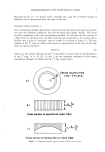
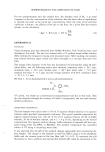
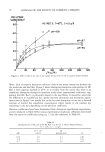
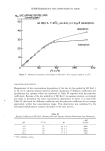
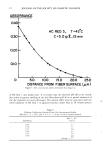
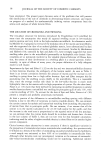
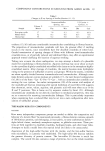
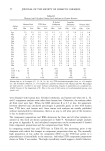
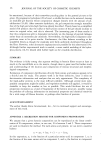
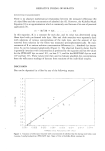
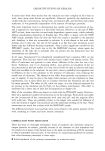
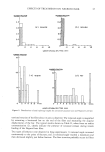
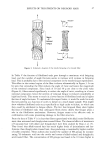
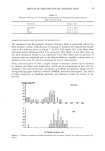
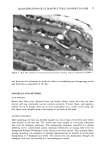
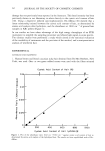
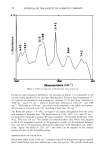
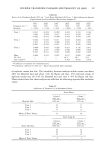
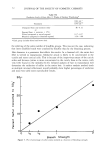
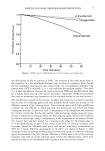
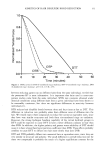
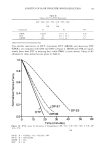
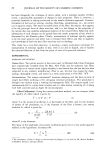
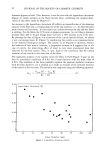
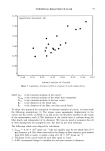
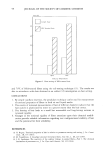
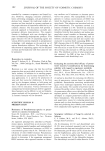
OXIDATIVE DYEING OF KERATIN 33 REFLECTANCE MEASUREMENTS There is no absolute mathematical relationship between the measured reflectance (R) of a dyed fiber and the concentration of adsorbed dye (C). However, the Kubelka-Munk Equation [ 1] is an approximation which is commonly used because of its ease of practical application (5). (1 - R)2/2R = KC ........... [1] In this equation, K is a constant for each dye, and its value was determined using fibers dyed with pre-formed indo dyes. Hair and cloth swatches were separately dyed with solutions of various concentrations of the indo dyes, and the amount of dye removed from solution by the fibers was measured spectrophotometrically. By mea- surements of R at various solution concentration differences (i.e., absorbed dye intens- ities), K can be evaluated graphically (Figure 1). The observed linearity shows that K is generally invariant with concentration as predicted by the equation and has the values for the PPD/AHT dye on wool 101, on hair 571 and for the BHP/NAP dye on wool 107 and hair 333. These values were then used to evaluate adsorbed dye concentrations from the reflectance readings of dyeouts from reactions of the individual couples. DISCUSSION Dye can be deposited in a fiber by any of the following means: :,7• n :-• I I 6 1 4,4, "-' 0 9 • r-Pt [v!,3 le: 5' F:',,.,'*• •,.'{ •:O r" E:: • ::.'J ,' C-r'r-, ':,:':/:-':,-• l •_. _.,. ,_. _ .... ._.._. Figure 1. Variation of reflectance function with concentration of adsorbed dye for dyeing wool fabric with 2-amino-5-methylindoaniline (PPD-AHT dye). Slope of line is Kubelka-Munk constant K.

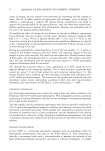
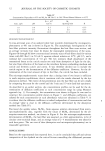
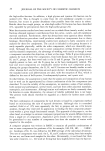
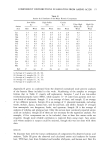
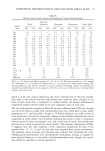
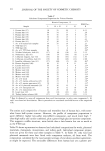
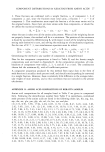
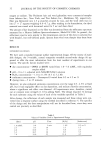
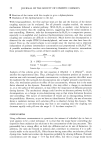
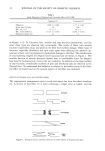
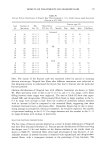
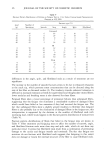
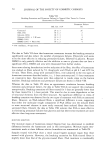
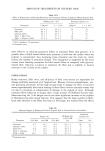
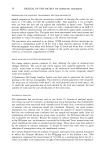
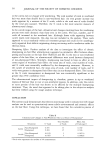
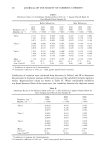
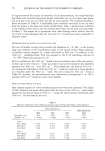
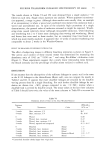
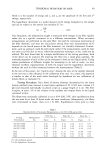
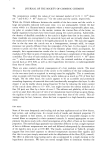
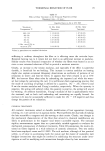
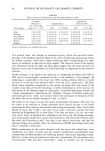
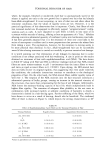
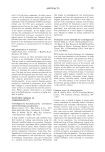
34 JOURNAL OF THE SOCIETY OF COSMETIC CHEMISTS © unreacted dye intermediates diffuse in and then undergo coupling © indo dye is formed in solution and then diffuses in © dye precursors are formed in solution, they diffuse in and undergo further oxidation to the dye Qualitative observations seem to support all three modes of coloration. Certainly color will slowly develop in the colorless hair removed from a dye bath after a short soaking time. In addition, hair can be dyed very effectively in the highly colored dyebath that results after 45 minutes of reaction with hydrogen peroxide, or from solutions of pre- formed indo dyes. The experimental design used in the current work assumes that the amount of dye deposited in a fiber can be expressed as a polynomial involving first- order, square, and product terms of all the 5 individual variables, i.e., [Dye]^b• = B0 + B• [Dye] + B• [Dye] 2 + B 3 (time) + B33 (time)2... .... + B•3 [Dye][time] ...... etc. The design evaluates the coefficients (B•., B2, B12 , etc.) of these terms and determines their significance in relation to the calculated experimental error. Coefficients smaller than the error are reduced to zero, and the associated term has no significant effect on dye deposition. The calculated values of all significant coefficients are shown in Table II. Since these values are coefficients of a response surface equation, no entry in a column means that that term does not contribute to dye deposition. Table II Coefficients (B) of Response Surface Equations PPD/AHT BHP/NAP Coefficients* Cloth Hair Cloth Hair B o (1.36) (4.68) (1.92) (1.36) B• [Dye] 0.28 1.71 0.49 0.28 B 2 (pH) 0.16 0.18 -- 0.16 B 3 (time) 0.13 0.71 0.32 0.13 B4 [H202] -- -- - 0.35 -- B 5 [Nonoxynol-9] - 0.17 - 0.59 -- - 0.17 B• -- 0.13 -- -- B22 -- --0.15 -- B33 -- __ __ B44 -- __ __ B55 -- -- -- 0.10 B•2 -- 0.22 -- 0.11 B• -- 0.51 -- 0.08 B•4 -- - 0.16 -- -- B•5 -- --0.40 -- 0.07 B23 .... B24 -- -- - 0.34 -- B25 .... B34 -- -- --0.29 -- B•5 - 0.06 -- -- - 0.06 B45 -- -- -0.25 -- * B t2 represents the coefficient for interaction of dye concentration with time. B• represents the coefficient for a dye concentration square term.
Purchased for the exclusive use of nofirst nolast (unknown)
From: SCC Media Library & Resource Center (library.scconline.org)