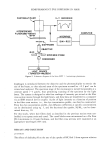
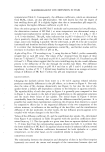
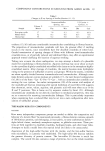
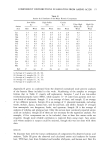
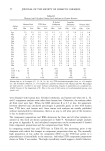
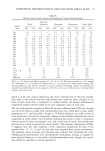
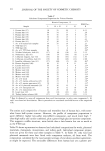
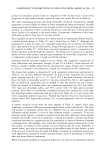
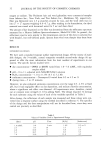
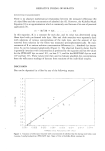
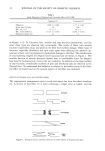
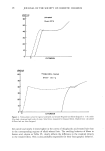
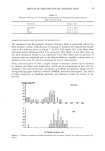
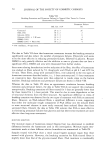
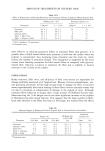
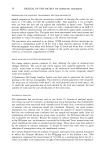
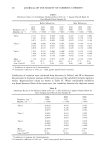
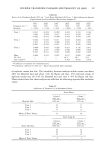
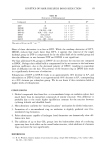
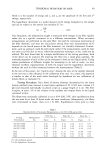
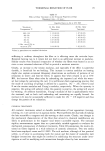
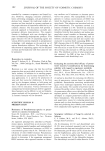
TORSIONAL BEHAVIOR OF HAIR 89 where n is the number of swings and a• and an are the amplitude of the first and n th swings, respectively. The logarithmic decrement is a useful measure of the energy dissipated in the sample and can be related to the torsion loss modulus G' by: G8 G' - . ........... (IV) Very frequently, the information sought is associated with changes in the fiber rigidity either due to a specific treatment or to a different environment. When successive measurements are performed on the same fiber, the need for continuous monitoring of the fiber diameter, and thus the inaccuracies arising from such measurements (as G depends on the fourth power of the fiber diameter), are virtually eliminated. Further- more, such an approach could be particularly useful if the measurements could be done not only in air but also in water, where the pendulum technique, so far, could not be utilized. We have found that by a simple modification of the testing procedure, both of the above can be attained. By inserting the fiber into a small glass capillary, the torsional properties of such a fiber can be evaluated in both air and liquid media. Using torsion pendulums of different weights for measuring in air and in water, we have obtained excellent reproducibility of both the torque and the logarithmic decrement without the need for fiber relaxation between the measurements (Table I). In the text of this report, the "rigidity ratio" denotes the ratio of the rigidity obtained in the test run to that obtained in the calibration (first run). In a sense, this approach is similar to that of the work index developed by Speakman for wet calibration of keratin fibers in extension (3). Testing Procedure. Hair fibers of known diameter (determined by the linear density method) were inserted in small glass capillaries (I.D. 0.565 mm, volume 4.9 ptL) and mounted individually on plastic strips at a gauge length of 2 cm. The fiber occupies, at most, 1% of the volume of the capillary and torques freely in the liquid contained within. The fibers were torsionally calibrated in air at 65% RH, 70øF, after equilibration from the wet state for at least 18 hours under the same conditions. Subsequently, the fibers were remeasured in water, then in 0.1 N HC1. Equilibration times prior to these Table I Reproducibility of Successive Measurements in Air (65% RH) and in H20 Testing Environment Fiber No. 1 Fiber No. 2 Fiber No. 3 Measurement No. T(sec) 8 T(sec) 8 T(sec) 8 Air (65% RH) 1 6.87 0.16 8.52 0.20 8.17 0.17 Air (65% RH) 2 6.88 0.17 8.48 0.20 8.12 0.18 Air (65% RH) 3 6.89 0.17 8.45 0.20 8.16 0.19 H20 1 9.81 0.40 17.77 0.47 16.00 0.56 H20 2 9.78 0.43 17.96 0.54 16.46 0.52 H20 3 9.93 0.43 17.98 0.47 15.78 0.52 T is the oscillation period. 8 is the logarithmic decrement.

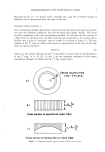
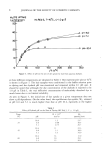
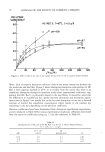
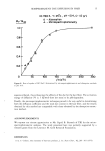
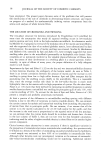
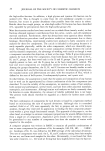
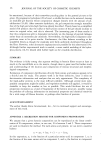
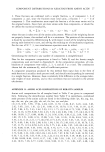
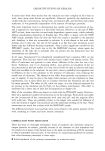
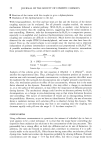
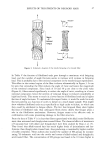
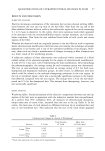
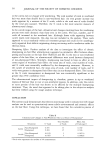
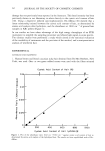
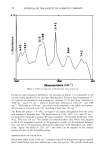
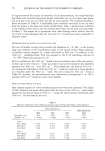
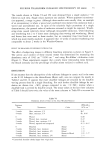
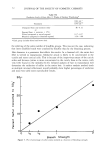
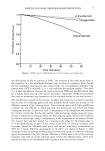
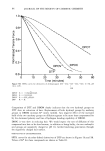
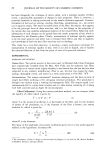
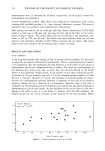
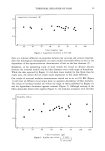
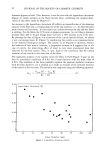
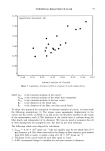
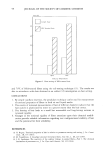
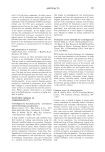
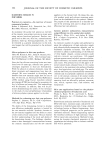
90 JOURNAL OF THE SOCIETY OF COSMETIC CHEMISTS measurements were 15 minutes and 18 hours, respectively, in the liquid in which the measurement was performed. Cosmetic Rlodification of Hair. Hair fibers were subjected to treatments with various commercially available products (i.e., hair coloring, bleaching, waving). The time of treatment was in accordance with manufacturers' instructions. Hair setting was carried out by winding individual fibers (conditioned at 65% RH) under 1 g load onto a 900 }xm rod, securing the free end of the fiber to the rod by means of Duco cement. The coiled fibers were set by heating in the laboratory oven either at 40 ø or 70øC for 30 min. The fibers were then removed from the rod and placed in the humidity chamber (at 65% RH) to monitor the set release. The values given in the text represent the set holding after 2 hours of release. RESULTS AND DISCUSSION HAIR DIAMETER It has long been known that styling of hair in general and the stability of a hair style in particular are greatly influenced by hair fineness. There is a growing body of evidence (1,4) suggesting that the explanation for this behavior is to be found in the nature of deformations which hair configuration has to endure. The latter are predominantly of the bending and torsion type and, as such, they are inversely related to the fourth power of hair diameter. Simply stated, in the absence of any other stabilizing factors, a fine hair of 50 }xm diameter has only 1/5 of the inherent styling stability of a hair that has a "normal" diameter of 75 }xm. The bending or torsional moduli are charac- teristics of a homogeneous material (whether a composite or not) and as an intensive property should not be a function of its dimension. However, hair is not only a composite on the ultrastructural level (filaments and matrix) but also shows histological inhomogeneity (cuticle and cortex). As the thickness of the cuticle layer (6 cells over- lapping each other to give a 3 }xm band) is invariant with the fiber diameter, the weight fraction of the cuticle increases as the diameter of the hair decreases. When 1.2 i.0 0.8 Torsion Hodulus dynes cm -2 1010 x ß ß ß ß ß ß ß I I I I I I 70 75 80 85 90 95 Fiber Diameter (•m) Figure 1. Torsionalmodulus of hair at 65%RH. I lOO
Purchased for the exclusive use of nofirst nolast (unknown)
From: SCC Media Library & Resource Center (library.scconline.org)