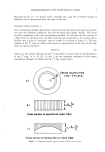
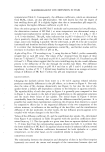
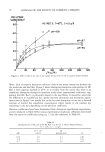
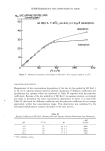
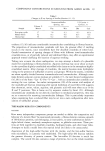
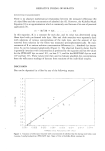
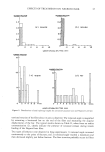
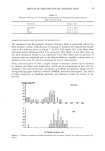
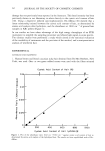
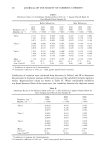
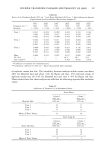
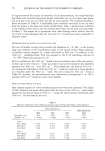
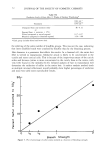
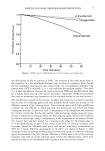
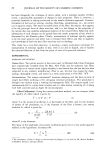
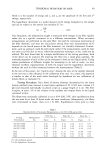
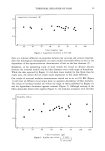
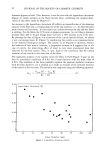
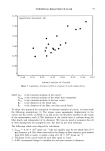
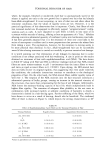
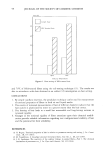
TORSIONAL BEHAVIOR OF HAIR 93 0.55 0.50 0.45 0.40 0.35 0.30 Logarithmic Decrement (•) ß i ! I I I I 0.10 fl.11 0.12 0.13 0.14 0.15 0.16 0.]7 Volume Fraction of Cuticle Figure 5. Logarithmic decrement in H20 as a function of cuticle content of hair. where Gcut Gcomp Gcort R• R1 is the torsional modulus of the cuticle. is the torsional modulus of the whole hair (composite). is the torsional modulus of the hair cortex. is the diameter of the whole hair. is the diameter of the fiber core (less cuticle band). To adopt this approach for evaluation of torsional modulus of cuticle, we have made the following assumptions' (1) The torque causes equiangular displacement in the cuticle and the cortex (2) There is no slip at the cuticle/cortex interface in the course of the measurement and (3) The thickness of the cuticle layer is uniform along the fiber length and independent of its diameter. We have no proof or assurance that all of these assumptions are stringently met, but they do not seem irrational. The following values were adopted for calculation: 1. Gcomp = 0.18 X 10¹⁰ dynes cm -2 (the wet rigidity ratio for the whole hair of 75 }xm diameter is 0.246 when corrected for the change in fiber diameter upon transfer from 65% RH to water, it yields a value of 0.18 X 10 ]ø dynes cm-2). 2. Thickness of the cuticle band for each fiber equal to 3 3. 0.001 incremental change in modulus for each }xm increase in diameter.

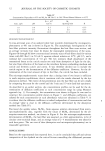
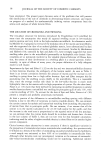
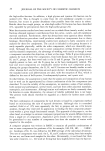
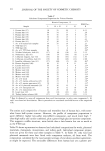
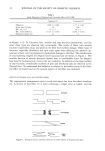
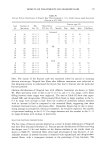
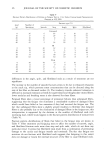
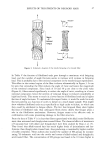
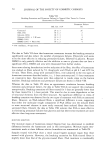
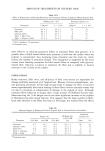
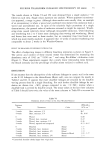
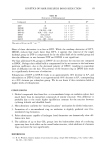
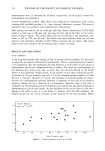
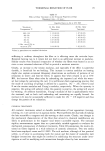
94 JOURNAL OF THE SOCIETY OF COSMETIC CHEMISTS The computation yielded the values of wet torsional moduli of 0.24 x 10 •ø dynes cm -2 and 0.012 X 10 •ø dynes cm -2 for the cortex and the cuticle, respectively. While the 20-fold difference between the moduli of the hair cortex and the cuticle is large and possibly endowed with some error, it is not unreasonable. Unlike the hair cortex which is a filament/matrix composite where a water-unpenetrable phase may, via polar or covalent links to the matrix, restrain the viscous flow of the latter, no highly organized structures have been found among the cuticle proteins. Admittedly, the density of disulfide crosslinks in the cuticle is higher than that in the matrix, but these crosslinks are concentrated in the exocuticle layer and are virtually absent from the endocuticle which is likely to be highly plasticized by water. The data also suggest that in the dry state the cuticle acts as a homogeneous, isotropic solid, its torque resistance not greatly different from the remainder of the hair. In this regard, it is of interest to point out that the melting of the filament phase which accompanies, for example, hair supercontraction results also in a drastic lowering of the wet torsional modulus of the fiber in spite of retaining the full and intact complement of the disulfide crosslinks. The value of such modulus lies in the range of 0.004 to 0.01 X 10 •ø dynes cm -2, which resembles that of the cuticle. Also, the torsional modulus of supercon- tracted hairs at 65% RH, as well as their logarithmic decrement, is indistinguishable from that of intact fibers. There are some cosmetic-related consequences of a low modulus cuticle. The most obvious is that the contribution of the cuticle to the stability of the hair configuration in the wet state (such as acquired in waving) must be negligible. This is unwelcome news to people with fine hair where the cuticle makes up as much as 25% of their hair weight. On the other hand, the cuticle appears to be an accessible and potentially rewarding depository of materials that could mechanically strengthen this layer. In this respect it can be readily shown (using Equation V) that by reducing the water content of the cuticle alone down to 15-16%, one might increase the torsion modulus of a fine (50 p•m) wet fiber by a factor of over 2. The softness and pliability of the cuticle can be an asset from the point of view of set impartation (water setting) as upon drying, the rigidity of the cuticle increases relatively more than that of the cortex. This ad- vantage may be lost, however, when the hair is exposed to a high humidity environ- ment. DRY HEAT Some of the most frequently used styling aids are heat appliances such as blow dryers, heat setters, and curling irons. In a recent study of tensile and chemical properties (7) of hair exposed to heat setters, no evidence was found of measurable changes in the treated fibers as compared to their untreated controls. It seemed appropriate to com- plement the above study with a brief investigation of the effect of heat on the torsional properties. The methodology approach was somewhat different in that a single exposure of hair to different temperatures was used and followed subsequently by determination of the rigidity ratio in air at 65% RH. The results, summarized in Table II, strongly suggest that even brief exposure to elevated temperature increases fiber rigidity and that this is not just simply associated with the dehydration of the fiber (P205 control). The effect is relatively long lasting and is also accompanied by a slight decrease in the logarithmic decrement. We have not tested enough fibers to determine whether the
Purchased for the exclusive use of nofirst nolast (unknown)
From: SCC Media Library & Resource Center (library.scconline.org)