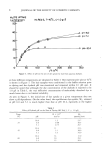
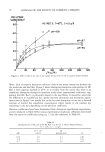
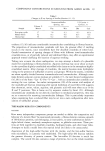
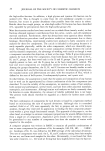
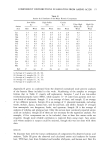
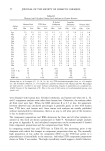
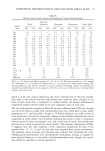
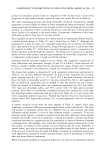
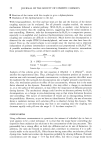
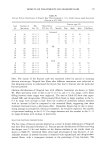
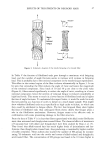
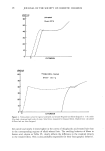
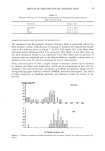
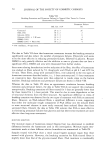
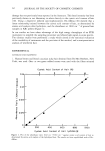
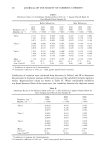
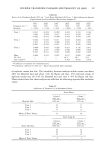
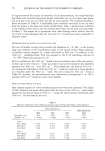
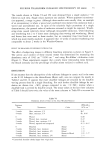
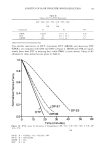
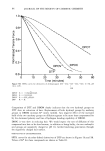
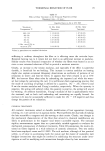
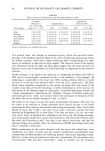
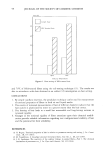
SEMIPERMANENT DYE DIFFUSION IN HAIR 9 temperatures (Table I). Consequently, the diffusion coefficients, which are determined from Mr/Moo values, are also pH-dependent. The well known fact that the degree of hair swelling above pH 10 is slightly higher than that at intermediate pH ranges (6), may explain the higher diffusion coefficient at pH 10.4. Since the amino groups in the HC Red 3 molecule can be protonated at low pH values, the dissociation constant of HC Red 3 at room temperature was determined using a standard spectrophotometric method, and a value of pK• = 3.7 + 0.1 (pKb = 10.3 + 0.1) was obtained. This pKa value indicates that at pH 5-6 about 0.5-5% of the dye is positively charged, and since the hair fiber is near its isoionic point in this pH range, some ionic binding is possible. On the other hand, at pH 10.4 the dye is neutral (unionized) and therefore has little affinity for negatively charged sites in the fiber hair. It is evident that thermodynamic parameters control Ms, and further studies will be necessary to elucidate the effect of pH on A plot of log D vs. 1/T according to eq. 5, using the data in Table I, yields a reasonably straight line at each pH value. The values of ED • obtained from the slopes of these lines are 73 kJ/mol (17.5 kcal/mol) at pH 10.4, and 65 kJ/mol (15.5 kcal/mol) at pH 6.0 and 5.1. These values suggest that the rate-controlling step for the overall diffusion process is the diffusivity of the dye through the swollen hair fibers. The difference between the activation energy at pH 10.4 and that at pH 5 and 6 is probably not significant. A value of 70 --- 5 kJ/mol may therefore be taken as an average activation energy of diffusion of HC Red 3 within this pH and temperature range. SOLVENT EVFECTS Changing the dyebath solvent from water to a 50 vol.% aqueous ethanol solution produces remarkable differences in the pH effects, as is shown in Figure 4. Not only does the value of Ms decrease dramatically (see Figure 3), but also the rate of dye uptake shows a definite pH dependence contrary to the behavior in aqueous solution. The reproducibility of each data point in Figure 4 is generally poor compared to that in Figure 3, due mainly to the lack of prior equilibration in the appropriate solutions and the much lower values of dye uptake. The initial slopes in Figure 4 deviate considerably from the linearity that is typical for diffusion-controlled processes. It is possible that under these experimental conditions the deviation from linearity is caused by competitive effects due to the sequential diffusion of the two components of the solvent mixture, its influence on the swelling of the hair fiber, and the simultaneous diffusion of the dye molecules. In other words, the dye diffusion process appears to be coupled with volume changes in the hair fiber. Values of the diffusion coefficient, D, and the equilibrium dye uptake, Ms, determined from Figure 4 are tabulated in Table II together with the partition coefficients deter- mined from eq. 11. The dye uptake at a given time from an aqueous dyebath is about 5-15 times that from the corresponding aqueous ethanol dye bath. It is evident that the lower solubility of HC Red 3 in aqueous solution results in enhanced affinity toward the hair fiber. The diffusion coefficients determined for both dyebaths at a given temperature, on the other hand, can be considered similar in magnitude. DESORPT1ON STUDIES The relationship between the absorption and desorption of dyes in hair fiber (sorption hysteresis) can reveal the nature and strength of the interactions between dyes and

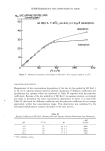
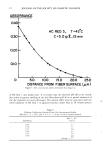
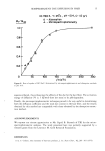
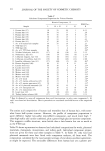
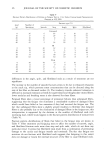
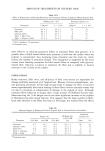
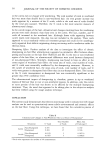
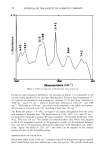
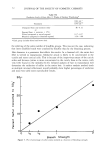
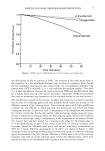
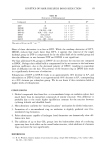
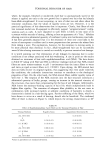
10 JOURNAL OF THE SOCIETY OF COSMETIC CHEMISTS DYE UPTAKE I,/.z•.=•g Hai.r) 4.0 3.0 2.0 {.0 HC RED 3, T:42"C, C:t.O g/•, _ pH =•0.8 pH =4.7 pH=9.0 , I I I I • • •, • 0 40 80 120 160 200 ?_.40 280 5?_0 iV2 (SV2) Figure 4. Effect of pH on the rate of dye uptake by hair from 50 vol. % aqueous ethanol dyebath. fibers. Lack of sorption hysteresis indicates a lack of any major interaction between the dye molecules and the fiber. Figure 5 shows absorption-desorption relationships for HC Red 3 from aqueous dyebath at 25øC. It is evident from the curves that there is no significant absorption-desorption hysteresis under these experimental conditions, sug- gesting that HC Red 3 is physically bound in the hair fibers. It should be noted that the differences in equilibrium dye uptake between absorption and desorprion experi- ments seen in Figure 5 are mainly due to the fact that desorption occurs into a dyestuff solution of limited but significant concentration which results in the residual dye remaining in the hair depending on the partition coefficient. Partition coefficients have been determined from desorption equilibrium experiments, and are tabulated in Table III for various experimental conditions. Affinities determined from the partition coefficients using eq. 12 are also tabulated in Table III. Table II pH Dependence of M,: and D for HC Red 3 in 50 vol. % Water-Ethanol Mixture (T = 42øC, C = 1.0g/l) D X 101ø M• pH (cm2/s) (Ixmol/g hair) 10.8 5.0 4.3 0.85 9.0 6.5 2.7 0.53 4.7 3.0 2.9 0.57
Purchased for the exclusive use of nofirst nolast (unknown)
From: SCC Media Library & Resource Center (library.scconline.org)