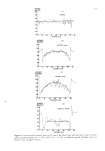
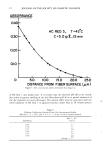
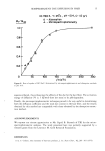
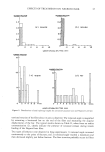
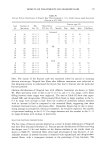
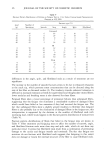
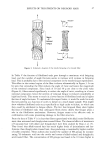
FOURIER TRANSFORM INFRARED SPECTROSCOPY OF HAIR 73 CONCLUSIONS The diamond cell-FTIR technique offers a rapid method to quantify oxidative hair damage incurred by various proceses such as weathering, waving, bleaching, or com- binations thereof. Oxidative damage varies considerably along a single hair fiber, with the greatest damage occurring near the tip. The magnitude of this variation is comparable to that found in replicate determinations within a tress and is likely to be the prime source of the latter variation. Hair diameter must also be considered a source of variation when transmission IR is used. While we feel the accuracy of any single absorbance ratio is high, the small sample size used in each measurement limits the precision of repeat determinations. We have shown, however, that triplicate determinations yield reproducible average oxidation values. Obtaining sulfonate absorbance intensities after spectral subtraction improves the precision of the method. Sulfonate bonds formed from oxidative disulfide bond fission are readily distinguished from Bunte salt thiosulfonate bonds formed by bisulfite treatment. Using spectral subtraction, complete spectra of oxidized species can be elucidated, which should permit qualitative differentiation of oxidation mechanisms. ACKNOWLEDGEMENTS The authors acknowledge the efforts of E. Cottington and R. Grubb for performing many of the analyses in these studies and thank I. T. Smith for many helpful discus- sions. REFERENCES (1) G. J. Weston, The infrared spectrum of peracetic acid-treated wool, Biochim. Biophys. Acta,, 47, 462-464 (1955). (2) A. Strasheim and K. Buijs, An infrared study of the oxidation of the disulfide bond in wool, Biochim. Biophys. Acta., 47, 538-541 (1961). (3) C. Robbins, Infrared analysis of oxidized keratins, Text. Res. J., 37, 811-813, (1967). (4) R. C. Shah and R. S. Gandhi, Infrared analysis of oxidized keratins, Text. Res. J., 38, 874-875 (1968). (5) H. Alter and M. Bit-Alkhas, Infrared analysis of oxidized keratins, Text. Res. J., 39, 479-481 (1969). (6) L. J. Bellamy, The Infrared Spectra of Complex Molecules, 3rd ed. (Wiley, New York, 1975), pp 407- 408. (7) N. B. Colthup, L. H. Daly, and S. E. Wiberley, Introduction to Infrared and Raman Spectroscopy, (Academic Press, New York, 1964), p 310. (8) C. R. Robbins, Chemical and Physical Behavior of Human Hair, (Van Nostrand Reinhold, New York, 1979), pp 29, 70. (9) L. J. Wolfram, "The Reactivity of Human Hair. A Review," in Hair Research Status and Future Aspects, C. E. Orfanos, W. Montagna, and G. Stuttgen, Eds. (Springer-Verlag, Berlin, 1981), pp 479-500. 10) M. Bit-Alkhas, Unpublished internal Gillette Co. reports. 11) C. E. Weir, E. R. Lippincott, A. Van Valkenburg, and E. N. Bunting, Infrared studies in the 1 •m to 15 •m region to 30,000 atmospheres, J. Res. Nat. Bur. Standards, A63, 55 (1959). 12) C. V. Poucherr, The Aldrich Library of Infrared Spectra, 3rd ed. (The Aldrich Chem. Co., Milwaukee, 1981), p 536.

74 JOURNAL OF THE SOCIETY OF COSMETIC CHEMISTS (13) A. Simon and D. Kunath, Vibrational spectra and structure of s-alkyl thiosulfates (Bunte salts), Bet. De/•tche Chem. Ges., 94, 1980- 1986 (1961). 14) E. Tolgyesi, Weathering of hair, Cosmetics a,d Toiletties, 98, 29-33 (1983). 15) J. A. Swift and A. C. Brown, "Scanning Electron Microscope Observations of Human Hair Weath- ering," in The First Hz•ma, Hair Symposium, A. C. Brown, Ed. (Medcom Press, New York, 1974), p 332. 16) V. N. E. Robinson, A study of damaged hair, J. Soc. Cosmet. Chem,, 27, 155 (1976). (17) L. J. Wolfram and M. K. O. Lindemann, Some observations on the hair cuticle, J. Soc, Cosmet. Chem., 22, 839 (1971).
Purchased for the exclusive use of nofirst nolast (unknown)
From: SCC Media Library & Resource Center (library.scconline.org)