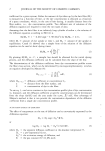
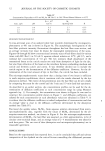
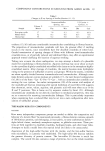
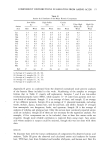
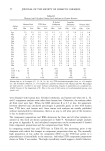
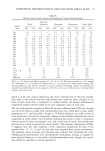
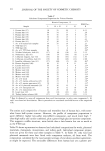
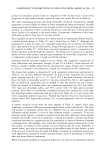
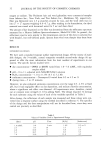
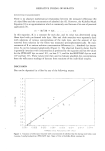
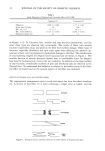
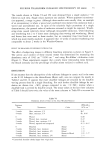
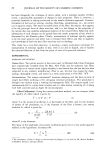
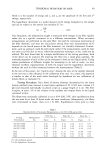
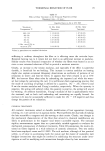
34 JOURNAL OF THE SOCIETY OF COSMETIC CHEMISTS © unreacted dye intermediates diffuse in and then undergo coupling © indo dye is formed in solution and then diffuses in © dye precursors are formed in solution, they diffuse in and undergo further oxidation to the dye Qualitative observations seem to support all three modes of coloration. Certainly color will slowly develop in the colorless hair removed from a dye bath after a short soaking time. In addition, hair can be dyed very effectively in the highly colored dyebath that results after 45 minutes of reaction with hydrogen peroxide, or from solutions of pre- formed indo dyes. The experimental design used in the current work assumes that the amount of dye deposited in a fiber can be expressed as a polynomial involving first- order, square, and product terms of all the 5 individual variables, i.e., [Dye]^b• = B0 + B• [Dye] + B• [Dye] 2 + B 3 (time) + B33 (time)2... .... + B•3 [Dye][time] ...... etc. The design evaluates the coefficients (B•., B2, B12 , etc.) of these terms and determines their significance in relation to the calculated experimental error. Coefficients smaller than the error are reduced to zero, and the associated term has no significant effect on dye deposition. The calculated values of all significant coefficients are shown in Table II. Since these values are coefficients of a response surface equation, no entry in a column means that that term does not contribute to dye deposition. Table II Coefficients (B) of Response Surface Equations PPD/AHT BHP/NAP Coefficients* Cloth Hair Cloth Hair B o (1.36) (4.68) (1.92) (1.36) B• [Dye] 0.28 1.71 0.49 0.28 B 2 (pH) 0.16 0.18 -- 0.16 B 3 (time) 0.13 0.71 0.32 0.13 B4 [H202] -- -- - 0.35 -- B 5 [Nonoxynol-9] - 0.17 - 0.59 -- - 0.17 B• -- 0.13 -- -- B22 -- --0.15 -- B33 -- __ __ B44 -- __ __ B55 -- -- -- 0.10 B•2 -- 0.22 -- 0.11 B• -- 0.51 -- 0.08 B•4 -- - 0.16 -- -- B•5 -- --0.40 -- 0.07 B23 .... B24 -- -- - 0.34 -- B25 .... B34 -- -- --0.29 -- B•5 - 0.06 -- -- - 0.06 B45 -- -- -0.25 -- * B t2 represents the coefficient for interaction of dye concentration with time. B• represents the coefficient for a dye concentration square term.

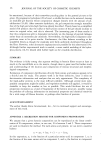
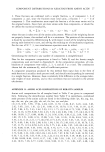
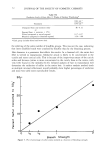
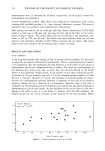
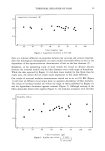
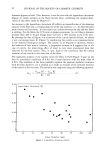
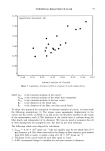
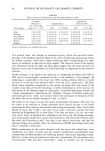
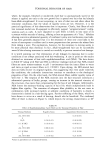
OXIDATIVE DYEING OF KERATIN 35 It seems clear from these results that the reactions are more complex on hair than on wool, since many more factors are significant. However, generally dye deposition in- creases with dye concentration, dyeing time, and solution pH, and decreases with added surfactant. It was generally independent of the amount of hydrogen peroxide. The most important factor in determining dye uptake was the concentration of dye, and it appeared to vary largely as a first-order function. However, in the case of PPD/ AHT on hair, there was also a second-order dependence (square term), which probably reflects simultaneous deposition of finished dye. This effect is absent with the BHP/ NAP couple, probably since the indo dye from this couple is unstable to the peroxide and, therefore, it does not accumulate in solution. It is also absent in the wool cloth dyeings, but in this case, the rate of dye uptake is so fast that color saturation occurs before indo dye diffusion becomes important. Time is also a significant variable for the PPD/AHT couple, but much less so for the BHP/NAP reaction, where again the instability of the indo dye to peroxide does not permit any dye deposition once the intermediates are exhausted. In all cases, Nonoxynol-9 (an ethoxylated nonylphenol) had a negative effect on dye deposition. This was also tested with sodium lauryl sulfate with similar results. The effect of surfactant was greatest in cases where diffusion of the indo dye was a key factor. Surfactant, due to its cleansing ability, may prevent accumulation of dye (or dye precursors) at the hair surface or it may tend to hold the dyes in solution and make them less available to the substrate. In any event, there is probably lower apparent rate of diffusion of dye to the substrate in the presence of surfactant, thus reducing the overall rate of coloration. The absence of any effect from peroxide concentration is not easy to explain. It may be due to the large molar excesses over dye employed in these experiments, but is more likely due to a balance between dye formation and dye loss by excess peroxide. The effect of pH, while not large, is in the direction expected for an increase in the oxidation rate by H202 on the primary intermediate. This effect is moderated by a faster rate of indo dye decomposition at higher pH. Most of the secondary effects are absent on cloth with the PPD/AHT couple. However, there are a significant number of interactions in the hair dyeings. Particularly noticeable are the interactions of dye concentration with time and pH, and the negative effect with surfactant. These are probably related to the longer time needed for diffusion of indo dye formed at higher concentrations and the additional swelling of the hair. These interactions are much less evident with the BHP/NAP couple. The differences between wool and hair seem to be related to the greater porosity of the wool, resulting in a faster and more intense coloration. CORRELATION WITH MECHANISM There has been no thorough mechanistic study of oxidation dye chemistry using hy- drogen peroxide as oxidant, partially because of the slowness of color formation and the sensitivity of many of the formed dyes to the high concentrations of H202 necessary to obtain reasonable reaction rates. It was shown (1), using hexacyanoferrate as oxidant, that color formation proceeded in three steps: © Initial oxidation of the primary intermediate to a reactive imine
Purchased for the exclusive use of nofirst nolast (unknown)
From: SCC Media Library & Resource Center (library.scconline.org)