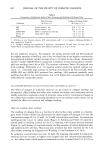
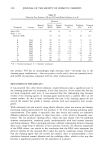
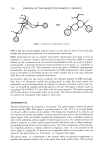
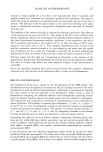
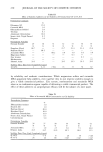
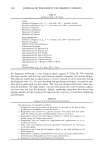
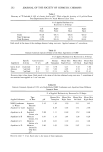
PARAMETERS FOR ASSESSING TOOTHPASTES 215 block system as used for determining the scratching values, with standard toothpaste II being replaced by standard toothpaste III (polishing standard). Standard toothpaste III was introduced for practical reasons. Originally it was a paste made out of polymethacrylate particles containing a small amount of finely powdered silicon carbide. The toothpaste identified as test product VIII (see TEST PRODUCTS below) is now used because of its comparable properties and its closer similarity to market toothpastes. Under the given conditions, it reduces the roughness from 0.200 ptm to approximately 0. 143 ptm, which corresponds to a polishing value of 36. After using the test toothpaste or standard toothpaste III, the new roughness (either RaC or RaIII) was determined. The calculation of the polishing values was then carried out according to the following formula: PV = (RaII- RaC^) X 72 (RaII- RaIII) m + (RaII- RaIII)•t4 CLEANING EFFECT The measurement of cleaning effect was carried out on extracted, stained human teeth by Missouri Analytical Laboratories (48). For each measurement, eight teeth were used. Their reflectance in visible light was measured, and the areas beneath the reflection curves were calculated. The magnitudes of the areas before (Ab) and after (A s) brushing with the test toothpaste were determined and from these the cleaning power (CP) was calculated according to the following formula: CP - As - Ab Ab X 100 The greater the cleaning effect of the toothpaste the higher its CP value will be. TEST PRODUCTS For the tests, the test products I-VI were used which contained as the sole abrasive component "Poliertonerde P10 feinst" (polishing alumina P10 from the A}coa Com- pany having a very narrow primary crystal size distribution of approximately 1 ptm) at concentrations of 1, 2, 3, 5, 8, or 10%. Furthermore, test product VII, a silica gel toothpaste, and test product VIII, the same formula as VII with a 1% addition of polishing alumina, were also tested. Table I contains the composition of test product VI with 10% polishing alumina. With test products I-V having lower alumina contents, the deficit was compensated for with water, and the consistency was adjusted by a minimal increase in the Carbopol © 940 content. Table II contains the composition of test product VII which can be trans- formed into test product VIII by adding 1% alumina with a corresponding decrease in water.

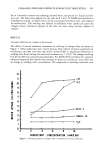
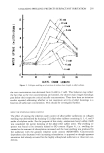
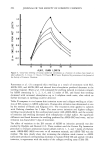
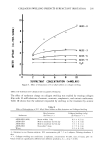
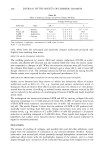
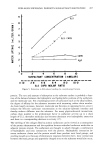
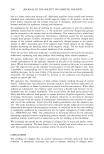
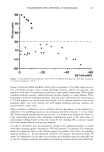
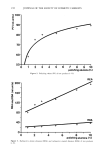
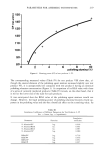
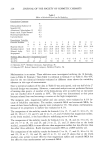
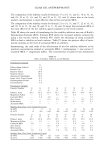
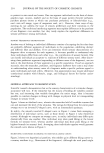
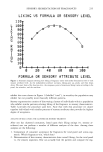
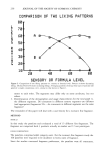
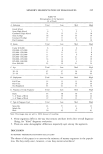
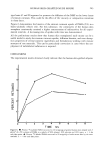
216 JOURNAL OF THE SOCIETY OF COSMETIC CHEMISTS Table I Composition of Test Product VI Concentration Ingredients (%) Water 37.4 Glycerin 86% 20.0 Sorbitol 70% 20.0 PEG-150 10.0 Alumina l 0.0 Flavor 1.2 PEG-60 Hydrogenated Castor Oil 0.6 Carbomer 940 0.5 Aminomethyl Propanol 0.2 Methylparaben 0.1 RESULTS As a general orientation, 20 toothpastes from the European and American markets were first tested for polishing and scratching effects. The results of these investigations given in Figure 1 show that the scratching values of the various pastes cover a wide range. It is particularly apparent that even the pastes with the lowest scratching values reveal only a slight polishing effect. This can be interpreted as an indication that the desired high polishing effects are not achieved with cleaning agents generally used today. On the basis of screening tests, it then became evident that toothpaste formulas with an addi- tion of polishing alumina satisfy this requirement very well. Test products I-VI with a polishing alumina content between 1% and 10% as the sole abrasive were therefore investigated. The results of polishing measurements presented in Figure 2 show that the polishing effects of test products I-VI improve with increasing cleaning agent concentration and at a high level tend towards a limit. The comparison of scratching and polishing values of test products with those of market products given in Figure 1 demonstrates that the test products scarcely scratch and polish comparatively well. Table II Composition of Test Product VII Concentration Ingredients (%) Water 19.65 Glycerin 86% 13.00 Sorbitol 70% 40.00 Hydrated Silica 17.00 PEG-4 4.00 Sodium Lauryl Sulfate 2.00 Titanium Dioxide 1.00 Flavor 1.20 Cellulose Gum 0.30 Further Ingredients 1.85
Purchased for the exclusive use of nofirst nolast (unknown)
From: SCC Media Library & Resource Center (library.scconline.org)