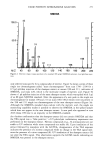
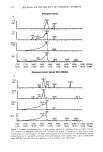
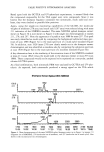
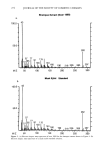
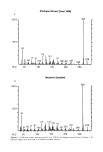
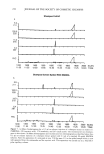
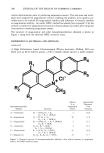
268 JOURNAL OF THE SOCIETY OF COSMETIC CHEMISTS cally excited NO• which chemiluminesces in the 600-800 nm range and is observed by passing the radiation through a band pass filter to a photomultiplier tube. Conse- quently, any compound which yields 'NO upon pyrolysis will potentially produce a response on the TEA. This response has been observed for materials other than N-nitro- samines including O-nitroso (O-NO), C-nitroso (C-NO), O-nitro (O-NO2), and C- nitro (C-NO 2) compounds (5-7). We have observed strong TEA responses from extracts of a shampoo (discussed in the Results and Discussion section) as well as other shampoos, conditioners, and antiper- spirant/deodorant products not discussed herein. Using a packed column GC/TEA system, the retention time of the TEA-responding material could not be distinguished from that of NMDDA. Unlike the NMDDA, however, the response was not reproduc- ible and the calculated concentration was unrealistically high (ppm levels instead of ppb) based on the absence of NMDDA precursor raw materials in the products. Upon re-examination of the same extracts by GC/MS, it was found that the compound pro- ducing the TEA response was not a nitrosamine but rather the nitromusk, musk xylol, present in the product perfumes. Other "nitrosamine-like" GC/TEA signals have also been linked to different nitromusk PRM including moskene and musk ketone. Because of the false positives (i.e., nitromusks) potentially present in many cosmetic products, we believe confirmatory experiments such as the use of UV photolysis (8), wet chemical procedures (8) and/or GC/MS (2) are necessary and should be required to confirm the presence/absence of nitrosamines when using the GC/TEA. An example of a false posi- tive in a shampoo extract is presented. EXPERIMENTAL APPARATUS GC/TEA. The GC/TEA system consisted of a Hewlett-Packard (Palo Alto, CA) Model 5710A gas chromatograph interfaced to a Thermo Electron Corporation (Waltham, MA) Model 543 Thermal Energy Analyzer. The GC/TEA system used a 3% silicone UCW-98 on 80/100 mesh Chromosorb WHP (¬" x 6') packed column. The column was maintained isothermally at 200øC nitrogen was used as the carrier gas at 20 ml/ min. One-microliter sample injections were made into a 200øC injector. The TEA was operated at a furnace temperature of 500øC, and a cold trap temperature of - 100øC. GC/MS. The GC/MS system was a Finnigan (San Jose, CA) Model 4610 gas chromato- graph/mass spectrometer equipped with the Super INCOS data system. Initially, samples were separated on a J&W Scientific (Rancho Cordova, CA) DB-1 capillary column (30 m, 0.25 micron film, 0.25 mm i.d.) maintained isothermally at 50øC for 1 minute followed by an initial program rate of 20øC/min. to 90øC (held for 2 minutes), then 8øC/min. to 325øC (held for 8 minutes). Samples (0.5-4 microliters) were injected at 250øC in the splitless mode. Helium was used as the carrier gas at a linear velocity of 30 cm/sec. The capillary column was interfaced directly into the source of the mass spec- trometer. The interface was maintained at 280øC. Ionization was achieved by electron impact at 70 eV. An improved GC/MS method was also used which employed a J&W Scientific (Rancho Cordova, CA) DX-4 capillary column (30 m, 0.25 micron film, 0.32 mm i.d.) and the

FALSE POSITIVE NITROSAMINE ANALYSES 269 "on-column" mode of sample injection (0.2- 0.5 microliters). The oven was maintained at 40øC for 2 minutes followed by a program rate of 20øC/min. to 75øC (held for 2 minutes) followed by 8øC/min. to 250øC (held for 19 minutes). The interface was held at 240øC. All other conditions were as above. UV-PHOTOLYSIS An aliquot of sample extract was transferred into a teflon-lined screw cap, borosilicate glass culture tube which was placed about 10 inches from the UV light source. The UV light was supplied from a GE 275 W suniamp and the sample was irradiated for one hour. N-nitrosamines are photolyzed under these conditions and their corresponding TEA signal disappears (8). At the end of the photolysis period, both irradiated and non-irradiated sample extracts were analyzed by GC/TEA and compared. SAMPLE PREPARATION Approximately 20 grams of shampoo were weighed into a tared 250 ml separatory funnel. A 20 milliliter aliquot of a 0.1 N HC1 solution containing 1.67 mg/g ascorbic acid (free nitrite scavenger) was added to the separatory funnel followed by 100 ml of methylene chloride. A liquid/liquid extraction was performed and the methylene chlo- ride layer was collected and filtered through a Millipore (Bedford, MA) 0.45 micron Nylon 66 filter. A second extraction was carried out on the remaining aqueous layer using a fresh 50 ml aliquot of methylene chloride. The organic layer was again collected and filtered as above and then the flitrates were combined and loaded onto a preparative scale silica gel column (to remove the more polar components). The column (19 mm X 100 mm) was prepared by slurry packing 100/200 mesh silica gel with methylene chloride followed by addition at the column top of a ten gram layer of anhydrous Na2SO 4 (to remove residual water) in methylene chloride. Glass wool was used to plug the column ends. After loading the flitrate (150 ml) onto the column, the sample was eluted with three successive 50 ml methylene chloride aliquots. Approximately three hundred milliliters of column eluent were collected directly into a Kadurna-Danish (KD) preconcentrator. A one milliliter aliquot of isooctane was added to the KD apparatus as a "keeper" and the sample was preconcentrated by submerging the KD preconcentrator tube into a 70øC water bath. The sample was evaporated to 10 ml in the KD apparatus and trans- ferred to a scintillation vial. The sample was evaporated to dryness using a gentle nitrogen flow stream and then diluted with 5 ml of methylene chloride. This extract was directly analyzed by GC/FID, GC/TEA, and GC/MS. REAGENTS All samples were prepared in HPLC grade methylene chloride (Fisher Scientific, Springfield, N J). The nitromusks were all perfume grade. Musk ketone was supplied by Naarden (New York, NY), while Givauden (Clifton, NJ) supplied the other nitromusk PRM's. The NMDDA standard was supplied courtesy of Hazleton Laboratories America (Madison, WI).
Purchased for the exclusive use of nofirst nolast (unknown)
From: SCC Media Library & Resource Center (library.scconline.org)