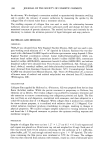
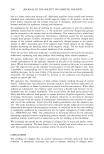
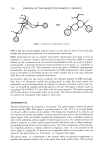
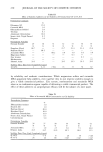
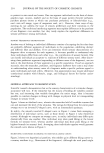
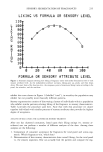
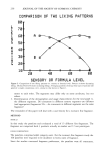
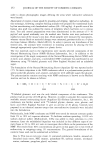
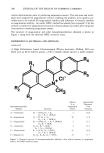
226 JOURNAL OF THE SOCIETY OF COSMETIC CHEMISTS H Figure 1. Structure of dibenzylidene sorbitol. HO DBS is like the anionic gellant sodium stearate in that they are both of low molecular weight and bring about gellation via intermolecular interactions. DBS's limitations for use in cosmetic and toiletry applications arise from its lack of solubility in common cosmetic solvents and its reactivity with acids. DBS is an acetal formed by the condensation of two moles of benzaldehyde with one mole of sorbitol. Consequently, it possesses the known chemical reactivity of an acetal, i.e., instability in the presence of acids (16). This instability limits the utility of DBS for antiperspirant formulations. For example, in our experiments the DBS antiperspirant solid formula- tions as described in the Roehi patents are stable initially but do not have sufficient shelf life to be considered commercial products. In principle, there are two ways to improve the chemical stability of DBS solid gels. One way is to chemically modify the gelling agent to make the acetal moiety less susceptible to acid decomposition by altering its intrinsic electronic and/or steric na- ture, or secondly by adding stabilizing agents to the gel. This paper is based in part on our patent US 4518582 (17) and deals with the latter approach. The former approach will be the subject of an another paper in this series. The efficacy and safety results will be reported in subsequent other papers in this series. EXPERIMENTAL The gel formulations are prepared as two phases. The gellant phase contains the glycol solvent and the DBS. This phase is typically heated to 130-150 ø C in an open beaker in a hood to effect solution of the gellant. The dissolution temperature is a function of the amounts of solvent and gellant. (Caution should be exercised to avoid breathing the glycol vapors.) The active phase contains the antiperspirant active in absolute ethanol or some other anhydrous solvent capable of dissolving the active. For volatile solvents this phase is prepared in a three-necked round bottom flask fitted with a reflux condenser, an explosion-proof stirrer, and an addition port. The other components of the formula- tion (stability additives, cosmetic additives, fragrance, color, etc.) are included in the active phase if compatible. If they are not compatible with the active phase, they are placed in the glycol phase or, if necessary, in a separate third phase. The glycol phase, at a temperature a few degrees above its gellation temperature, is quickly and carefully added to the active phase held under gentle reflux. The resulting

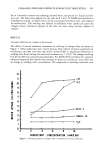
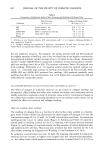
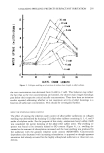
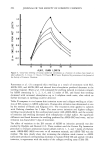
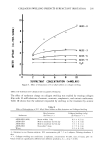
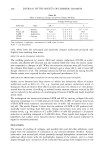
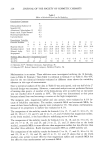
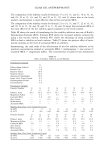
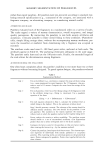
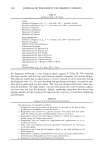
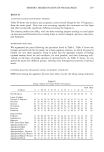
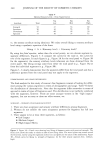
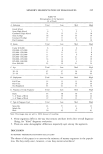
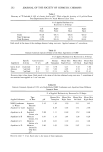
CLEAR GEL ANTIPERSPIRANTS 227 mixture is mixed rapidly for a very short time (typically less than 15 seconds), and rapidly poured into containers for subsequent gellation and evaluation. The speed at which the sticks are prepared is important because the gel usually sets up in less than a minute. The addition of the hot glycol phase to the cooler but refluxing active phase causes a considerable evolution of potentially flammable vapor that must be handled with due care. The stability of the various solid gels is evaluated by placing a one-ounce clear glass jar of the solid gel in an oven set at 60 ø C. Two weeks in the 60 ø C oven without com- pletely liquefying indicates the formulation will probably exhibit adequate stability at the lower conventional temperature stability conditions. In our experience, one day at 60 ø C generally corresponds to two weeks at 45 ø C, so that two weeks at 60 ø C corre- sponds to over half a year at 45 ø C. The complete liquefication point is used as the stability evaluation criterion because it is a less subjective end point than the typical loss of hardness test for a solid gel. Generally a solid gel will maintain adequate gel hardness for at least two thirds of the time that it takes to liquefy completely at 60 ø C. The best signal that the solid gel is beginning to deteriorate is the presence of the characteristic almond odor of benzaldehyde that results from the decomposition of DBS. The odor is evident long before any other physical evidence of gel deterioration is noticeable. All of the materials employed were used as received from their supplier. Anhydrous materials were used because of the deleterious effect of water on the formulations. RESULTS AND DISCUSSION The liquefaction of the gel is caused by the decomposition of the DBS gellant. The mechanisms for the decomposition of acetals are the acid catalyzed reaction with water (hydrolysis) or with an alcohol (transacetalation). Hydrolysis is minimized by limiting the water content of the raw materials in the formulation. Table I shows a series of formulations comparing the stabilities obtained with formulations containing various ratios of solvents: butylene glycol to hexylene glycol and also ethanol to isopropanol. This experiment was conducted to determine if transacetalation can be minimized by choice of solvents. The stability of constant glycol formulas (1, 2, and 3 4, 5, and 6 7, 8, and 9 10, 11, and 12) marginally increases as the formula increases in isopropanol content and decreases in ethanol content. The stability of constant alcohol formulas (1, 4, 7, and 10 2, 5, 8, and 11 3, 6, 9, and 12) marginally decreases as the formula increases in hexylene glycol content and decreases in butylene glycol content. Controlling the choice of the stick solvent (ethanol, isopropanol, butylene glycol, hex- ylene glycol), while affecting stability somewhat, does not provide an appreciable in- crease in stability. Table II presents the data for five possible stability additives, magne- sium sulfate, cocamide MEA, zinc acetate, methenamine (hexamethylene tetramine), and acetamide MEA. It was postulated that the anhydrous magnesium sulfate would tie up the free water introduced from the raw materials. The others were chosen as possible buffering agents. Cocamide MEA and acetamide MEA are amides that act as Lewis bases and also contain a small amount of free MEA. Zinc acetate is an organic solvent-soluble inorganic base.
Purchased for the exclusive use of nofirst nolast (unknown)
From: SCC Media Library & Resource Center (library.scconline.org)