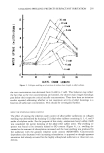
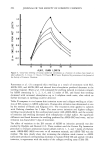
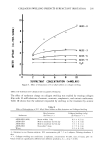
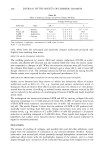
PARAMETERS FOR ASSESSING TOOTHPASTES 221 The measurement results for test product VIII demonstrate that these parameters allow the production of marketable toothpastes, which with respect to all properties closely approximate dental requirements. Test product VIII's excellent cleaning power is also apparent from clinical tests. The advantage of this product becomes particularly evident when compared with the other market products. The current results present a modified picture of the ideal cleaning agent systems com- pared with conventional concepts by focusing attention on a specific form of enamel abrasion. This new concept resolves the conflict which is undesirable from a dental point of view, viz., that a high cleaning effect is only possible at the cost of high dentin abrasion. A further consequence is that one will have to search for other comparable polishing agent systems in an extensive series of tests in a wider and possibly even different field to those studied so far. REFERENCES (1) Statement of the FDI/WG4 task group I on dentifrice abrasivity, FDI-Congress, Hamburg, September 1980. (2) R. R. Lobene, P.M. Soparkar, and M. B. Newman, Plaque removing effectiveness of brushing with dentifrice or water, J. Dent. Res., 62, 199 (1983). (3) H. Stean and G. C. Forward, Measurement of plaque growth following toothbrushing, Community Dent. Oral Epidemiol., 8, 420-423 (1980). (4) R. W. Phillips and V. Huysen, Dentifrices and the tooth surface, American PerJ•mer and Essential Oil Review, 50, 33-41 (1948). (5) M. L. Swartz and R. W. Phillips, Comparison of bacterial accumulations on rough and smooth enamel surfaces, J. Periodontol., 28, 304-307 (1957). (6) M. L. Swartz and R. W. Phillips, Cleansing, polishing and abrasion technics (in vitro), Ann. Rev. N.Y. Acad. Sci., 153, 120-136 (1968). (7) D. Singer and H.-D. Mierau, Plaquebildung und Oberfl•ichenstruktur des Zahnschmelzes, Dtsch. zahniz'rztl. Z., 33, 527-528 (1978). (8) H.-D. Mierau, Beziehungen zwischen Plaquebildung, Rauhigkeit der Zahnoberfl•iche und Selbstreinigung, Dtsch. zahniirztl. Z., 39, 691-698 (1984). (9) R. S. Manly, A structureless recurrent deposit on teeth, J. Dent. Res., 22, 479-481 (1943). (10) J. Head, Modern Dentistry, (W. B. Saunders Company, Philadelphia, 1977), pp 60-64. (11) R. R. Lobene, Clinical studies of the cleaning functions of dentifrices, J. Am. Dent. Ass., 105, 798-802 (1982). (12) M. Pader, Dentifrices: Perspectives, Cosmetics & Toiletries, 97, 40-59 (May 1982). (13) J. B. Wilkinson, Efficacy of dentifrices--formulation and evaluation, Cosmetics & Toiletries, 97, 45-48 (October 1982). (14) O. K. Dolles, H. M. Eriksen, and P. Gjermo, Tooth stain during 2 years' use of chlorhexidine- and fluoride-containing dentifrices, Sc•nd. J. Dent. Res., 87, 268-274 (1979). (15) G. J. Leonard, J. J. Witt, and R. A. Underwood, The enhancement of chlorhexidine stain in dogs, J. Dent. Res., 591, Abstr. 27 (1980). (16) A. Gaffar, H. P. Niles, and C. B. Davis, Evaluation of an oligomer or an oligomer plus cetyl pyri- dinium chloride against plaque, stain, calculus, and gingivitis,J. Dent. Res., 60, 1432-1439 (1981). (17) J. E. Ellingsen, G. R/311a, H. Eriksen, and H. Nordb/3, Dental stain by chlorhexidine, a possible mechanisrn, J. Dent. Res., 61, Abstr. 174 (1982). (18) J. L. McDonald, B. R. Schemehorn, and G. K. Stookey, The influence of dietary factors upon dental staining in the rat, f/. Dent. Res., 61, Abstr. 30 (1982). (19) W. D. Miller, Experiments and observations on the wearing of tooth tissue variously designated as erosion, abrasion, chemical abrasion, denudation etc., Dent. Cosmos, 49, 1-23, 109-124, 225-247 (1907). (20) A. Sagnes and P. Gjermo, Prevalence of oral soft and hard tissue lesions related to mechanical tooth cleaning procedures, Community Dent. Oral Epidemiol., 4, 77-80 (1976).

222 JOURNAL OF THE SOCIETY OF COSMETIC CHEMISTS (21) R. J. Grabenstetter, R. W. Broge, F. L. Jackson, and A. W. Radike, The measurement of the abrasion of human teeth by dentifrice abrasives: A test utilizing radioactive teeth, J. Dent. Res., 17, 1060-1068 (1958). (22) K. H. R. Wright and J. I. Stevenson, The measurement and interpretation of dentifrice abrasive- ness, J. Soc. Cosmetic Chemists, 18, 387-411 (1967). (23) Council of Dental Therapeutics, Abrasivity of current dentifrices, J. Am. Dent. Ass., 81, 1177-1178 (1951). (24) J. J. Hefferren, A laboratory method for assessment of dentifrice abrasivity, J. Dent. Res., 55, 563-573 (1976). (25) British Standards Institution, Specification for toothpastes, BS 5136, (1981). (26) J. B. Wilkinson and B. R. Pugh, Toothpastes--cleaning and abrasion, J. Soc. Cosmet. Chem., 21, 595-605 (1970). (27) D. Slop, J. F. de Rooij, and J. Arends, Abrasion of enamel I., An in vitro investigation, Caries Res., 17, 242-248 (1983). (28) O. Pfrengle and C. Pietruck, Die Messung der Abrasivitiit von Zahnputzmitteln an Dentin, Fette, Seifen, Anstrichmitte/, 67, 682-688 (1965). (29) A. W. Bouchal, The abrasiveness of dentifrices, The Toilet Goods Association, 45, 2-5 (1966). (30) H. Ashmore, N.J. van Abbe, and S. J. Wilson, The measurement in vitro of dentine abrasion by toothpaste, Brit. Dent. J., 133, 60-66 (1972). (31) W. B. Davis and P. J. Winter, Measurement in vitro of enamel abrasion by dentifrice, J. Dent. Res., 55, 970-975 (1976). (32) P. R. Hotz, Untersuchungen zur Abrasivitiit yon Zahnpasten, Schw. Monatsschr. Zahnheilk., 93, 93-97 (1983). (33) P.M. Baxter, W. B. Davis, and J. Jackson, Toothpaste abrasive requirements to control naturally stained pellicle, J. Oral Rehabi/., 8, 19-26 (1981). (34) C. E. Alford, E. J. Heikel, F. C. Nachod, M. Prinzner, and M. L. Tainter, Polishing power of dentifrices: Quantitative studies,J. Amer. Dent. Ass., 36, 270-277 (1948). (35) L. R. Bailey and R. W. Phillips, Effects of certain abrasive materials on tooth enamel,J. Dent. Res., 29, 740-748 (1950). (36) G. K. Stookey and J. C. Muhler, Laboratory studies concerning the enamel and dentin abrasion prop- erties of common dentifrice polishing agents, J. Dent. Res., 47, 524-532 (1968). (37) T. Schiff and K. J. Shaver, The comparative effect of two commercially available dentifrices on tooth surfaces as determined by a tooth reflectance meter, J. Oral Medicine, 26, 127-133 (1971). (38) T. Gaberthiiel, Refiektometrische Untersuchungen der Pollerkraft yon Zahnpasten, (Inaugural Dis- sertation, Universitiit Zurich, 1975). (39) K. Elmer, T. Gaberthiiel, K. Brunner, and H. R. Miihlemann, Refiectometry and micromorphology of polished, etched and repolished teeth, Helv. Odont. Acta, 19, 40-47 (1975). (40) M. S. Putt, C. J. Kleber, and J. C. Muhler, A comparison of the polishing properties of human and bovine enamel, J. Dent. Res., 59, 1177 (1980). (41) R. S. Manly, P. W. Brown, D. P. Harrington, G. L. Crane, and D. A. Schlichting, Laser diffu- someter for estimation of smoothness of human dental enamel produced by dentifrice abrasives, Archs. Oral Bio/., 20, 479-483 (1975). (42) G. Redmaim and H. Ryden, Dentifrice abrasivity: The use of laser beams for comparative studies in vitro of surface changes, Swed. Dent. J., 3, 91-100 (1979). (43) S. v. Brasch, J. Lazarou, N.J. van Abbe, and J. O. Forrest, The assessment of dentifrice abrasivity in vivo, Brit. Dent. J., 127, 119-124 (1969). (44) P.O. Gerdin, Studies in dentifrices V: The effects of grinding and non-grinding dentifrices on enamel surfaces. An in vivo Study, Sv. Tand/ek Tidskr., 65, 191-209 (1979). (45) C. C. Saxton, The effects of dentifrices of the appearance of the tooth surface observed with the scanning electron microscope, J. Periodontal Res., 11, 74-85 (1976). (46) O. Pfrengle and C. Pietruck, Ein neues Verfahren zur Messung der Putzkraft yon Zahnreinigungs- mitteln, Fette, Seifen, Anstrichmitte/, 68, 44-47 (1966). (47) M. S. Putt, C. J. Kleber, J. A. Davis, R. G. Schimmele, and J. C. Muhler, Physical characteristics of a new cleaning and polishing agent for use in a prophylaxis paste, J. Dent. Res., 54, 527-534 (1975). (48) J. J. Marcus and E. Ginzler, Method for determining the cleaning power of dentifrice products, Missouri Analytical Laboratories, Inc., Information Manual, 1982.
Purchased for the exclusive use of nofirst nolast (unknown)
From: SCC Media Library & Resource Center (library.scconline.org)