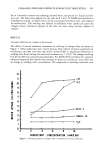
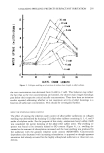
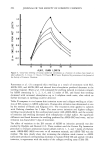
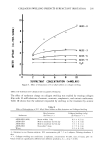
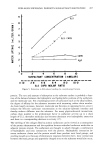
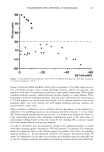
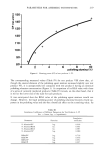
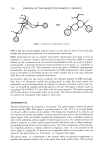
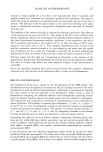
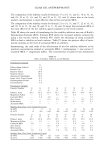
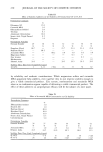
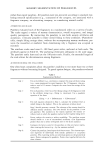
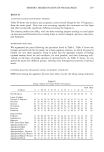
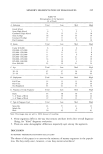
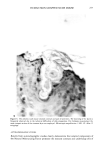
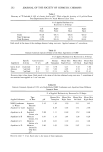
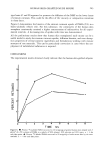
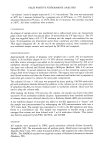
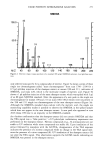
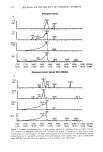
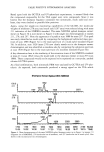
PARAMETERS FOR ASSESSING TOOTHPASTES 219 11 1t o I I I I I I I I I 2 4 6 8 10 polishing alumina (%) Figure 4. Cleaning power (CP) of test products I-VI. The corresponding measured values (Table IV) for test product VIII show that, al- though the enamel abrasion of the polishing agent mixture increased slightly over test product VII, it is unexpectedly low compared with test product I having an identical polishing alumina concentration (Figure 3). A comparison of its REA value with those of a series of currently marketed products (Table IV) reveals, on the other hand, that it is still at the lower end of the scale for such products. It was anticipated that the RDA value of the polishing agent mixture would not change. However, the high polishing power of polishing alumina becomes clearly ap- parent in the polishing value and also has a beneficial effect on the scratching value. As Table III Correlation Coefficients of Different Parameters for Test Products I-VI (lin. = linear, log. = logarithmic) Correlation- Parameter Function coefficient % Alumina/PV log. 0.910 % Alumina/RDA lin. 0.961 % Alumina/REA lin. 0.987 % Alumina/CP log. 0.980 RDA/PV log. 0.736 REA/PV log. 0.936 RDA/CP log. 0.952 REA/CP log. 0.927

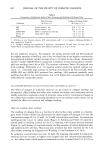
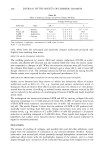
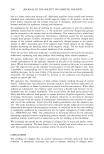
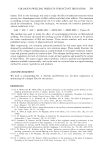
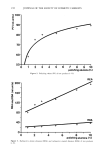
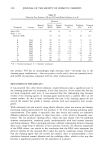
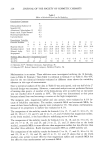
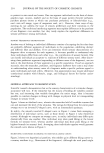
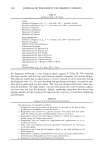
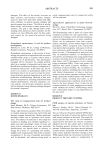
220 JOURNAL OF THE SOCIETY OF COSMETIC CHEMISTS Table IV Values for Test Products VII and VIII and Market Products A to K Toothpaste Abrasion Abrasive Dentin Enamel Scratching Polishing Cleaning Country Type* (RDA) (REA) (SV) (PV) (CP) Silica (VII) Silica + 1% Alumina (VIII) 60 15 - 15 3 80 55 26 -7 36 211 A USA N 65 15 - 10 9 33 B FRG N 30 13 - 20 5 35 C FRG N 78 11 - 6 7 40 D FRG N 89 18 - 32 4 53 E USA S 199 32 - 76 - ! ! 70 F USA N 78 46 - !!4 - 15 79 G FRG S 154 122 - 115 - 20 96 H USA N 9! !7 - ! 8 10! I USA S 98 17 - 52 2 !90 K USA N !20 !96 - 7 ! 3 ! 267 * N = Normal toothpaste. S = Smokers' toothpaste. test product VIII has an astonishingly high cleaning value--obviously due to the cleaning agent combination--this test product can be said to have an extremely favor- able profile of properties compared with the other market products. DISCUSSION OF THE RESULTS It was assumed that, after dentin abrasion, enamel abrasion plays a significant part in the cleaning properties of a toothpaste, if not a key function. As the reason why this has not been recognized until now, it was assumed that this relationship only becomes evident if the cleaning agents or cleaning agent systems have a uniform effect on the enamel surface. As this is most conclusively the case if the cleaning agents do not scratch the enamel but polish it instead, systems with such properties were investi- gated. With extremely low and scarcely rising dentin abrasion, there was serious and sharply increasing enamel abrasiveness for test products I-VI with increasing polishing agent concentrations. This makes it especially clear that dentin and enamel are extremely different substrates with respect to their wear rates--a fact which is frequently over- looked. The test products' cleaning effect, which also rises steeply with the polishing alumina concentration, correlated purely mathematically with both enamel abrasion and dentin abrasion. This in principle prevents a definite relationship between cleaning effect and a single form of abrasion. If one considers, however, the absolute magnitude of the RDA values, one arrives at the conclusion that the REA value represents the decisive variable for the cleaning effect under the specific conditions chosen. Provided that the cleaning agent does not scratch the enamel, there is understandably a close correlation between enamel abrasion and the polishing effect, which in this way also becomes a significant parameter for the assessment of a product.
Purchased for the exclusive use of nofirst nolast (unknown)
From: SCC Media Library & Resource Center (library.scconline.org)