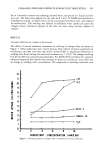
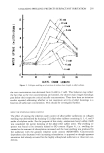
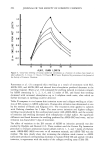
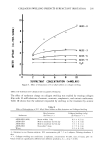
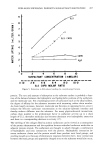
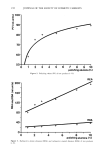
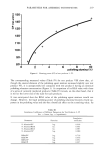
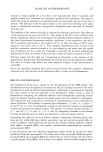
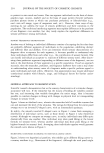
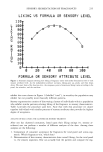
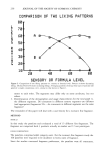
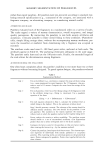
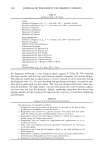
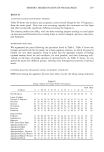
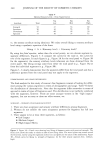
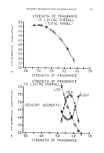
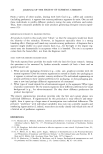
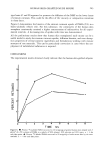
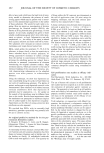
COLLAGEN SWELLING PREDICTS SURFACTANT IRRITATION 207 7 6 5 4 2 ffff• ///o /j/•,// SLS:C• / •""-.--o CAPB 0 0 0 0 0 H20 0 2 4 6 8 I0 SURFACTANT CONCENTRATION { mMOLAR } 0:10 2:8 4:6 6:4 8:2 I0:0 SLS :CAPB MOLAR RATIO Figure 5. Reduction in SLS-induced swelling by cocamidopropyl betainc. protein. The rate and amount of adsorption at the substrate surface is probably a func- tion of the balance between the hydrophilic and hydrophobic portions of the surfactant, and the molecular size. For a homologous series of surfactants such as the alkyl sulfates, the degree of affinity for the substrate increases with increasing carbon chain number. As chain length increases, however, molecular size becomes an opposing factor, since it reduces the effective surfactant concentration at the solution-substrate interface and thereby reduces diffusion into the substrate. For many physicochemical interactions, carbon chain number is the predominant factor in surfactant activity up to a chain length of C12 thereafter molecular size becomes dominant over hydrophobic attraction and there is a corresponding decrease in activity (17). The swelling of the collagen film by anionic surfactants can be viewed as a consequence of the protein denaturation and the repulsion between adsorbed surfactant molecules on adjacent protein strands. The surfactants are thought to adsorb through a combination of hydrophobic and ionic interactions with the protein. Hydrophobic interaction be- tween surfactant chains and the protein would leave pendant ionic head groups, and swelling would occur because of electrostatic repulsion between them. Ionic interactions between the head groups and oppositely charged sites on the substrate would also occur,

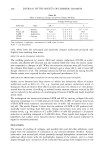
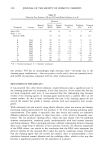
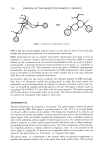
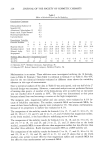
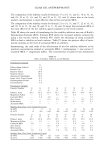
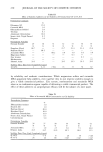
208 JOURNAL OF THE SOCIETY OF COSMETIC CHEMISTS but to a lesser extent near neutral pH. Additional repulsive forces would exist between adsorbed ionic surfactants and the overall negative charge of the protein. As the sub- strate matrix expands and the tertiary structure is disrupted, additional sites would become available for surfactant binding and hydration. An explanation for the lack of swelling by cationic surfactants is that the surfactant- substrate interactions are attractive, i.e. the surfactant's positively charged head groups may be attracted to the anionic sites on the substrate. This attractive force would tend to cancel the surfactant-surfactant electrostatic repulsion caused by the positively charged head groups. Further, electrostatic interaction of the positively charged head groups of the cationic surfactant with the negatively charged groups in the protein would, in effect, neutralize part of the negative high charge density on the collagen, thereby decreasing the repelling forces of the negative charge. The net result would be little or no swelling above the normal hydration of the membrane. There are no ionic surfactant-surfactant or surfactant-substrate interactions for nonionic surfactants, explaining why they produce little swelling above normal hydration. For anionic surfactants, the relative contribution of these two interior forces to the overall conformation of the substrate depends on the pH of the binding site environ- ment. When the environment is acidic, electrostatic repulsive forces are at a minimum since the negative sites on the substrate are protonated. As the pH begins to rise, there is probably a corresponding rise in the repulsive forces within the protein matrix, and swelling increases. In the case of skin, if the protein structure has not been permanently denatured, the swelling is reversible by removal of the surfactant and returning the sample to neutral pH (10). We speculate that ethoxylation of alkyl sulfates reduces swelling because of several factors. Ethoxylation may effectively decrease repulsive forces between surfactants ad- sorbed to interfaces, as shown by decreases in critical micelie concentration. When alkyl sulfates are ethoxylated, the ethylene oxide units form a flexible link between the hy- drophobe and the charged hydrophile. This would afford the head group greater mo- bility and allow adjacent head groups to assume positions of greater separation, thereby decreasing electrostatic repulsion. The resultant reduction in electrostatic repulsion would increase with the degree of ethoxylation. Ethoxylation also increases the molec- ular size of the surfactant, which sterically hinders penetration into the substrate ma- trix. The steric hindrance is small for lower molecular weight surfactants but becomes dominant as the amount of ethoxylation increases, as evidenced by the fact that swelling is completely unaffected by concentration for the higher ethoxylates of alkyl sulfates, e.g. AEOS-6EO and -9EO. The combination of decreasing affinity for the substrate, decreasing repulsion between neighboring protein strands, and decreasing access to the substrate interior would result in reductions in the net swelling of the membrane. We developed this model for the swelling of collagen film to study and predict surfac- tant-induced irritation. We have found it to be a helpful tool which allows us to con- sider the possible interactions occurring within the protein matrix. CONCLUSIONS The swelling of collagen film by anionic surfactants correlates well with their skin irritation. A radiotracer technique was used to measure swelling of collagen mem-
Purchased for the exclusive use of nofirst nolast (unknown)
From: SCC Media Library & Resource Center (library.scconline.org)