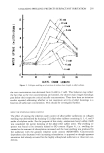
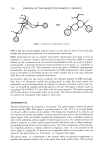
j. Soc. Cosmet. Chem., 37, 225-231 (July/August 1986) Acid stable dibenzylidene sorbitol gelled clear solid antiperspirant formulations: I T. SCHAMPER, M. JABLON, M. H. RANDHAWA, A. SENATORE, and J. D. WARREN, Shulton Research Division, American Cyanamid Company, 697 Route 46, Clifton, N•I 07015. Received December 4, 1985. Synopsis The stability of clear, solid antiperspirant formulations gelled with dibenzylidene sorbitol was investigated. It was found that the choice of glycol or alcohol solvent had a minor effect on product stability. A major enhancement of stability was achieved by incorporating acetamide MEA, methenamine, or zinc acetate, alone or in combination, as stabilizing agents. Using these materials, products have been prepared that are stable for over a year at 45 ø C. INTRODUCTION Antiperspirant formulators have been trying to prepare clear solid antiperspirants with the aesthetic application properties of stearate gelled alcohol/glycol stick deodorants for many years. The advantages of the stearate stick deodorant application aesthetics are clarity, ease of application, cool and refreshing feel on application, lack of powdery residue, and non-greasy feel. However, the known chemical incompatibility of the acidic antiperspirant salts with sodium stearate prevents the successful formulation of products. In addition, neutral or basic aluminum salts, although compatible with so- dium stearate, are known not to produce highly efficacious products. The publication of US patents 4154816 (1) in 1979 and 4346079 (2) in 1982 by Roehi (assigned to Naarden) discloses the possibility of producing a clear solid antiperspirant with the aesthetics of a deodorant. Roehl's patents describe the gellation of glycols containing acidic aluminum antiperspirant salts with dibenzylidene sorbitol (DBS) to give clear solid antiperspirant formulations. DBS (Figure 1) is not a new chemical. Thomas and Sibi reported the condensation product of benzaldehyde and sorbitol in 1926 (3). The structures of the three condensa- tion products between benzaldehyde and sorbitol (mono: 2,4-benzylidene sorbitol di: 1,3:2,4-dibenzylidene sorbitol (DBS) and tri: 1,3:2,4:5,6-tribenzylidene sorbitol) were reported in the 40s and 50s (4-10). The thermodynamically unfavored 2,4:3,5- dibenzylidene sorbitol was reported in the 60s (11, 12). Kinetic data on the condensa- tion reaction was also reported in the 60s (13, 14). A NMR paper (15) in 1976 dis- closed the solution structures of the di and tri benzylidene sorbitols. DBS is an excellent gelling agent for organic solvents. Numerous patents have been issued for products utilizing this feature. DBS is an unusual gelling agent because it is a relatively small, compact neutral molecule with a molecular weight of 358 daltons. This contrasts to the high molecular weights of the usual polymeric gelling agents. 225

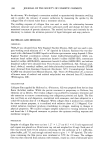
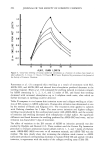
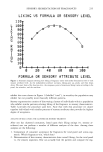
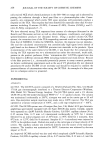
226 JOURNAL OF THE SOCIETY OF COSMETIC CHEMISTS H Figure 1. Structure of dibenzylidene sorbitol. HO DBS is like the anionic gellant sodium stearate in that they are both of low molecular weight and bring about gellation via intermolecular interactions. DBS's limitations for use in cosmetic and toiletry applications arise from its lack of solubility in common cosmetic solvents and its reactivity with acids. DBS is an acetal formed by the condensation of two moles of benzaldehyde with one mole of sorbitol. Consequently, it possesses the known chemical reactivity of an acetal, i.e., instability in the presence of acids (16). This instability limits the utility of DBS for antiperspirant formulations. For example, in our experiments the DBS antiperspirant solid formula- tions as described in the Roehi patents are stable initially but do not have sufficient shelf life to be considered commercial products. In principle, there are two ways to improve the chemical stability of DBS solid gels. One way is to chemically modify the gelling agent to make the acetal moiety less susceptible to acid decomposition by altering its intrinsic electronic and/or steric na- ture, or secondly by adding stabilizing agents to the gel. This paper is based in part on our patent US 4518582 (17) and deals with the latter approach. The former approach will be the subject of an another paper in this series. The efficacy and safety results will be reported in subsequent other papers in this series. EXPERIMENTAL The gel formulations are prepared as two phases. The gellant phase contains the glycol solvent and the DBS. This phase is typically heated to 130-150 ø C in an open beaker in a hood to effect solution of the gellant. The dissolution temperature is a function of the amounts of solvent and gellant. (Caution should be exercised to avoid breathing the glycol vapors.) The active phase contains the antiperspirant active in absolute ethanol or some other anhydrous solvent capable of dissolving the active. For volatile solvents this phase is prepared in a three-necked round bottom flask fitted with a reflux condenser, an explosion-proof stirrer, and an addition port. The other components of the formula- tion (stability additives, cosmetic additives, fragrance, color, etc.) are included in the active phase if compatible. If they are not compatible with the active phase, they are placed in the glycol phase or, if necessary, in a separate third phase. The glycol phase, at a temperature a few degrees above its gellation temperature, is quickly and carefully added to the active phase held under gentle reflux. The resulting
Purchased for the exclusive use of nofirst nolast (unknown)
From: SCC Media Library & Resource Center (library.scconline.org)