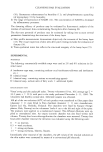
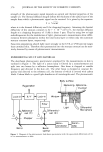
NUDE RAT SKIN PERMEABILITY 299 CHEMICALS Tritiated water and a series of •4C-labeled n-alkanols were obtained from New England Nuclear Corp. Included were "neat" solutions of methanol (50 mCi/mmol), ethanol (24 mCi/mmol), butanol (4 mCi/mmol), hexanol (5 mCi/mmol), octanol (5 mCi/mmol), and 3H-water (25 mCi/g). Stock solutions of each compound were prepared by diluting "neat" compound with distilled water to provide specific activities in the range of 0.2- 1.0 }xCi/mL. PERMEATION PROCEDURE Each half-cell was filled with 3 mL of normal saline. The cell contents were stirred for 15 minutes to assure temperature equilibration. Two-hundred microliter samples were withdrawn from each half-cell and assayed for background counts. The donor compart- ments were charged with radiolabeled compounds at concentrations in the micromolar range. This point was considered time zero for the experiments. A 50 }xL sample was withdrawn from the donor compartment after mixing five minutes and assayed radio- isotopically. At predetermined times, 200 }xL samples were withdrawn from the re- ceiver compartments and assayed. These samples were replaced with 200 }xL of saline to maintain a constant volume in the receiver compartment. ASSAY PROCEDURE The samples withdrawn during the experiment were transferred to 10 mL of scintilla- tion cocktail (Aquasol ©, New England Nuclear, Boston, MA) and were assayed on a Beckman Liquid Scintillation Counter, Model LS-5801. DATA ANALYSIS The data were plotted as dpm collected in the receiver compartment as a function of time. The dpm values were corrected for losses due to sampling. The permeability coefficient from a given run was calculated from: Jt = P'A'AC = V'dc/dt where Jt = the total pseudo-steady state flux in dpm/hour across the skin P = the permeability coefficient (cm/hour) A = the diffusional area (cm 2) AC = the concentration differential across the membrane, which was taken to be equal to the donor phase concentration, (dpm/cm 3) V = the half-cell volume of the receptor compartment (cm 3) dc/dt = the steady-state slope in terms of dpm/cmS/hour RESULTS AND DISCUSSION MECHANISTIC CONSIDERATIONS AND SUITABILITY OF THE NUDE RAT AS AN ANIMAL MODEL The in vitro permeability coefficients (P-values) for n-alkanols and water through nude rat skin are summarized in Table I, along with similar data for other animal models,

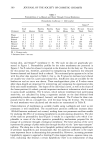
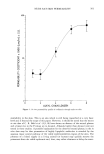
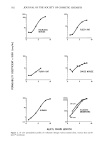
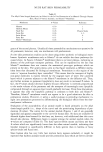
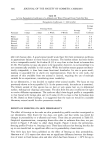
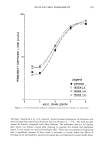
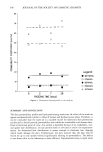
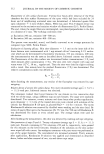
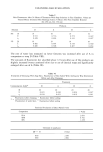
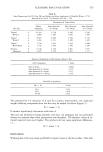
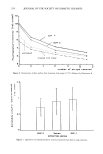
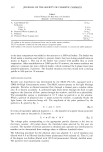
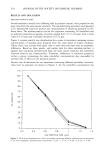
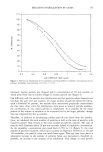
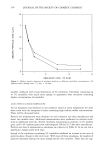
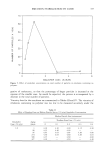
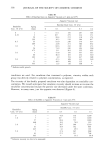
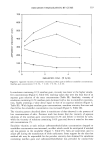
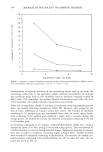
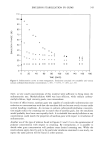
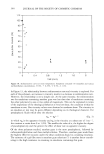
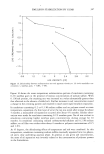
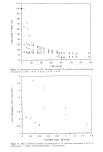
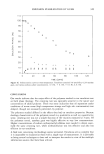
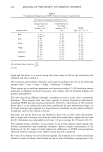
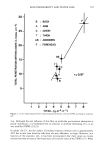
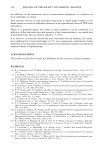
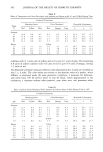
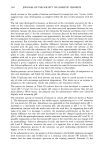
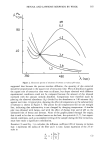
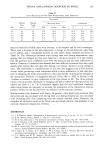
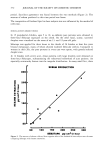
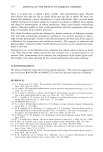
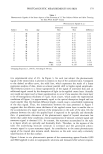
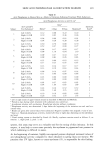
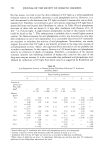
300 JOURNAL OF THE SOCIETY OF COSMETIC CHEMISTS Table I Permeabilities of n-Alkanols and Water Through Various Membranes Permeability Coefficient x 1000 (cm/hr) Skin Silastic © Nude Permeant Rat Hairless Hairless Fuzzy Swiss Furry 80 mcm 50 mcm Human Mouse Rat Rat Mouse Rat Thick Thick Water 4.2 Methanol 4.4 Ethanol 4.2 Butanol 14.2 Hexanol 47.7 Octanol 59.0 Reference: PS 0.5 2.3 -- 11.7 -- 3.4 -- 0.5 3.6 -- 1.8 7.7 2.4 33 -- 0.8 3.4 1.0 2.0 4.7 2.4* 60 94 2.5 13.5 2.4 7.4 14.6 4.8 203 360 13.0 63.8 -- 21.8 19.0 9.4 764 970 52.0 114.9 30.0 30.8 25.5 -- 1260 1320 1 2 3 4,5 6 7 8 8 PS = Present study. * Estimated data--see text. human skin, and Silastic © membrane (1-8). The nude rat data are graphically pre- sented in Figure 1. Permeability profiles for the other membranes are presented in Figure 2. No P-value for ethanol is reported in the literature for the furry rat. The curve for this animal was, therefore, generated by extrapolating the regression line obtained between hexanol and butanol back to ethanol. This estimated point appears to be in line with the other data reported in Table I that is, the P-values for methanol and ethanol are usually very close for a particular animal skin. Insufficient data are available for the hairless rat and no curve was drawn. These semilogarithmic plots of P-values versus alkyl chain-length are important for interpreting and comparing the experimental data from each model membrane. The shapes of the individual curves, as well as the slopes of the linear portions (x-values), provide important mechanistic information which is used to assess model suitability. The x-values, which indicate membrane lipid partitioning sensitivity, are calculated by doing a regression analysis on the data obtained from permeability studies using ethanol, butanol, and hexanol. The P-values for these com- pounds tend to fall on a straight line, with the slope being the x-value. The w-values for each membrane were calculated and the results are summarized in Table II. Characterization of membranes as suitable models using n-alkanols and water as test permeants is well established. The octanol/water partition coefficient increases about 100-fold between methanol and octanol, making these test permeants excellent models for studying the effect of increasing lipophilicity on percutaneous absorption. The plot of the nude rat permeability data (Figure 1) results in a sigmoidal curve which is ex- plainable in terms of the three operative permeability mechanisms proposed for the passage of a permeant through a biological membrane. The lower plateau of the curve represents the passage of polar molecules through the skin via the "pore-type transport" pathway. The sharp rise in the curve (lipophilic pathway) reflects increasing significance of permeant lipophilicity and demonstrates that the partition coefficient is the single most important factor in determining skin permeability. However, increasing permeant lipophilicity appears to approach a limiting P-value (upper plateau-aqueous tissue con- trol), indicating that beyond a certain lipophilicity there is no enhancement of drug
Purchased for the exclusive use of nofirst nolast (unknown)
From: SCC Media Library & Resource Center (library.scconline.org)