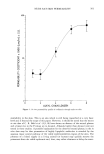
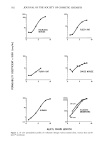
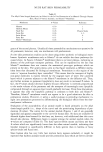
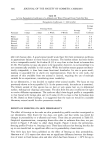
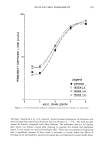
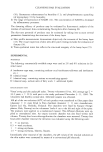
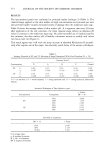
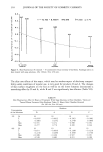
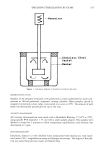
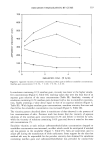
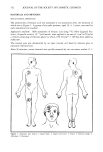
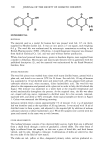
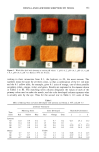
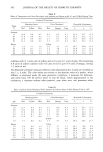
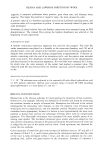
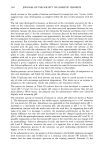
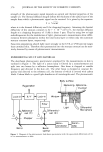
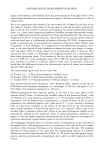
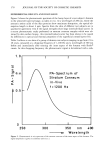
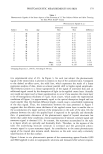
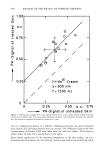
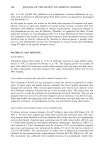
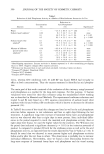
EMULSION STABILIZATION BY GUMS 333 --Homomixer --Stainless gteel Jacket ---Beaker Figure 1. Schematic diagram of emulsion manufacturing setup. SEDIMENTATION STUDY Samples of the prepared emulsions were permitted to stand undisturbed at room tem- perature in 100-ml graduated, stoppered, mixing cylinders. Other samples, placed in stoppered cylindrical culture tubes, were stored in an oven at 45øC. The amount of each phase was determined periodically for up to one year. VISCOSITY MEASUREMENT All viscosity determinations were made with a Brookfield Rheolog 2.5 LVT at 25øC, using spindle #18 (diameter 1.75 cm) with a small sample adapter. The samples were allowed to stand for 5 minutes to allow temperature equilibration, and viscosity was determined at 3 rpm. PHOTOMICROGRAPHY Emulsions, diluted 1:2 with distilled water presaturated with mineral oil, were exam- ined under 150 X magnification using an Olympus microscope. The degree of floccula- tion was noted from pictures made on Polaroid film.

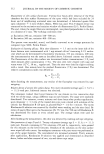
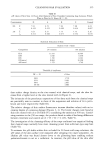
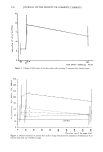
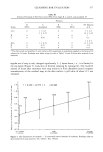
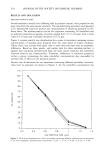
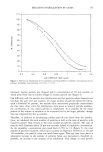
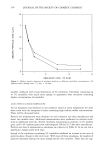
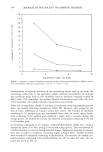
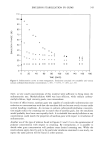
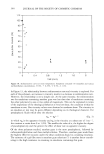
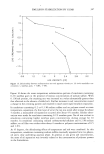
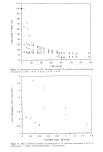
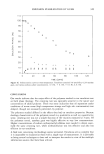
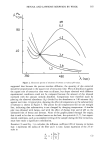
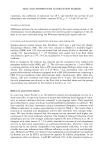
334 JOURNAL OF THE SOCIETY OF COSMETIC CHEMISTS RESULTS AND DISCUSSION EMULSION MANUFACTURE Several emulsions (usually five) differing only in polymer content, were prepared at the same time from the same master emulsion. The manufacturing procedure used appeared to be reproducible based on particle size measurements of emulsions prepared on dif- ferent dates. The median particle size for five replicates containing 1% emulsifier (and no polymer) prepared on separate occasions ranged from 4.3 to 4.8 •m with a mean value of 4.52 •m and a standard deviation of 0.22 •m. Figure 2 contains particle size distributions for a series of emulsions containing various concentrations of xanthan gum prepared from the same batch of master emulsion. Values of per cent oversize were quite close to each other and there were no systematic differences. Based on these results, and similar data for other emulsion batches, it appears that emulsions manufactured from the same master emulsion had essentially identical particle size characteristics. Therefore, differences in emulsion properties within a group (containing the same emulsifier concentration) may reasonably be ascribed only to effects of the polymers present. Particle size distributions for two emulsions containing different emulsifier concentra- tions (and no polymer) are shown in Figure 3. As the emulsifier concentration was 11o Ld lOO 9o 8o 7o 6O 50- 40- 30- 20- 10- 0.2 0.4 0.6 0.8 1 1.2 1.4 LOG PARTICLE SIZE (Dr'n) Figure 2. Particle size distribution of a series of emulsion containing different xanthan gum concentrations at 1% (w/w) emulsifier. Xanthan gum concentration: [] 0%, + 0.1%, O 0.2%, /• 0.3%, X 0.4%.
Purchased for the exclusive use of nofirst nolast (unknown)
From: SCC Media Library & Resource Center (library.scconline.org)