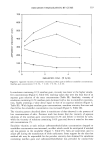
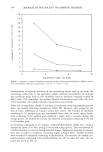
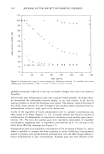
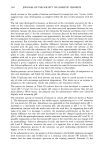
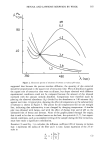
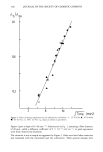
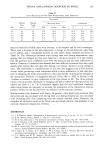
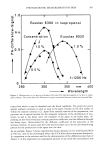
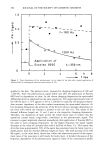
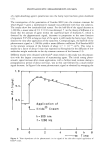
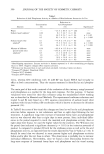
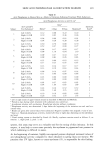
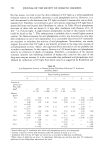
j. Soc. Cosmet. Chem., 37, 375-385 (September/October 1986) Evaluation of drug penetration into the skin by photoacoustic measurement K. KOLMEL, Universita'ts-Hautklinik, von-Siebold-Str. 3, 3400 Gb'ttingen, Federal Republic of Germany, and A. NICOLAUS, B. SENNHENN, and K. GIESE, Institut fiir Medizinische Physik und Biophysik der Universit, it, Gosslerstr. 10 F, 3400 Gb'ttingen, Federal Republic of Germany. Received March 4, 1986. Synopsis In this study photoacoustic spectroscopy was used to measure in vivo the ultraviolet absorption spectra of various sunscreen preparations topically applied to the inner aspect of the forearm. By means of the depth sensitive photoacoustic technique it was possible to differentiate between the absorption of light within the outermost layers of treated skin and within the total horny layer. From observation of the photoacoustic signal after application of the sunscreen to the skin, information about its penetration behavior was ob- tained. INTRODUCTION According to Wester and Maibach the following in vivo methods are used for the deter- mination of percutaneous absorption: measurements of radioactivity in excreta or blood after topical application of radiolabeled agents, surface recovery, surface disappearance, and biological or pharmacological response (1). Although cellophane-tape stripping is frequently considered as an in vivo method too, it holds an intermediate position as the horny layer is destroyed at the investigated skin area. Using sunscreens as an example, we will demonstrate that photoacoustic spectroscopy is a new technique which can be used for determining in vivo the penetration behavior of topically applied agents. For methodological reasons the main information obtained concerns penetration into the horny layer. Photoacoustic spectroscopy has been shown to be a promising technique for obtaining optical absorption spectra of biological tissues (2,3), with interesting potential as a tool for noninvasive spectral analyses in medicine (4). In the area of dermatology, the method has been used to study the water content of the stratum corneum and for the determination of the distribution of drugs in the skin (5,6). With this technique a rhythmically chopped monochromatic beam of light is directed onto the sample. It is on the bottom of an airtight cell with a quartz window on the opposite side to allow light incidence. The surface of the sample becomes rhythmically heated due to the absorption of light. In the adjacent sealed gas space the periodic heating of the surface yields pressure oscillations which can be detected by a sensitive microphone. The 375

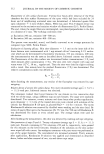
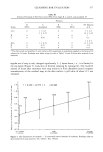
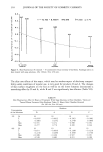
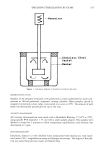
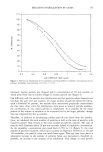
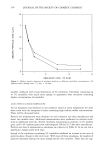
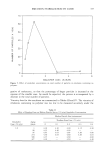
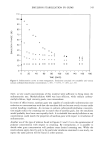
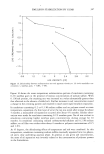
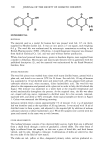
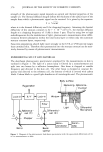
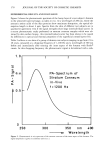
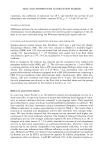
376 JOURNAL OF THE SOCIETY OF COSMETIC CHEMISTS strength of the photoacoustic signal depends on optical and thermal properties of the sample (2). The thermal diffusion length defines the thickness of the surface layer of the sample from which a photoacoustic signal can be received. It is given by the equation where o• is the thermal diffusivity and f the chopping frequency. Assuming the thermal diffusivity of dry stratum corneum to be 7 x 10 -4 cm2/s (7), the thermal diffusion length at a chopping frequency of 1 kHz is about 5 •m. Thus by using low or high audiofrequencies for the modulation of light, photoacoustic measurements allow differ- entiation between absorption within the total horny layer or within only the outermost stratum carneurn layers, respectively. Sunscreen preparations absorb light more strongly in the UVA or UVB spectral ranges than untreated skin. Therefore their penetration into the stratum carneurn can be sensi- tively detected by means of photoacoustic measurements. EXPERIMENTAL SET-UP AND MATERIALS The dual-beam photoacoustic spectrometer employed for the measurements on skin is outlined in Figure 1. The light of a xenon lamp is filtered by a monochromator and split into two beams by a reflective beamsplitter. One beam is chopped at variable frequency and directed to the skin cell. The other beam is chopped at constant fre- quency and directed to the reference cell, the bottom of which is covered with carbon black. Carbon black is a good light absorber at all wavelengths used. The photoacoustic Lock-in Registration 1 Mirror t 1 Reference - cell { Y } - Chopper Body surface Lock-in I Window--- • O• :1]_ Difcfe•r, •i• '- • [Mono- x chromofor Beam splitter Measuring- Reference- /Chamber • Differential Microphone • Xenon - lamp Figure 1. Diagram of the photoacoustic dual-beam spectrometer with the open-ended differential cell for in vive measurements on skin.
Purchased for the exclusive use of nofirst nolast (unknown)
From: SCC Media Library & Resource Center (library.scconline.org)