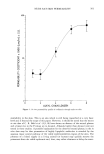
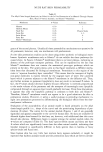
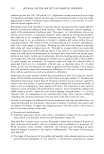
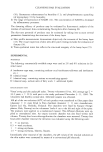
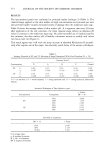
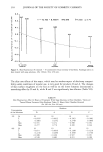
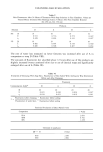
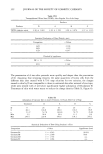
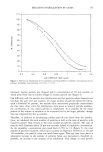
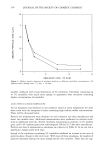
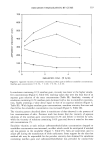
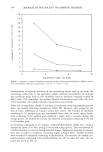
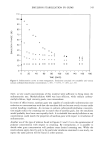
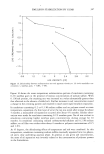
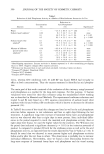
NUDE RAT SKIN PERMEABILITY 303 Table II The Alkyl Chain Length Sensitivity (w-Value) for the In Vitro Permeation of n-Alkanols Through Human Skin, Skins of Various Animals, and Silastic © Membrane Membrane w-Values Reference Human 0.30 1 Hairless Mouse 0.32 2 Nude Rat 0.26 Present Study Fuzzy Rat 0.26 4, 5 Swiss Mouse 0.15 6 Furry Rat 0.15 7 Silastic © Membrane 0.26 8 gence of the second plateau. Usually all three permeability mechanisms are operative for all permeants however, only one mechanism will predominate. In vitro skin permeation studies can be done using either synthetic or biological mem- branes. Synthetic membranes such as Silastic © do not exhibit the three pathways dis- cussed above. In Figure 2 (Silastic © membrane) there is no lower plateau, indicating an absence of the pore-type transport pathway. This can be explained by the fact that Silastic © membrane does not contain the anatomical pore-type pathways which are present in the skin. The upper plateau seen in this figure represents a different mecha- nism from that discussed for biological membranes. Permeation in this region of the curve is "aqueous boundary layer controlled." This means that the transport of highly non-polar molecules is mainly limited by the stagnant layer of water (the unstirred layer) which is present adjacent to the Silastic © membrane in the diffusion cell. Thus, any further increase in permeant lipophilicity does not result in increased P-values. In fact, the P-values should decrease slightly because diffusivity is inversely proportional to the molar volume of the permeant and the transport of increasingly more lipophilic compounds through an aqueous layer would gradually decrease. From these discussions, it appears that only the lipophilic pathway is common to both skin and Silastic ©. Therefore, Silastic © membrane would not appear to be a good substitute for skin in permeation studies. However, it serves a useful purpose in providing mechanistic in- sight into permeation processes by differentiating the biological effects from the ther- modynamic influences. Evaluation of the acceptability of an animal model is based primarily on the alkyl chain-length profile (i.e., shape of the curve) and the partitioning dependency of per- meation (q'r-value). The curves for the animal models (Figures 1 and 2) are generally sigmoidal and appear comparable to the curve for human skin. No data are available for alkanols higher than hexanol for the furry rat however, with additional data this curve should also plateau. Differences begin to appear among the animal models when the q'r-values are compared (Table II). The furry species (Swiss mouse and furry rat) have q'r-values which are significantly lower than the other animal models, indicating that lipoidal transport is significantly different in furry species than in hairless or fuzzy species (nude and fuzzy rats). Since human skin has very little hair (certain hairy regions excluded), it might be expected that hairless animals would provide permeation data which are better correlat-

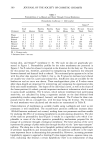
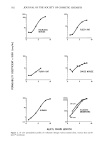
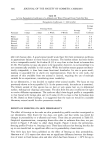
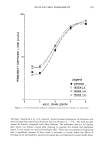
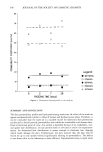
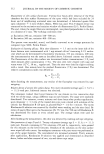
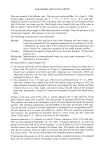
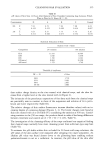
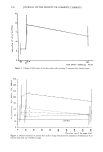
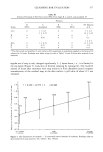
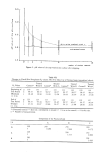
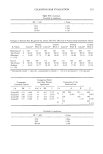
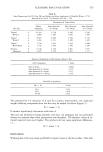
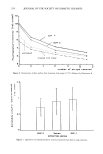
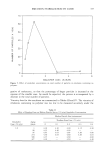
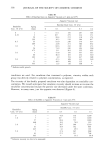
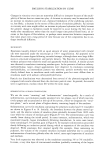
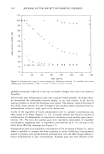
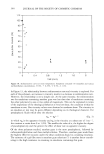
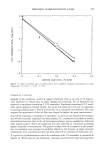
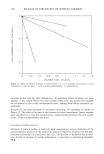
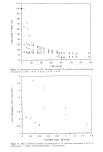
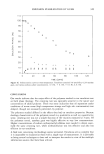
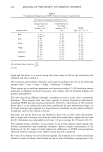
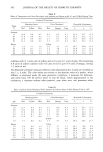
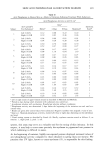
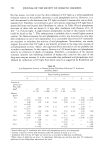
304 JOURNAL OF THE SOCIETY OF COSMETIC CHEMISTS Table III In Vitro Permeability Coefficients of n-Alkanols and Water Through Frozen Nude Rat Skin Permeability Coefficients x 1000 (cm/hr) Average Freezing Times Frozen Average + Permeant 0 Days 2 Days 1 Week 4 Weeks Frozen Unfrozen Water 4.2 4.1 4.2 3.2 3.8 4.0 Methanol 4.4 5.4 6.1 3.8 5.1 4.8 Ethanol 4.2 6.2 5.7 4.1 5.3 4.8 Butanol 14.2 17.8 18.6 15.1 17.2 15.7 Hexanol 47.8 49.0 53.3 46.2 49.5 48.7 Octanol 59.0 67.8 60.1 72.7 66.9 63.0 able with human data. A good animal model would have the three permeation pathways in approximate balance to those found in humans. The hairless mouse has been shown to be a comparable model. Its zr-value (0.32) is very close to that found in human skin (0.30). The hairless rat may also prove to be equivalent however, to our knowledge it is not commercially available in this country. While the hairless mouse appears mechanis- tically comparable, it does have some functional drawbacks. Its size is quite small, making it unsuitable for in situ/in vivo experimentation. Even for in vitro work, the amount of skin available from one animal is limited, requiring the use of multiple animals for an experiment, introducing more variability. In our laboratories, it was decided to explore other animal models. The fuzzy rat was previously shown to be acceptable (4,5). In the present study, the nude rat is examined. The female animal of this species has no hair or very sparse hair on its abdominal surface, making hair clipping unnecessary. The skin from this area is sufficient for eight to twelve diffusion experiments. The nude rat alkyl chain-length profile is comparable to that found with human skin and its q'r-value (0.26) is close to that for human skin (0.30). Based on these findings, it is suggested that the nude rat would be a suitable laboratory animal model for skin permeation studies. EFFECTS OF FREEZING ON SKIN PERMEABILITY The effect of freezing on the nude rat skin permeability profile was also investigated in our laboratories. Skin frozen for two days, one week, and four weeks was tested for changes in permeability to n-alkanols and water. These data are presented in Table III. Graphical representations, comparing frozen skin data to unfrozen skin data, are pre- sented in Figure 3 (P-value vs. alkyl chain length). Figure 4 shows the permeation- freezing profile (P-value vs. freezing time). These data indicate that freezing the skin for up to one month had no significant effect on its permeability characteristics. Very little data have been published on the effect of freezing on skin permeability. Harrison et al. (11) report that there was no significant difference between the absorp- tion of water in fresh human skin and skin which had been frozen at - 20øC for up to
Purchased for the exclusive use of nofirst nolast (unknown)
From: SCC Media Library & Resource Center (library.scconline.org)