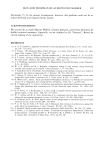
SKIN PERMEABILITY AND WATER LOSS 357 (16) R. L. Bronaugh, R. F. Stewart, E. R. Congdon, and A. L. Giles, Methods for in vitro percutaneous absorption studies. I: Comparison with in vivo results, Toxicol. Appl. Pharmacol., 62, 474-480 (1982). (17) J. W. Bridges, M. R. French, R. L. Smith, and R. T. Williams, The fate of benzoic acid in various species, Blochem. J., 118, 47-51 (1970). (18) R.J. Feldmann and H. I. Maibach, Absorption of some organic compounds through the skin in man,J. Invest. Dermatol., 54, 399-404 (1970). (19) A. Rougier, D. Dupuis, C. Lotte, R. Roguet, and H. Schaefer, In vivo correlation between stratum comeurn reservoir function and percutaneous absorption, J. Invest. Dermatol., 81, 275-278 (1983). (20) D. Dupuis, A. Rougier, R. Roguet, C. Lotte, and G. Kalopissis, In vivo relationship between horny layer reservoir effect and percutaneous absorption in human and rat, J. Invest. Dermatol., 82, 353-356 (1984). (2 l) K. Grice, M. Sattar, M. Sharratt, and H. Baker, Skin temperature and transepidermal water loss, J. Invest. Dermatol., 57, 108- 110 (1971). (22) K. A. Holbrook and G. F. Odland, Regional differences in the thickness (cell layers) of the human stratum corneum: An ultrastructural analysis, J. Invest. Dermatol., 62, 415-222 (1974). (23) M. A. Pathiak and T. B. Fitzpatrick, "The Role of Natural Photoprotective Agents in Human Skin," in Sunlight and Man, T. B. Fitzpatrick, Ed. (University of Tokyo Press, 1974), pp 725-750. (24) G. E. Burch, and N. P. de Pasquale, Hot Climates, Man and His Heart (Thomas, Springfield, Illinois, 1962). (25) A.M. Kligman, The use ofsebum, BritishJ. Dermatol., 75, 307-319 (1983). (26) G. Plewig and R. R. Marples, Regional differences of cell sizes in human stratum comeurn. Part I., J. Invest. Dermatol., 54, 13-18 (1970). (27) R. Marks, S. Nicholls, and C. S. King, Studies on isolated corneocytes, Int. J. Cosmet. Sci, 3, 251-254 (1981). NOTE: Reprint requests to A. Rougier.

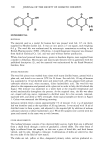
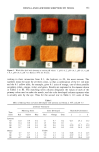
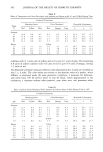
j. Soc. Cosmet. Chem., 37, 359-367 (September/October 1986) The absorption of lawsone and henna by bleached wool felt K. C. JAMES, S. P. SPANOUDI, and T. D. TURNER, Welsh School of Pharmacy, University of Wales Institute of Science and Technology, P.O. Box 13, Cardiff, CF1 3XF, United Kingdom. Received January 24, 1986. Synopsis Bleached wool felt was chosen as a substitute for human hair to avoid complications due to natural pig- ment. Pieces were dyed by immersion in lawsone or henna suspension, and their colors assessed using a Lovibond tintometer and a Hunterlab colorimeter. With lawsone, immersion for 30 minutes was sufficient to dye the wool. The hue and intensity of the color developed did not change significantly when the pH was varied between 3 and 5, in contrast to the electronic spectra of lawsone solutions, in which absorbance decreased progressively with decreasing pH. Below pH 6 the color of the wool varied little with pH and was predominantly red, but above pH 6 the intensity decreased and the yellow component became pre- dominant. At pH 4.5 the intensity of the red component increased with dyeing temperature between 15 and 50øC, and became progressively more predominant. The color developed with henna increased with temperature, and also with time, probably because time was required to extract coloring matter from the plant tissue. In contrast to lawsone, henna gave a color which was predominantly yellow and had a greater blue component over the whole pH range. Both factors were attributed to the chlorophyll content. Sub- stantivity was tested by extracting felts with water and measuring the absorbance of the extract after timed intervals. The extraction rate was unaffected by dyeing time, pH, or temperature. Examination of the extracted wool pieces suggested that a slow reaction occurs on the wool, either producing new compounds which are more substantive than lawsone to wool or changing the mode of attachment, and thereby in- creasing the strength of the interaction. INTRODUCTION The henna plant (Lawsonia inermis L.) contains a red-orange component which is sub- stantive to keratin. Henna has been used as a hair dye since the dawn of history, and is still commonly employed as a conditioner and coloring agent in cosmetic preparations for the hair. The leaves are reduced to a fine powder and mixed with hot water, to form a paste, which is applied to the hair while still hot. Lawsone, 2-hydroxy-1,4-naphtho- quinone (I) is the principal active constituent. No other coloring material has been identified, although the whole leaf is known to behave differently towards the hair from lawsone alone (1). Forestier (1) followed the absorption of lawsone and henna by mea- suring the increase in weight of the hair after treatment. The object of this communica- tion is similar, but examines absorption in terms of the color developed. It was there- fore necessary to use bleached lambs' wool as substrate, rather than human hair, because it has the advantage of being white, with no complicating pigments. 359
Purchased for the exclusive use of nofirst nolast (unknown)
From: SCC Media Library & Resource Center (library.scconline.org)