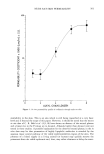
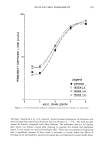
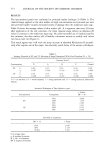
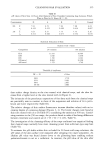
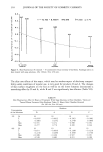
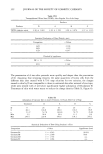
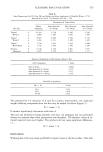
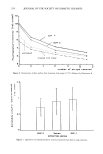
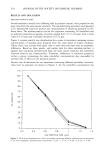
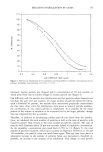
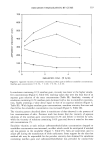
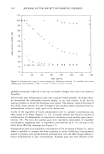
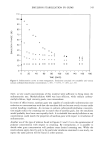
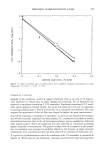
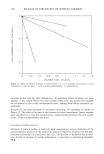
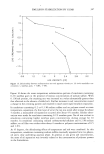
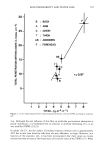
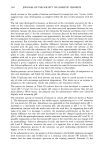
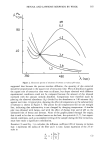
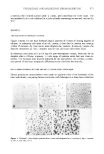
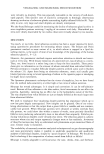
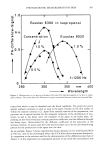
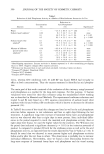
EMULSION STABILIZATION BY GUMS 343 11o '-l- z o -- Ld lOO .• 90- 80- 70- 60- 50- 40- 30- 20- 10- 0 0 ,5 0 + + + o o o + + [] [] [] [] [] [] ,5 O0 o o o ++ + + + DD D D D D D O [] [] I I I I I I I I I I I I I I I I I 20 40 60 80 1 O0 1 20 1 40 1 60 180 TIME (DAYS) Figure 9. Sedimentation curves at room temperature. Emulsions contained 1% emulsifier and various sodium carboxymethylcellulose concentrations. [] 0%, + 0.5%, O 1.0%, A 1.5%. three, as very small concentrations of this material were sufficient to bring down the sedimentation rate. Methylcellulose 4000 was least efficient, while sodium carboxy- methylcellulose, high viscosity grade, was intermediate. In terms of effectiveness, xanthan gum was capable of considerable sedimentation rate reduction at concentrations such that the emulsion did not become overly viscous under normal handling conditions. An increase in sodium carboxymethylcellulose concentra- tion might reduce the creaming rate to match that of xanthan gum, but the emulsions would probably have been unacceptably thick. It is doubtful that methylcellulose at any concentration could match the properties of xanthan gum with respect to retardation of sedimentation. Another use of the type of relation found in Figures 11 and 12 is in the optimization of polymer concentration with respect to creaming. By interpolation, it is possible to decide what gum concentration will produce some desired creaming rate. While the results shown apply directly only to the particular emulsions examined in our study, we expect the same pattern will be found in other systems.

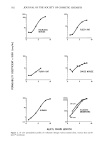
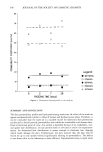
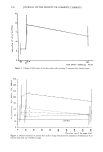
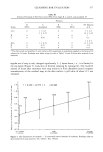
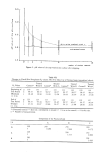
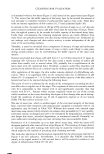
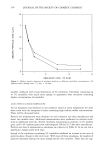
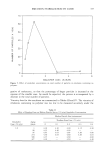
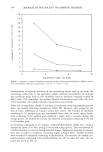
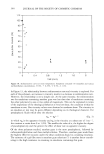
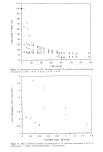
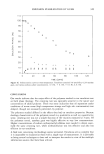
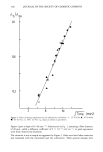
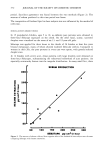
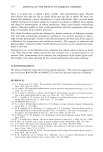
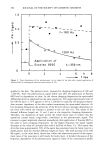
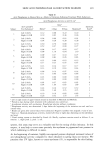
344 JOURNAL OF THE SOCIETY OF COSMETIC CHEMISTS 11o z 100 • 90- 80- 70- 60- 50- 40- 30- 20 10 o + [] _ D [] .. I I I I I I I 1 I I 0 0.4. 0.8 1.2 1.6 2 TIME (DAYS) Figure 10. Sedimentation curves at room temperature. Emulsions contained 1% emulsifier and various methylcellulose concentrations. [] 0%, + 0.25%, O 0.5%, /• 1.0%. In Figure 13, the relationship between sedimentation rate and viscosity is explored. For each of the polymers, an increase in viscosity results in a decrease in sedimentation rate. However, the relationship is not a simple one. At the same viscosity, the sedimentation rate for emulsions containing xanthan gum was less than that of emulsions containing the other polymers by one or two orders of magnitude. This can be explained in terms of the importance of the rheological behavior at very low shear, the condition within the emulsions at rest. Our viscosity values were obtained at moderate shear. The viscosity in an emulsion at rest may be quite different depending on its rheological character. For pseudoplastic fluids which obey the relation q^ = qs n-• (Eq. 3) in which 'q^ is the apparent viscosity and •ls is the viscosity at a shear rate of 1 sec-1, the constant n varies from 0 to 1 (20). The smaller the value of n, the higher the degree of pseudoplasticity and the greater the effect of shear rate on apparent viscosity. Of the three polymers studied, xanthan gum is the most pseudoplastic, followed by carboxymethylcellulose and then methylcellulose. Therefore, xanthan gum would have the highest effective viscosity under the shear conditions found in a standing emulsion. The existence of a gel-like state in xanthan gum solutions (7) is another factor contrib- uting to the high resistance to creaming in emulsions containing this gum.
Purchased for the exclusive use of nofirst nolast (unknown)
From: SCC Media Library & Resource Center (library.scconline.org)