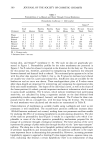
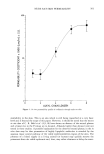
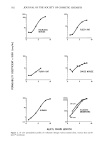
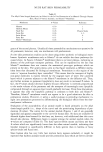
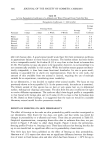
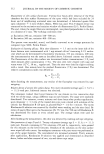
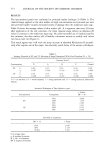
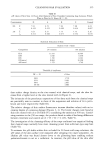
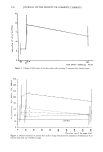
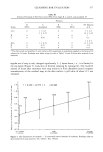
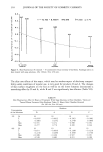
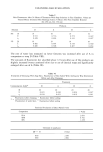
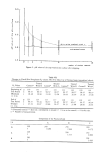
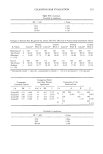
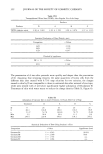
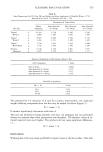
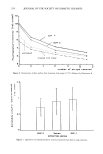
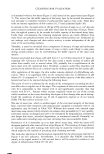
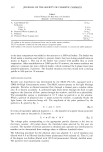
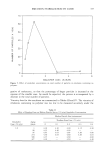
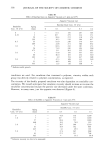
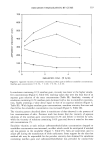
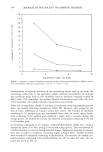
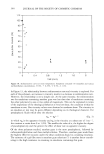
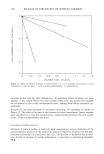
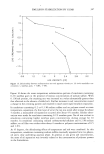
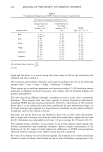
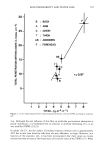
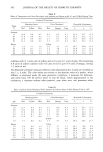
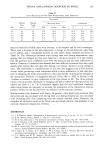
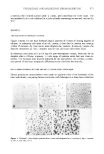
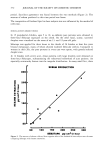
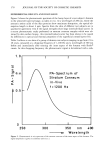
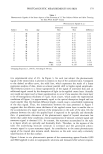
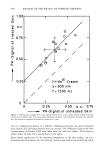
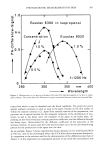
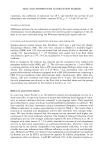
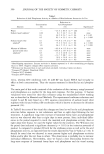
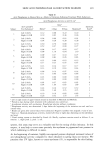
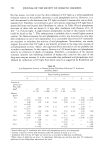
PHOTOACOUSTIC MEASUREMENTS ON SKIN 379 Table I Photoacoustic Signals of the Inner Aspects of the Forearms of 13 Test Subjects Before and After Treating the Skin With Ilrido © Cream Photoacoustic Signals (a.u.) Untreated Treated Subject Sex Age Skin Skin Difference 1 M 28 0.20 0.43 0.23 2 M 26 0.25 0.47 0.22 3 F 24 0.47 0.77 0.30 4 M 26 0.18 0.43 0.25 5 F 26 0.47 0.82 0.35 6 M 24 0.25 0.46 0.21 7 M 27 0.59 0.78 0.19 8 F 25 0.49 0.68 0.19 9 M 27 0.38 0.59 0.21 10 M 25 0.26 0.52 0.26 11 M 26 0.40 0.63 0.23 12 M 24 0.37 0.68 0.31 13 F 25 0.34 0.70 0.36 Mean: 0.358 0.612 0.255 -+ SD: 0. 125 0. 139 0.058 Chopping frequency 1,200 Hz wavelength 300 nm. tive experimental error of 4%. In Figure 3, for each test subject the photoacoustic signal of the treated skin is plotted in relation to that of the untreated skin. Compared to the dashed no-effect-curve, the solid line, which represents the result of a linear regression analysis of data, shows an almost parallel shift to higher signal amplitudes. This behavior points to a linear superposition of the signal of untreated skin and an additional signal caused by the absorption of light in the applied cream layer. Actually one would not expect such a linear superposition to occur if one assumes the cream layer to be of homogeneous thickness of 3 •m. Such a layer, which under the experimental conditions of Figure 3 is approximately equal to the optical absorption length and not much smaller than the thermal diffusion length, would cause a considerable weakening of the skin signal. Thus, the interrelation between the data presented in Figure 3 suggests that the effective mean thickness of the applied cream layer is smaller due to the accumulation of a larger portion of the preparation in the sulci of the skin. On the plateaus between the sulci the applied layer is expected to be optically and thermally thin. A quantitative discussion of the photoacoustic signal of layered structures has shown that under these conditions a linear superposition of stratum corneum signal and sunscreen signal is obtained (11). In contrast, the sunscreen accumulated in the sulci is in layers which are optically and thermally thick. Therefore, in the regions of the sulci the underlying stratum corneum is screened and the generated photo- acoustic signal is a pure sunscreen signal. Its contribution to the mean photoacoustic signal of the treated skin remains small, however, as the sulci cover only a relatively small fraction of the skin surface. Figure 4 shows in vivo photoacoustic spectra of the sunscreening agents Eusolex 6300 and 8020 applied to skin in isopropanolic solutions and measured after solvent evapora-

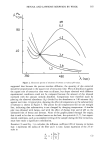
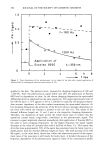
380 JOURNAL OF THE SOCIETY OF COSMETIC CHEMISTS 1.00 O.U. 0.75 0.50 ! I o o 0.25 o/ IJrido © Creom 300 n rn 1200 Hz I I 0.25 0.50 o.u. 0.75 = PA-Signo[ of untreoted Skin Figure 3. Photoacoustic signals of the inner aspects of forearms of 13 test subjects before and after treating the skin with Ilrido © cream. The mean signal amplitudes obtained with treated and untreated skin together with the respective standard deviations are marked by a cross. tion at a chopping frequency of 1,200 Hz. Differences between the spectra obtained with treated and untreated forearm skin are plotted. The differential spectra for both concentrations of Eusolex 6300 were taken from the same test subject. They show an almost linear increase with concentration of the agent. After topical application of the sunscreen preparation to the skin surface, the sun- screening agent penetrates into the stratum corneum and reaches the underlying viable
Purchased for the exclusive use of nofirst nolast (unknown)
From: SCC Media Library & Resource Center (library.scconline.org)