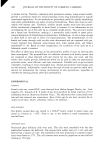
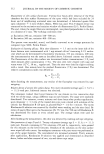
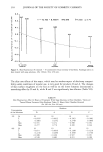
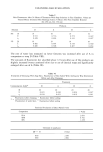
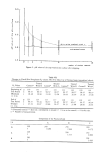
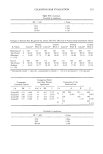
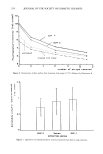
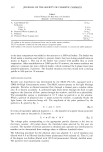
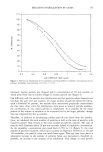
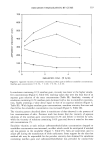
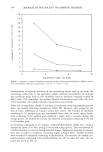
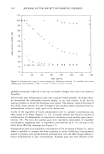
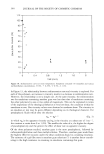
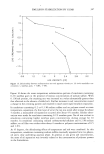
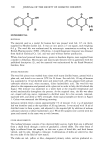
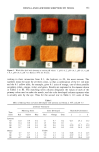
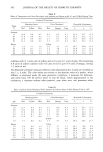
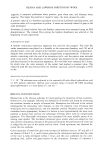
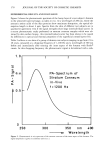
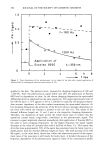
EMULSION STABILIZATION BY GUMS 341 Changes in viscosity over time are somewhat difficult to interpret because of the multi- plicity of factors that can come into play. A decrease in viscosity may be associated with an increase in emulsion particle size, chemical breakdown of the stabilizing polymer, or, less likely, a decrease in the extent of flocculation of emulsion globules. An increase in viscosity with time might reflect an increase in polymer hydration (not likely because the greatest change in hydration would be expected to occur during the first days or weeks after manufacture rather than the much longer time period found here), an in- crease in the degree of flocculation, or perhaps some interaction between components that takes place over a long period of time because one of the components has to un- dergo interfacial diffusion. MICROSCOPY Emulsions (usually diluted with an equal amount of water presaturated with mineral oil) were examined under the microscope at 150 x magnification. All appeared to be flocculated to some degree following extended storage, although there were large differ- ences in structural arrangement and particle density. The floccules in emulsions made without polymer were relatively small and apparently weakly bonded. A similar picture was observed in emulsions containing xanthan gum. In the presence of sodium carboxy- methylcellulose, larger, denser agglomerates were observed. In emulsions containing methylcellulose, an intermediate pattern was observed particle networks were more clearly defined than in emulsions made with xanthan gum but more diffuse than in emulsions made with sodium carboxymethylcellulose. Particle size distributions were determined from several of the photomicrographs and compared with results obtained from the electronic particle sizer. In general, the results were in agreement median values fell within the same range. SEDIMENTATION AT ROOM TEMPERATURE We use the terms "creaming" and "sedimentation" interchangeably. As a result of sedimentation, our emulsions usually separated into two phases, one of which was rela- tively opaque and accumulated at the top of the system, which we designate the "emul- sion phase," and a second phase of higher density consisting largely of the medium. Sedimentation curves for emulsions containing the polymers studied and 1% emulsifier are shown in Figures 8 to 10. Initially, the boundary between the phases moved up- ward, and the relative volume of emulsion phase gradually decreased from 100% with time while the volume of medium grew (Figures 8-10). The sedimentation curve was usually linear during the initial period. In many instances, sedimentation, which was monitored visually, began immediately following manufacture. In some cases (emul- sions containing 0.3% xanthan gum in Figure 8, for example) sedimentation proceeded slowly following an induction period during which no separation of the emulsion was observed. With emulsions that creamed rapidly (for example, those containing no polymer), the volume of the creamed emulsion increased somewhat due to continued sedimentation of emulsion globules after the initial, more rapid separation of emulsion and medium. Very little separation was observed in the emulsions containing 3% or 5% emulsifier. In some, a very thin layer of concentrated emulsion (probably consisting of the largest

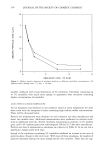
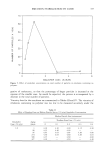
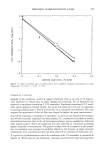
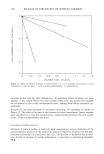
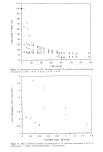
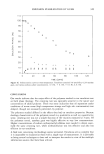
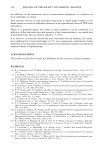
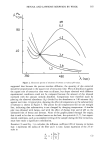
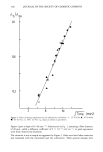
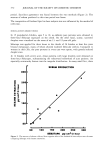
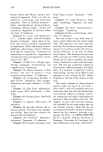
342 JOURNAL OF THE SOCIETY OF COSMETIC CHEMISTS 11o T Q_ Z o -- 100 -f 90- 80- 70- 60- 50- 4-0- 30- 20- 10- • X X A X O A ,", A o ,o o o o o o o + ++ [] ODD DO 0 o o o o o o ++ + + + ooo [] [] a a a a •l •l •l a 0 20 40 60 80 100 120 140 TIME (DAYS) Figure 8. Sedimentation curves at room temperature. Emulsions contained 1% emulsifier and various xanthan gum concentrations. [] 0%, + 0.1%, • 0.2%, /• 0.3%, X 0.4%. globules) eventually collected at the top no further changes with time were observed thereafter. Initial steady state sedimentation rates were computed where possible. To obtain these, we determined the relationship between height, in cm, and volume, in ml, for the mixing cylinders in which the emulsions were stored. The absolute value of the slope of the initial, linear portion of a plot of height of the emulsion phase (calculated from the sedimentation curves) rs. time, gave us the desired rate. A plot of the logarithm of initial sedimentation rate rs. polymer concentration was often found to be linear (Figures 11, 12). A similar relation was found in studies of sedimentation of sulfamerazine in suspensions containing several xanthan gum concen- trations (19). The rates for xanthan gum were essentially independent of emulsifier concentration, suggesting that, at emulsifier concentrations up to 1%, the gum is the major factor affecting creaming rate (Figure 11). Sedimentation rates at an emulsifier concentration of 1% are shown in Figure 12, which makes it possible to compare the three polymers in terms of efficiency (concentration needed to produce some predetermined sedimentation rate) and effectiveness (ability to reduce sedimentation at any concentration). Xanthan gum was most efficient of the
Purchased for the exclusive use of nofirst nolast (unknown)
From: SCC Media Library & Resource Center (library.scconline.org)