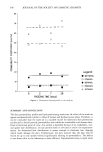
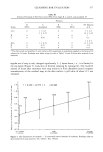
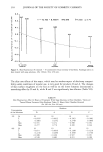
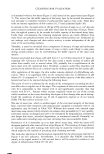
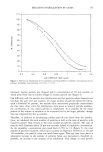
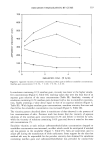
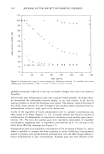
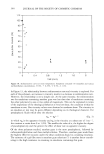
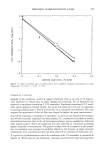
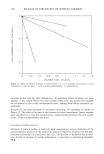
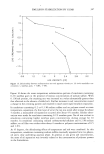
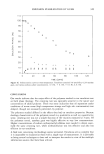
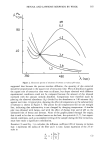
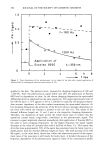
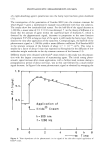
EMULSION STABILIZATION BY GUMS 349 lOO 90 80- 70- 50- 40 3o 2o Io + + + + + + + + 20 40 60 80 1 O0 120 TIME (DAYS) Figure 16. Sedimentation curves at room temperature. Emulsions contained 1% emulsifier, 0.2% xanthan gum, and various sodium sulfate concentrations. [] 0 M, + 0.1 M, O 0.2 M, /• 0.3 M. CONCLUSIONS Our results indicate that the major effect of the polymers studied in our emulsions was on bulk phase rheology. The creaming rate was especially sensitive to the nature and concentration of added polymer. There was some indication that oil separation under conditions of severe stress (high temperature storage and high salt concentration) was delayed, though not necessarily prevented, by polymer. The polymers studied differed in the effects they had on emulsion properties. Because rheology characteristics of the polymers varied in a qualitative as well as a quantitative sense, creaming rate was not a simple function of the viscosity measured at 3 rpm. Of the polymers tested, xanthan gum was highly effective at very low concentrations. Higher concentrations of sodium carboxymethylcellulose were needed to obtain essen- tially the same creaming rate, while methylcellulose was less effective and also less efficient in our emulsions. A final note concerning methodology seems warranted. Emulsions are so complex that it is impossible to characterize them with a single type of measurement. It is advisable to bring several techniques to bear and to interpret the results in view of the multiple information sources that have been utilized.

350 JOURNAL OF THE SOCIETY OF COSMETIC CHEMISTS ACKNOWLEDGEMENT The authors thank the Kelco Division, Merck and Company, Inc., for supporting this project, and Ortho Pharmaceutical Corporation for use of instrumentation. REFERENCES (1) T. W. Schwartz, Emulsions with hydrocolloids, Amer. Perrum. Cosmet., 77, 85-92 (1962). (2) P. Kovacs and B. Titlow, Stabilizing cottage cheese creaming emulsions with a xanthan gum blend, Amer. Dairy Review, 34J-34N (April 1976). (3) J. A. Serralach and G. Jones, Formation of films at liquid-liquid interfaces, Ind. Eng. Chem., 23, 1016-1023 (1931). (4) J. A. Serralach and R. J. Owen, Strength of emulsifier films at liquid-liquid interfaces, ibid., 25, 816-821 (1933). (5) T. F. Tadros and B. Vincent, "Emulsion Stability," in Encyclopedia of Emulsion Technology, P. Becher, Ed. (Marcel Dekker, Inc., New York, 1983), Vol. 1, pp 129-286. (6) A. Jeanes, J. E., Pittsley, and F. R. Senti, Polysaccharide B-1459: A new hydrocolloid polyelectro- lyre produced from glucose by bacterial fermentation, Appl. Polymer, Sci., 5, 519-526 (1961). (7) J. L. Zatz and S. Knapp, Viscosity of xanthan gum solutions at low shear rates, J. Pharm. Sci., 73, 468-471 (1984). (8) M. Milas and M. Rinando, Conformational investigation on the bacterial polysaccharide xanthan, Carbohyd. Res., 76, 189-196 (1979). (9) G. Holzwarth, Conformation of the extracellular polysaccharide of Xanthomonas campestris, Biochem. 15, 4333-4339 (1976). (10) P. J. Whitcomb., B. J. Ek, and C. W. Macosko, Am. Chem. Soc. Symp. Set., 45, 160-173 (1977). (11) E. R. Morris, "Molecular Origin of Xanthan Solution Properties," in Extracellular Microbial Polysac- charides, P. A. Sanford and A. Laskin, Eds. (ACS, Washington D.C., 1977), pp 81-89. (12) Xanthan Gum/Keltrol/Kelzan, 2nd ed. (Kelco Div. of Merck Co., Inc., 1976). (13) J. S. Tempio and J. L. Zatz, Interaction of xanthan gum with suspended solids, J. Pharm. Sci., 70, 554-558 (1981). (14) P. Becher, Emulsions: Theory and Practice, 2nd ed. (ACS Monograph Series, Reinhold Publishing Corp., New York, 1966), pp 267-325. (15) D. Fairhurst, M.P. Aronson, M. L. Gum, and E. D. Goddard, Some comments on non-ionic sur- factant concentration effects in oil-in-water emulsions, Colloids and Surfaces, 7, 153-159 (1983). (16) F. R. Dintzis, G. E. Babcock, and R. Tobin, Studies on dilute solutions and dispersions of the polysaccharide from Xanthomonas campestris NRRLB- 1459, Carbohyd. Res., 13, 257- 267 (1970). (17) Cellulose Gums.' Chemical and Physical Properties (Hercules Incorporated, 1980). (18) Handbook on Methocel.' Cellulose Ether Products (Dow Chemical Company, 1978). (19) J. L. Zatz and C. Yarus, Stabilization of sulfamerazine suspension by xanthan gum, Pharm. Res., 3, 118-121 (1986). (20) J. R. Van Wazer, J. W. Lyons, K. Y. Kim, and R. E. Colwell, Viscosity and Flow Measurement, (Interscience, a Div. of John Wiley & Sons, Inc., New York, 1966), p 15. (21) T. Mitsui, Y. Machida, and F. Harusawa, An application of the phase-inversion temperature method to the emulsification of cosmetics. I. Factors affecting the phase-inversion temperature, Bull. Chem. $oc. of Japan, 43, 3044-3048 (1970). (22) W. C. Liao and J. L. Zatz, Effect of added salts on flocculation of local anesthetic suspensions con- taining nonionic surfactants, J. Soc. Cosmet. Chem., 31, 123-131 (1980).
Purchased for the exclusive use of nofirst nolast (unknown)
From: SCC Media Library & Resource Center (library.scconline.org)