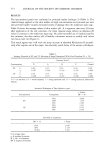
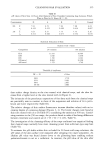
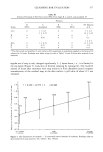
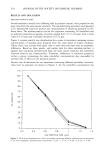
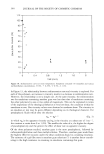
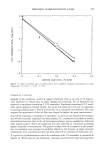
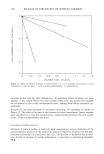
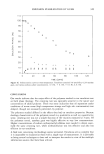
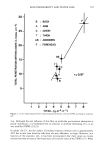
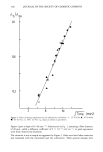
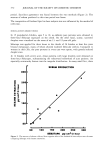
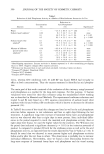
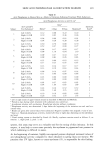
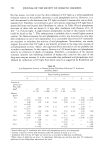
J. Soc. Cosmet. Chem., 37, 351-357 (September/October 1986) In vivo relationship between percutaneous absorption and transepidermal water loss according to anatomic site in man DIDIER DUPUIS, ANDRI• ROUGIER, CLAIRE LOTTE, DONALD R. WILSON, and HOWARD I. MAIBACH, Ddpartement de Bio/ogie, Laboratoires de Recherche Fondamenta/e de L'Oreal, 1 avenue Eugbne Schue//er, 93600 Au/nay sous bois, France (D. D., A.R., C.L. ), and Department of Dermato/ogy, University of California, San Francisco, San Francisco, CA 94143 (D.R.W, H.I.M.). Received May 2 7, 1986. Synopsis The relation between transepidermal water loss (TEWL) and percutaneous absorption of benzoic acid has been studied as a function of anatomic location in vivo in man. The results suggest a possible linear relation (r = 0.97, p 0.001) between the two parameters. This confirms the importance of anatomic site on the degree of permeability of the cutaneous barrier and the value of measurements of TEWL and penetration in the evaluation of its functional state. INTRODUCTION In its role as a barrier, the skin participates in homeostasis by limiting 1): water loss (1,2), and 2): percutaneous absorption of environmental agents (3,4). The stratum corneum's role of a double barrier is intimately linked to its degree of hydration (5,6), transport mechanisms being diffusional (3,7). In man (8,9) and in animals (10), an increase in water permeability of the skin corresponds to an increase in permeability to topically applied compounds. However, most of the studies dealing with this topic are only qualitative observations and the relationship linking these two parameters is unknown. At present, TEWL can be considered a parameter indicative of the functional state of the cutaneous barrier (11, 12, 13). Among the factors modifying the in vivo percutaneous absorption of a compound, anatomic site is of particular importance (14, 15). The present study attempts to establish the relationship between TEWL and penetra- tion, as a function of anatomic site in man. 351

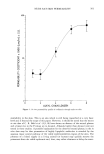
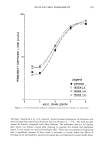
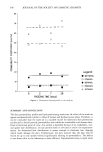
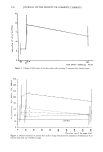
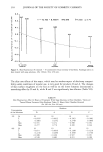
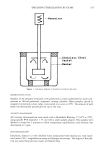
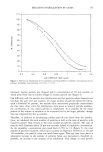
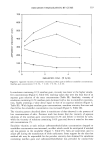
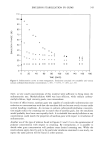
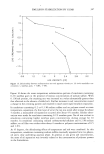
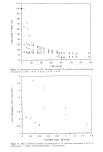
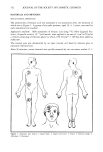
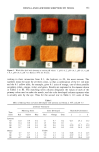
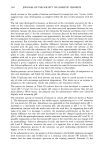
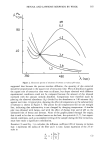
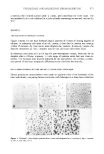
352 JOURNAL OF THE SOCIETY OF COSMETIC CHEMISTS MATERIALS AND METHODS PERCUTANEOUS ABSORPTION The penetration of benzoic acid was measured at six anatomical sites, the locations of which are in Figure 1. A group of six male patients, aged 34 --- 2 years, was used for each anatomical site studied. Application conditions. 1000 nanomoles of benzoic acid (ring •4C) (New England Nu- clear), of specific activity 10 -3 •Ci/nmole, were applied to an area of 1 cm 2 in 20 •1 of a vehicle consisting of ethylene glycol to which 10% Triton © x 100 had been added as surfactant. The treated area was demarcated by an open circular cell fixed by silicone glue to minimize chemical loss. After 30 minutes, excess chemical was quickly removed by two successive washes (2 X Figure 1. Anatomic sites tested. 1: Upper back. 2: Upper outer arm. 3: Chest. 4: Anterior thigh. 5: Abdomen. 6: Forehead.
Purchased for the exclusive use of nofirst nolast (unknown)
From: SCC Media Library & Resource Center (library.scconline.org)