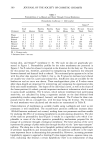
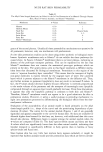
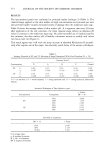
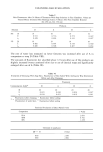
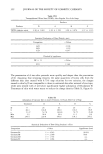
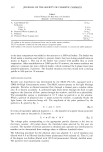
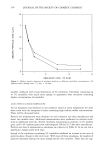
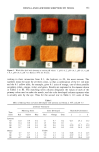
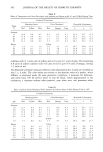
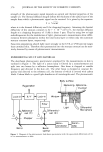
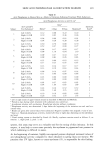
HENNA AND LAWSONE SORPTION BY WOOL 363 negative b measures yellowness when positive, gray when zero, and blueness when negative. The larger the positive or negative value, the more intense the color. A positive value of a is therefore equivalent to red in the Lovibond matching series, and a positive value of b is equivalent to yellow. L values are inversely related to gray in the color developed. Absorbances of colored solutions from the Soxhlet extractions were measured using an EEL absorptiometer. The colored filter giving the highest absorbance was selected at the beginning of each experiment. SUBSTANTIVITY TESTS A Soxhlet continuous extraction apparatus was used for this purpose. The wool felt under examination was placed in a thimble in the extraction chamber, and 150 ml of distilled water, twice the volume of the thimble, poured into the boiling compartment. Samples were removed from the boiling compartment at approximately 15-minute in- tervals, coinciding with the end of an extraction cycle, and the precise time recorded with a stop watch. The absorbance of each sample was measured on the absorptiometer and then returned to the extraction apparatus. All wool felts were extracted for 2 hours, by which time the color intensity of the extract had reached a constant value. The extracted wool felt was removed from the thimble, squeezed, and left overnight at 50øC to dry. INFLUENCE OF pH ON ELECTRONIC SPECTRA 5 X 10 -5 M solutions were adjusted to the required pH with dilute hydrochloric acid or 10% sodium carbonate. Spectra were scanned using a Unicam SP 1800 recording spectrophotometer at a scan speed of 2 nm sec-• RESULTS AND DISCUSSION Human hair is the obvious substrate for investigating the properties of hair cosmetics. Forestier (1), for example, followed the absorption of lawsone and henna by measuring the resultant increase in weight of human hair. Absorption was followed in the current investigation by measuring color changes, so that the inherent color of human hair would give rise to complications, and was therefore avoided. Bleached lambs' wool was considered more appropriate, because it is known to have approximately the same com- position as human hair and has the advantage of being white with no complicating pigments. The Hunterlab colorimeter was considered the more reliable means of as- sessing color uptake. The Lovibond tintometer gives results which are subjective, but was used for comparison, because in the practical situation the performance of a hair dye is judged by the eyes of the stylist and his client. Good agreement was obtained be- tween the two methods. Color intensities of wool felts dyed with lawsone for different times at 30 ø and pH 4.5 are shown in Table I. L, a, and b values given by the colorimeter indicate that the color of the wool is fully developed within 1 hour, and this was confirmed by the corre- sponding (red, yellow and gray) results on the tintometer. Forestier (1) observed a

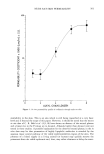
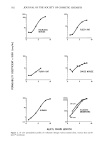
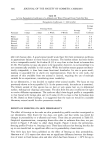
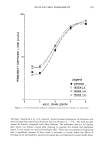
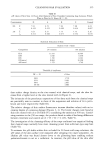
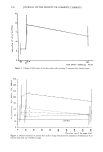
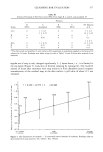
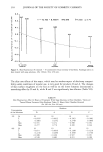
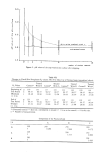
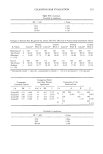
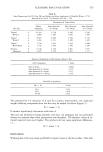
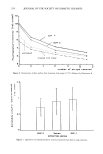
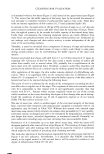
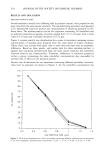
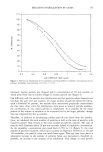
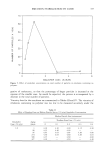
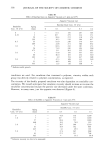
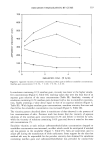
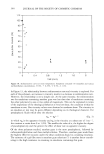
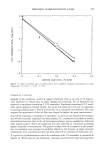
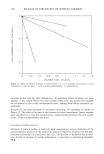
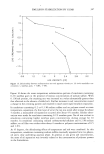
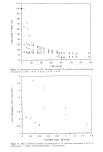
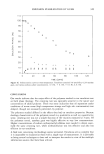
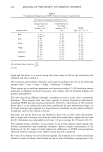
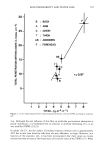
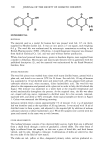
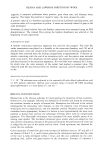
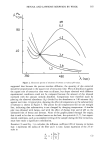
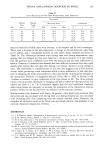
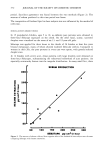
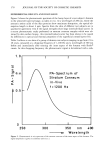
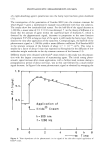
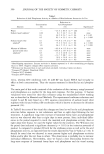
364 JOURNAL OF THE SOCIETY OF COSMETIC CHEMISTS steady increase in the uptake of lawsone and henna by human hair over 7 hours, which suggests that color development is complete before the hair is fully saturated with the dye. The red color developed by lawsone, as detected on the tintometer and given by the a value on the colorimeter, remained constant with changing dyeing time. The corre- sponding values for henna were lower, but there was good agreement between the two methods, because the mean ratios of the intensities for lawsone and henna were 2.0 for the tintometer and 2.3 for the colorimeter. A feature detected by both instruments was that while the yellow component was approximately the same for lawsone and henna, the red component for lawsone was greater than the yellow, while with henna the order was reversed. Put in another way, the overall color for lawsone was orange-red, and that for henna was orange-yellow. Another difference, between both methods and dyes, occurred with the gray tints. Henna showed a tenfold increase over lawsone on the tintometer, but with the colorimeter, the L values were approximately the same. Chlo- rophyll, which is known to be a constituent of henna (3,5), is probably the cause. Being green in color, chlorophyll would contribute to both yellow and blue, which would combine with red to give a high gray value on the tintometer, thereby making the yellow predominant in the color developed. In contrast, the green of the chlorophyll, because it gives a negative a value, reduced the red (a) component of the colorimeter, but did not influence L or b, which were virtually the same for lawsone and henna. Cox (3) attributed the green hue of hair dyed with henna to chlorophyll. Similar patterns can be detected in Table II, which shows the effect of temperature on the color developed, and Table III, which gives the influence of pH. Table II indicates that with both lawsone and henna, there is a small increase in inten- sity of color with increasing application temperature. This shows up as an increase in grayness in the colorimetric results and redness in the tintometer results. The results for lawsone in Table III indicate that the color developed is constant be- tween pH 3.0 and 5.0, but at higher pH values it becomes less intense (less red and more yellow). With henna, the grayness and the predominant yellow note diminish slightly with increasing pH. The electronic spectra of solutions of lawsone at various pH values are shown in Figure 2. The absorption maximum in the visible region, representing an n -• q-r* transition (6), was located at 454 nm. Absorbance was negligible at this wavelength below pH 3, increased to a maximum with increasing pH, and plateaued at pH 5 to 10. These observations contrast with the results seen with the wool felts, by suggesting that a pH value of at least 5 is necessary to achieve the maximum performance on the hair. A further difference was that the color developed on the felt changed significantly above pH 6, while the spectrophotometer results remained constant between pH 5 and 10. A possible explanation is that the internal pH value of the wool fiber does not change with its surroundings. Selective absorption of acids and bases by wool is minimal between pH 4 and 8. However, whatever the cause, it is apparent that, at least in the present situation, absorption spectra of dye solutions can give misleading information with respect to the in situ situation. In the substantivity tests, the quantity of dye released in the Soxhlet apparatus increased with extraction time and levelled out at a limiting value around 140 minutes. The extract had the same electronic spectrum as the starting material. Forestier (1) has
Purchased for the exclusive use of nofirst nolast (unknown)
From: SCC Media Library & Resource Center (library.scconline.org)