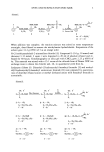
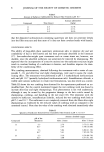
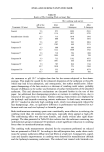
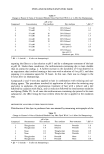
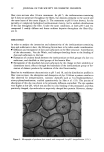
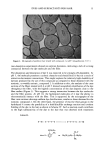
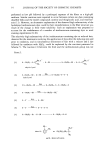
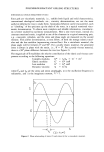
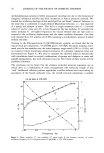
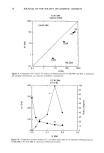
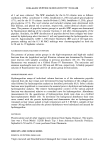
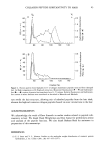
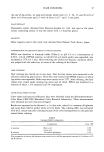
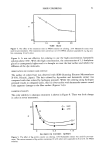
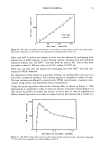
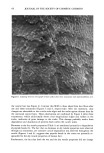
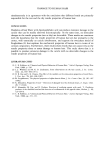
POLYMER/SURFACTANT GELLING STRUCTURES 21 RHEOLOGICAL CHARACTERIZATION OF GELS Since gels are viscoelastic materials, i.e., exhibit both liquid and solid characteristics, conventional rheological methods, viz., viscosity determinations, are not the most useful or informative way to study them. Anomalous behavior can be encountered, such as "climbing" of the specimen up the shaft of the rotor, in a typical rotational visco- metric determination. To obtain more complete and reliable information, viscoelastic- ity is better studied by oscillatory measurements. Here a sine wave strain, instead of a constant rotational strain, is applied to one of the elements in a typical measuring pair, e.g., concentric cylinders, and the stress and phase angle are measured on the second element. This allows determination, as seen below, of both the storage (elastic) mod- ulus and the loss modulus (representing viscous flow). For a viscoelastic material, the phase angle will be between 0 ø and 90 ø. For a purely elastic material, the generated stress is always in phase with the strain, i.e., 8 = 0 ø. For a purely viscous material, there is a 90 ø phase difference between the two (see Figure 2). The magnitude of 8 establishes the relative contribution of the elastic and viscous com- ponents according to the following equations: Complex modulus G* = 'ro/'y o = G'+ iG" Elastic modulus G' = G* cos8 Loss modulus G" = G* sin8 Dynamic viscosity qq = G'%o where I•o and •o are the stress and strain amplitudes, •o is the oscillation frequency in radians/sec, and i is the imaginary constant, :k/-•. t, (a= Figure 2. Phase relationship of stress (% and strain 0/) for a viscoelastic material.

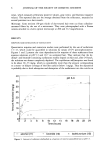
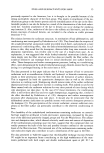
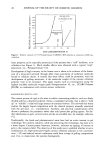
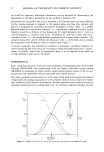
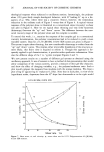
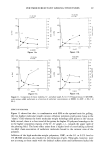
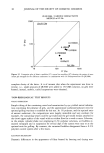
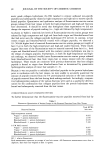
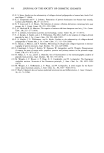
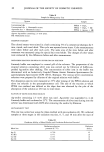
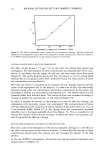
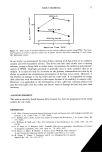
22 JOURNAL OF THE SOCIETY OF COSMETIC CHEMISTS As would be expected, additional information can be obtained by determining the dependence of the above parameters on the oscillatory frequency (8). Intuitively one can predict that as to is increased it will become more and more difficult for the viscous element to respond to the applied strain and that this element will present a progressively increasing mechanical impedance to flow. Thus, in a simple Maxwell model for a viscoelastic material, i.e., a spring and a dash-pot in series, typical behavior would be as follows: at low frequencies G" could dominate over G', but at a critical frequency a crossover will occur. Ultimately G" will fall toward zero as G' continues to rise, i.e., the model behaves progressively as a purely elastic element. The crossover point of G' and G" defines the relaxation time, tr, of the body and is actually the reciprocal of the frequency value at crossover (see Figure 3). A second, somewhat less informative, method to investigate viscoelastic behavior in- volves measuring the stress decay of a viscoelastic body after application of an "instant" strain. In general, some kind of exponential decay is to be expected from which an average relaxation time can be calculated. EXPERIMENTAL First, using data trends of work previously published on Polyquaternium-10 [UCARE Polymer JR400)/SDS, but substituting with the higher molecular weight analog (JR30M)], we examined the high viscosity range preprecipitation region of the hi-com- ponent pair and established that gel structures were indeed formed. We chose a polymer concentration of 1% for most of the work and prepared the desired compositions by mixing equal parts of a 2% polymer solution with a solution of surfac- rant double the final desired concentration. Another qualitative test involved a study of foaming characteristics by a simple shake test. To introduce sufficient fluidity into the 1.0 1.0 q'l •q 0.$ -2 0 2 Ioq {•t r } G"/G Figure 3. Graphs of'q'/'q, G'/G, and G"/G versus log (LOt r) based on the Maxwell model.
Purchased for the exclusive use of nofirst nolast (unknown)
From: SCC Media Library & Resource Center (library.scconline.org)