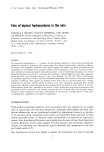
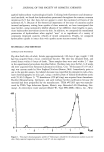
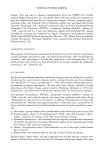
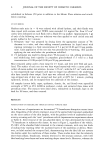
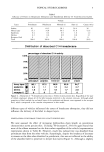
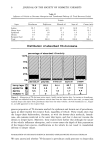
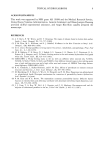
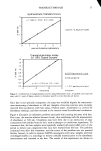
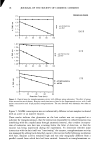
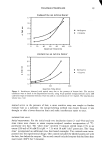
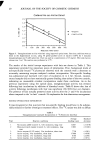
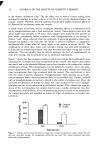
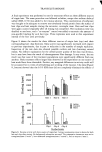
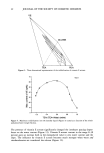
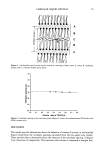
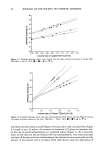
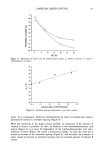
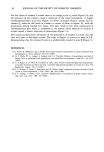
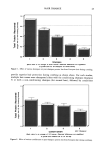
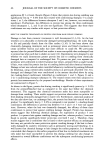
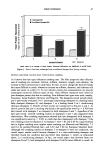
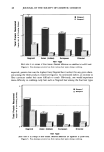
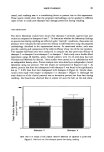
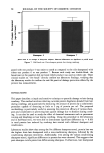
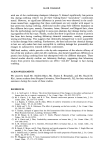
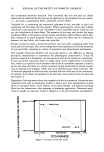
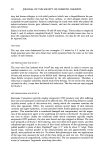
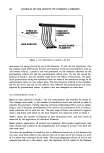
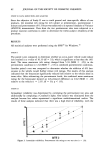
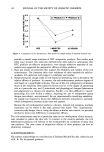
LAMELLAR LIQUID CRYSTAL 37 70- 50- 40 30 20 10 0 -10 -20 -30 VE (%) Figure 13. Penetration of solvent into the lameliar liquid crystal. [•, Water as solvent O, water q- triethanolamine as solvent. 40- 39.• 38 • 37 • 36-' 35 ] 34 ' 33 • 32 • 30 • 0.0 011 012 013 0'.4 0.5 Volume ratio of VE/(TENOLA) Figure 14. Interlayer spacing extrapolated to zero water content. water. As a consequence, replacing triethanolamine by water in extremum also causes a pronounced increase in interlayer spacing (Figure 8). With the conditions in the liquid crystal clarified, an evaluation of the location of vitamin E acetate is possible. At first, its location in the triethanolamine/oleic acid system (Figure 9) is in layer B independent of the triethanolamine/oleic acid ratio. Addition of water (Figure 10) caused a pronounced change. At first the water per se caused an increase of the interlayer spacing (Figure 8), and secondly, the presence of water caused an increase of interlayer spacing with an increased amount of vitamin E acetate.

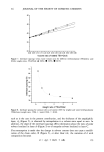
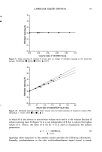
38 JOURNAL OF THE SOCIETY OF COSMETIC CHEMISTS For low values of vitamin E acetate there is no change in the d o value (Figure 10), but the presence of the vitamin causes a reduction of the water penetration. A higher triethanolamine/oleic acid ratio (Figure 11) allows increased vitamin content and in- creased d o value for the levels of vitamin in excess of those in Figure 10, with the penetration having reached low values. The later trend is even more pronounced if triethanolamine plus water is considered as the solvent. Now addition of vitamin E acetate caused a drastic reduction of penetration (Figure 13). The results actually allow calculation of the penetration of vitamin E acetate into the oleic acid layer in the liquid crystal. The slope in Figure 14 gives an ot value of 0.8, demonstrating that the vitamin E acetate is preferentially located in zone B (Figure 5). REFERENCES (1) J. Fuchs, R. Mehlhom, and L. Packer, Free radical reduction mechanisms in mouse epidermis skin homogenates, J. Invest. Dermatol., 93, 633 (1989). (2) H. S. Black, W. A. Lenger, J. Gerguis, and J. I. Thornby, Relation of antioxidants and level of dietary lipid to epidermal lipid peroxidation and ultraviolet carcinogenesis, Cancer Res., 45, 6254 (1985). (3) V. E. Kagan, E. H. Witt, R. Goldman, G. Seita, and L. Packer, Ultraviolet light induced generation of vitamin E radicals and their recycling. A possible photosensitizing effect of vitamin E in skin, Free RadicalRes. Commu., 16, 51 (1992). (4) S. E. Friberg, P. Liang, F. Lockwood, and M. Tadros, Single compound forming a lyotropic liquid crystal at room temperature, J. Phys. Chem., 88, 1045 (1984). (5) S. E. Friberg, C. Solans, and L. Gan-Zuo, Solubilization in non-aqueous lyotropic liquid crystals, Mol. Cryst. Liq. Cryst., 109, 159 (1984).
Purchased for the exclusive use of nofirst nolast (unknown)
From: SCC Media Library & Resource Center (library.scconline.org)