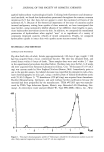
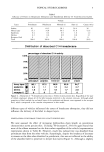
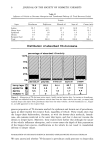
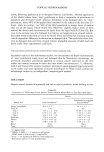
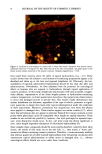
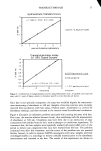
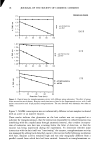
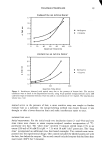
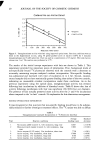
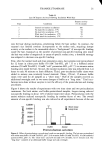
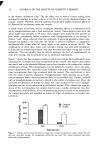
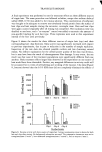
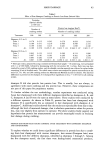
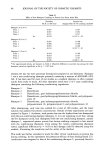
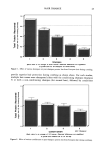
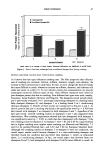
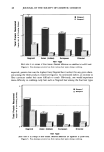
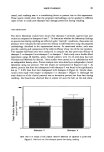
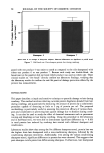
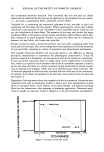
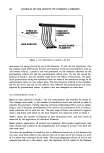
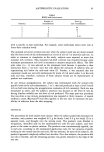
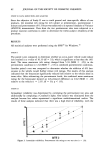
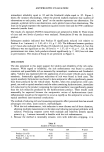
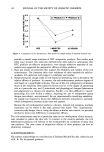
ANTIPRURITIC EVALUATION 63 intrasubject reliability equal to .92 and the Cronbach's alpha equal to .95. Figure 3 shows the intrasite relationships, where the plotted markers represent that number of observations at each point each "petal" on the marker represents one observation. For example, a plotted circle is one observation, and a plotted cross is four observations. The lines on the graph represent the regression equation (center line) and the 95 % confidence intervals (outside lines). The results of a repeated ANOVA measurements are presented in Table II. Three levels of time and two levels of product were analyzed. Formulation B was the benzocaine product. Subsequent analysis indicated that Product B significantly reduced itch relative to Product A at 1 minute (t = 2.41 df = 41 p .02). The difference between products at 0.5 hours also indicated that Product B reduced itch more than Product A, but this difference was not significant at the .05 level (t = 1.57 df = 41 p . 12). At both posttreatment test times, both products showed significantly (p .001) less itch than at pretreatment. The results of Study II are presented in Figure 4. DISCUSSION The data presented in this paper support the validity and reliability of the itch esthe- siometer. With regard to reliability, the itch esthesiometer was found to produce consistent and quantifiable itch as measured by intrasubject correlation and Cronbach's alpha. Validity was examined after the application of oil-in-water vehicles and a topical anesthetic. Statistically significant reductions of itch were found in both cases. The topical anesthetic formulation was found to have antipruritic effects significantly greater than those produced by the vehicle alone. Further, when two antipruritics were com- pared, one with a topical anesthetic and the other containing hydrocortisone, immediate itch reduction by the product containing the topical anesthetic was significantly greater than the itch reduction produced by the hydrocortisone product. These results could reasonably be expected because the antipruritic action of hydrocortisone (anti- inflammatory) would not be expected to occur as rapidly as the antipruritic action of a topical anesthetic (anti-neuronal conduction). The method of inducing itch and measuring antipruritic effect presented here has several advantages over other, more invasive, methodologies: 1. With the itch esthesiometer, itch induction is more discrete and of short duration, allowing multiple measurements to be taken and reducing perceptual problems with subjects. Producing response curves with multiple and relatively densely spaced points (e.g., 1-minute intervals) is feasible with the itch esthesiometer. 2. Because the method is minimally invasive, even with mild skin stripping, it is Table II Analysis of Variance Results Factor F-Value DF P Level Product (A or B) 4.82 41,1 .034 Time (Pre, 1 m, 0.5 h) 10.59 41,1 .002 Product x time .87 41,1 .357

64 JOURNAL OF THE SOCIETY OF COSMETIC CHEMISTS .-. 6.0 • • PRODUCT A •- PRODUCT B • 4.5 ß r 3.5 3.0 • • PRE 3 MINUTES 0.5 HOURS TIME possible to model usage situations of OTC antipruritic products. Past studies with other more invasive itch induction methods have often failed to substantiate that OTC products are effective antipruritics, even though subjective responses of con- sumers have supported the antipruritic efficacy of these products. 3. Data and results are presented that support the reliability and validity of the itch esthesiometer. The literature lacks clear validation of other methods for mild-to- moderate itch induction with respect to reliability and validity. 4. Simple perceptual ratings scales of itch depend on preexisting itch to determine the relative efficacy of products. In contrast, the itch esthesiometer produces degrees of itch based on a quantifiable stimulus. The use of the itch esthesiometer eliminates much of the variability from subjective factors such as 1) the degree of preexisting itch at a particular site, and 2) attentional and physiological changes (habituation and adaptation) to a chronic itch sensation. Further, it is often difficult to "match" preexisting itch sites within a subject, requiring the use of independent group designs (one subject, one treatment). By not experimentally controlling variability, the sample size required to detect real differences between treatments is increased, which subsequently increases study time and expense. Because the itch esthesiometer produces a discrete, isolated itch sensation, multiple treatments can be tested in the same general time frame. This "simultaneous" crossover study design, that is, using the subject as his/her own control, is a powerful method to detect true differences in antipruritic efficacy. The itch esthesiometer may be of particular value for the development of skin moistur- izers intended to relieve dry skin itch. In contrast to the invasive methods, the itch esthesiometer produces itch relevant to the recommended use conditions of many skin care products. The time course of antipruritic efficacy of these products can now be objectively evaluated. ACKNOWLEDGMENTS The authors acknowledge the contributions of Julianne Mitchell for data collection and of K. B. Hu for general guidance.
Purchased for the exclusive use of nofirst nolast (unknown)
From: SCC Media Library & Resource Center (library.scconline.org)