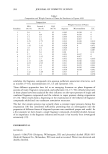
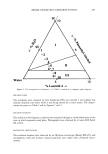
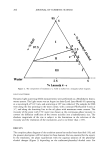
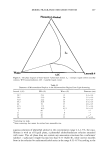
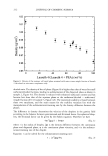
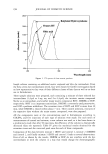
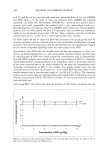
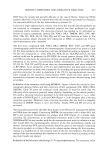
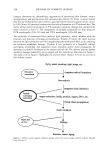
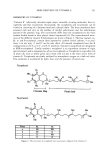
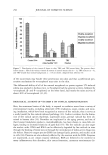
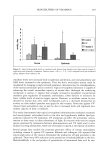
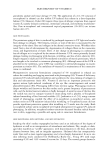
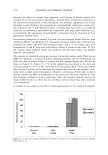
256 JOURNAL OF COSMETIC SCIENCE lOO 90 80 70 60 50 40 30 20 lO o Control Skin Treated Skin minus baseline Vit E TRF Fraction [] alpha-tocopherol [] gamma-tocophero] [] alpha-tocotrienol [] gamma-tocotrienol Figure 7. Distribution of the vitamin E forms in skin, TRF, and TRF-treated skin. The percent distri- bution (mean + SD) of the various vitamin E isomers in control mouse skin (n = 3), TRF mixture (n = 4), and TRF-treated skin (minus background n = 19) are shown. Adapted from reference 30. of the tocotrienols may hinder their penetration into skin and that a preferential pen- etration mechanism for ot-tocopherol may exist in the skin. The differential ability of all of the natural tocopherols to protect against UV-induced edema was studied in hairless mice. ot-Tocopherol had the greatest activity, followed by •/-tocopherol. [3- and 8- tocopherol, on the other hand, had nearly the same activity of about 40% of ot-tocopherol (31,32). BIOLOGICAL ACTIONS OF VITAMIN E ON TOPICAL ADMINISTRATION Skin, the outermost barrier of the body, is exposed to oxidative stress from a variety of environmental insults, including ultraviolet (UV) irradiation, ozone, smoke, and ioniz- ing irradiation, which have been recognized as sources of free radicals thus it serves as a useful model for free-radical-induced pathology (33). Indirect evidence for the forma- tion of free radical species (hydroxyl, superoxide anion, peroxyl radical) has been ob- tained in human skin (34). Peroxides are implicated in the aging process, and one of their known breakdown products, malondialdehyde, has been shown to cross-link col- lagen, leading to decreased elasticity of aged skin (35). The free radicals can also target the nucleic acids. DNA and RNA can be effectively degraded by free radicals in time through the binding of metal ions or through the intercalation of redox-active drugs into the helices. Reactive oxygen species (ROS) can damage lipids, proteins, and nucleic acids in cells (36). Proteins are also adversely affected by the reaction with the ROS. Enzymes are inactivated, as are certain enzyme inhibitors. ROS are believed to be involved in many inflammatory skin disorders, skin cancer formation, cutaneous autoimmune dis-

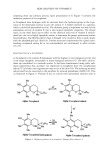
SKIN DELIVERY OF VITAMIN E 257 eases, phototoxicity, photosensitivity, and skin aging. In cutaneous tissues, solar UV irradiation induces immediate damage, leading to erythema and sunburn, and is gen- erally believed to be responsible for the delayed damage leading to premature aging and cancer. Electron spin resonance (ESR) spectroscopy has been used to confirm irrefutably that UV exposure leads to the generation of a host of free radical species by as yet uncharacterized mechanisms. Topical administration of antioxidants is one approach to diminishing oxidative injury (37). Shindo eta/. (33), while studying the antioxidant defense mechanism in murine epidermis and dermis, found that o•-tocopherol levels decreased with irradiation in both layers to approximately the same degree. Vitamin E is the major lipophilic antioxidant of exogenous origin found in tissues and is an obvious choice for enhancement of antioxidant protection by topical application. A variety of antioxidants, especially vita- min E and ubiquinol, are present in skin. Topical application provides an efficient means of enriching the tissue in protective antioxidants such as vitamin E. The cosmetic industry's main claim for vitamin E has been as a "natural moisturizer" to relieve dry skin and indirectly to aid in concealment of wrinkles and facial lines perceived as characteristics of aging and dry skin. However, studies carried on for more than a decade have now revealed significant benefits of vitamin E beyond moisturization of dry skin. Thiele eta/. (38) used vitamin E concentration as a marker of oxidative damage and found that ozone depleted topically applied but not inherent vitamin E, suggesting that ozone probably attacks the outermost layers of the skin, where the vitamin E presumably is the most concentrated. Ozone exposure (10 ppm for 2 h) caused lipid peroxidation in cutaneous tissues, and prior vitamin E application was found to ameliorate this damage. ESTERS OF (x-TOCOPHEROL o•-Tocopherol functions as an antioxidant when the phenolic hydroxyl of its chromanol ring is free (unesterified) (39). The free -OH can function as a scavenger of free radicals or singlet oxygen, usually being itself oxidized in the process to the semiquinone or quinone. The hydroxyl group can be protected from oxidation by esterification with the carboxyl group of an organic acid, forming esters such as the acetate or succinate derivatives, which are thought to reduce the antioxidant activity of the tocopheryl acetate or succinate esters to zero. The esterified forms of o•-tocopherol are stable to oxidation on storage. o•-Tocopheryl acetate, a liquid oil, when applied to the skin acts as a prodrug and has to release the active o•-tocopherol by a suitable hydrolysis reaction. o•-Tocopheryl acetate, being a lipid, is thought to diffuse across cell membranes, enter cells, and be associated with other hydrophobic membranous structures present in the cells such as the mitochondria and nuclear membranes. Kamimura and Matsuzawa (40,41) have suggested two routes for absorption of o•-tocopherol through the skin: (a) from the stratum corneum into the epidermis and then the dermis, and (b) through the hair follicles, by way of the pilosebaceous canal and into outer root sheaths and even- tually into the dermal tissue. In their study they did not show that the acetate ester was hydrolyzed to the free form, though they have speculated that it may occur. Tocopheryl linoleate is believed to be a superior moisturizing agent, with both the tocopherol and linoleic acid playing their respective roles. However, in studies using linoleate, the difficulty in distinguishing between the effect of tocopherol from the fatty acid should be borne in mind.
Purchased for the exclusive use of nofirst nolast (unknown)
From: SCC Media Library & Resource Center (library.scconline.org)