414 JOURNAL OF COSMETIC SCIENCE GEMINI SURFACTANTS FOR SUNSCREENS Klaus Kwetkat, Ph.D. Sasol Olefins & Surfactants GrnbH, Marl, Germany Gemini Surfactants Gemini surfactants, i.e. two surfactant moieties (a hydrophilic group and a hydrophobic chain) joined by a spacer, have attracted a lot of attention in recent years. Their main characteristics are superior interfacial activity, high electrolyte tolerance, mildness and high flexibility when compared to their conventional counterparts. Most gemini surfactants show low diffusion velocities and there is evidence that exchange rates between bulk phase and aggregates (e.g. micelies) are considerably slower than for conventional surfactants. In other words gemini surfactants tend to form more stable aggregates. Translating the unique properties of gemini surfactants into applications has been the main hurdle to commercialization so far. A simple, one to one exchange with conventional surfactants gives mediocre results at best. CERALUTION TM H - gel network emulsions When gemini surfactants are incorporated into a well balanced matrix of cosmetic raw materials their unique properties can be exploited in formulations. CERALUTION TM H (behenyl alcohol, glyceryl stearate, glyceryl stearate citrate, sodium dicocoylethylenediamine PEG-15 sulfate) is such a matrix that can be used as a building block in personal care formulations. It has been designed as liquid crystalline lameliar gel network O/W emulsifier. As this system is based on a gemini surfactant it can form stable liquid crystalline gel networks very efficiently and under a wide range of circumstances, i.e. oil loads and polarities, pH values (4 to 12) and electrolyte concentrations. The gel network helps to form and stabilize emulsions mainly in three ways. It's formation leads to extremely low interfacial tension which allows the formation of very small droplets - CERALUTION TM H is very efficient in this aspect (at 2.5 wt % with 0.1 wt% of a hydrocolloid stable nano-emulsions are formed). The third phase, the gel network, separates oil droplets and water phase. Moreover the lameliar gel network increases the viscosity of the emulsion. Usually the gel network emulsifiers are designed to increase viscosity even at low concentrations. The viscosity helps to stabilize the emulsion against creaming or sedimentation. The CERALUTION TM H gel network has a critical temperature (at which the lamellar gel network starts to disintegrate) of 65 øC. The higher the critical gel network temperature the better the temperature stability of the emulsion. Nonionic surfactants which are added to an emulsion on top of the gel network emulsifier will usually be incorporated into the network and will lower the viscosity. More important, they will also lower the critical gel network temperature and will thus destabilize the whole system. The critical gel network temperature also influences water resistance of a gel network emulsion as the temperature at which a dried gel network can be re-wetted follows the critical gel network temperature. Consequently water resistance is also compromised as soon as nonionic surfactants are added on top of the optimized gel network emulsifier. CERALUTION TM H gel network emulsions are very electrolyte tolerant. The comparison of two identical emulsions, one with CERALUTION TM H the other with a nonionic system shows that at a sodium chloride concentration of 4 wt % the emulsion with the nonionic emulsifier system is about to separate whereas the CERALUTION TM H based emulsion does not show any effect. The gemini surfactant blend, CERALUTION TM H, can also be used as a dispersant. At concentrations of approx. 1 to 2 wt %, titanium dioxide, be it with a hydrophilic or hydrophobic coating, is as efficiently dispersed as in commercially available titanium dioxide dispersions. The lamellar gel network formed by CERALUTION TM H adds protection against oxidation to, e.g. a sunscreen. Tests in which the level of lipid peroxides (monitored by the squalene / squalene peroxide ratio) was checked before and after the irradiation with UV light (10 J / cm 2) showed an effect comparable to a lotion which contained free tocopherol. We still do not know the mechanism but have proved that the effect is reproducible and not dependent on a special formulation. CERALUTION TM based sprayable emulsions As explained above a gel network emulsifier imparts viscosity to an emulsion. Thus its effect on an emulsion which needs to have very low viscosity (comparable to water) would be detrimental. CERALUTION TM H can be modified by the addtion of another gemini surfactant based blend, C ERALUTION TM F (sodium lauroyi iactylate, sodium dicocoylethylenediamine PEG-15 sulfate). The latter blend was developed as a building block for hair and skin cleansing and can also be used to switch off the gel network formation when added to CERALUTION TM H. Contrary to lotions or creams

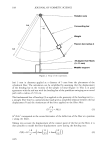
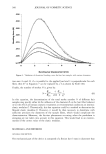
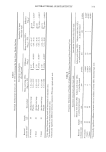
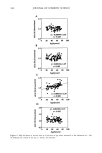
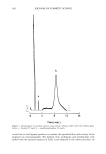
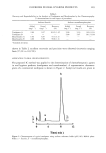
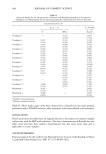
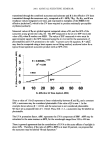
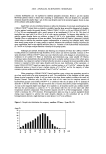
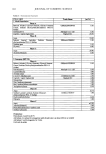
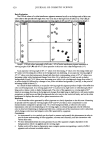
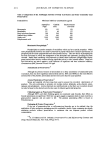
2001 ANNUAL SCIENTIFIC SEMINAR 415 a kinetic stabilization can be exploited to stabiliz.e sprayable emulsions. Below 1 •tm the random Brownian particle motion is faster than creaming or sedimentation. Thus all droplets of a sprayable emulsion should be smaller than 1 pro. In this case droplets need to be protected against fusion in case of the collision with another droplet. Apart from very low interfacial tensions to allow the formation of extremely small droplets the CERALUTION TM system forms a protective probably lameliar layer around the dispersed oil droplets. To give optimal results the gemini blends, CERALUTION TM H (0.5 wt %) and CERALUTION TM F (1.0 wt %) are complemented with a small amount of an isotrideceth-12 (0.5 wt %). This level of emulsifier can cope with l0 to 28 wt % of oil with varying polarities. To improve heat stability, i.e. stability against droplet fusion on collision, at least 0.1 wt % of a hydrocolloid, cellulose, starch, Xanthan Gum or combinations of them are added. The hydrocolloid will lead to a structural viscosity which helps to stabilize the emulsion against sedimentation or creaming but collapses easily when shear stress (pump action of a spray pump) is applied. Moreover the structural viscosity improves the spray application itself as the applied emulsion stays in. Variation of the hydrocolloid concentration (0.1 to 0.4 wt %) helps to adjust emulsion viscosity to the pump system. Although gel network formation and foaming are switched off when the CERALUTION TM building blocks are combined the high flexibility of the system can still be exploited. Contrary to PIT spray emulsions CERALUT[ON TM sprays can cope relatively easily with changes in oil polarities (e.g. variations in oil soluble UV filters or emollients) and electrolytes (e.g. water soluble UV filters). Looking at spray characteristics the gemini blends lead to a smaller surface tension of the whole spray formulation. As a large new surface is formed when the emulsion is sprayed the lowest possible surface tension is required to form small spray droplets and thus an even distribution of the sunscreen. A typical CERALUTION TM based sun spray shows a surface tension, ix, of 31 mN*m 4 whereas the best commercial system is found to have a surface tension of 33 nN*m 4 and for the majority of other nonionic systems surface tensions between 36 and 37 mN*m 4 are found. When preparing a CERALUTION TM based emulsion spray a three step procedure proved to give best results and to be quite economical as well. The combination of the complete oil and water phases (typical examples in table 1) will not lead to the shear forces needed to achieve the small oil droplets wanted. Therefore only one fifth to one sixth of the water but the complete amount of hydrocolloid glycerin and CERALUTION TM F is combined with the oil phase at 60 øC (instead of about 85 øC for PIT emulsions). The pre-emulsion has a viscosity that allows proper homogenization. As soon as the required droplet size (figure 1) is reached (i.e. all droplets smaller lam, median smaller 400 nm) the pre-emulsion is cooled to 35 øC and diluted with the rest of the water and other temperature sensitive compounds. This procedure requires only 40 % of the homogenization volume which is necessary for a PIT emulsion. If homogenization takes too long in a given equipment (total energy input required to achieve the small droplets depends on the individual set up of the homogenization device) a slight decrease in water phase (1 to 2 %) is sufficient. Figure 1: Droplet size distribution for sunspray: median: 370 rim, l•m: 99,4 % Area % 14 12 10 8 8 4 2 0
Purchased for the exclusive use of nofirst nolast (unknown)
From: SCC Media Library & Resource Center (library.scconline.org)