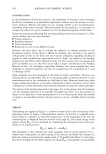
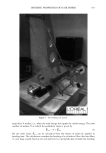
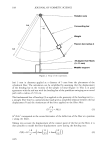
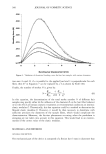
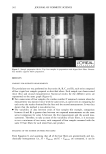
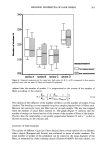
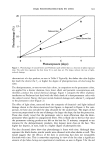
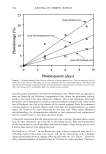
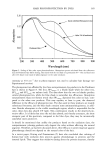
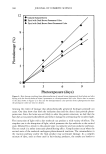
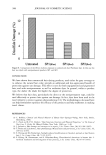
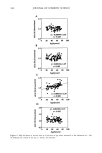
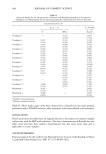
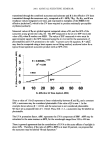
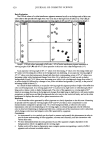
420 JOURNAL OF COSMETIC SCIENCE Data Evaluation The CIELab values of a violet interference pigment measured on all seven backgrounds of skin tone color chart at the specular (0 ø) angle were very close due to the high level of reflectivity. The CIELab valttes of this pigment measured at aspecular viewin• an•les of 20 ø and 45 ø are presented in Graph 1. Graph 1. CIELab values (presented at full scale = 45) of violet interference pigment measured at viewing angles of 20 ø (0) and 45 ø (O) from specular on skin tone color chart backgrounds (1-7) At an aspecular viewing angle of 20 ø, L* values were decreasing, a* values were becoming redder and b* values were becoming less yellow as the background was darkening. At an aspecular viewing angle of 45% L* values were decreasing more dramatically then their corresponding values at 20ø a* values were becoming redder with a background change from white (1) to light brown (5), and less red on darker backgrounds (6) and (7) b* values were becoming more yellow with a background change from white (1) to yellow-beige (4) followed by a change to less yellow on darker backgrounds (5) and (6), to the point of becoming bluish on black (7). As a result of these tendencies, at a specular viewing angle this pigment produces bright violet reflection color on all backgrounds. At a viewing angle of 20 ø it is perceived as light violet on white through yellow- beige and as intense violet on darker backgrounds. The color of this pigment at a viewing angle of 45 ø travels in an orange direction as the background changes from light beige to light brown, with some notable exceptions: on dark brown and black backgrounds the color stays in the violet-red family, and on the white background it displays the actual yellow-green transmission color. Discussion It was found that colors generated by effect pigments are clearly dependent on the skin tone. Measuring at specular and two aspecular viewing angles of 20 ø and 45 ø provides a more comprehensive color characterization compared to specular only. On a white background both, a reflection color and a transmission color are seen depending on the viewing angle on a black background only the reflection color is observed. Depending on background skin tone, a certain part of the transmission color is absorbed, which changes color travel and impacts color effect generated by a pigment. Conclusions ß An instrumental in-vitro method was developed to measure and quantify this phenomenon in order to provide better understanding of effect pigments, colorants and cosmetics, and their interaction with various skin tones. ß We have demonstrated that the color generated by an effect pigment is highly dependent on the background on which it is applied and the viewing angle. ß Further work will be done to characterize more complex systems incorporating a variety of effect pigments and colorants in suitable vehicles.

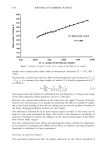
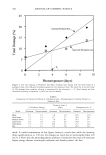
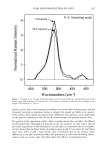
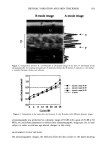
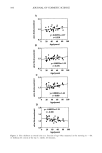
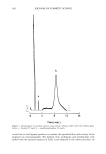
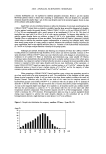
2001 ANNUAL SCIENTIFIC SEMINAR 421 STRUCTURE AND PROPERTY RELATIONSHIP OF NONIONIC SURFACTANTS AND EMULSIFIERS Silke Hoppe, Ph.D. SASOL, Austin, TX INTRODUCTION The choice of an emulsifier or surfactant is of vital importance to the preparation of stable cosmetically elegant products, especially when formulations contain hard to emulsify or solubilize ingredients like silicones, lactates etc. The benefits and dosage level of surfactants in hair and skin care applications are influenced by several different properties including their hydrophilic lipophilic balance (I-{LB). Alcohol Ethoxylates (AE) are the most widely used nonionic surfactants on the market today. The I-{LB of Alcohol Ethoxylates can be calculated by a common method: dividing the weight % of EO by 5. This method does not differentiate between different hydrophobe structures (multiple branched, linear, monobranched), and may lead a formulator to believe that one ethoxylate can easily be replaced for another. This study compares five series of nonionic surfactants based on structurally distinct hydrophobes of similar molecular weight. Each series covers HLB values from 8 to 15. Linear, defined I3-branched (Guerbet), multiple branched, monobranched Oxo and secondary hydrophobes with varying degrees of ethoxylation will be compared regarding their solubility, surfactant and emulsifier performance. Figure 1 illustrates the differences in alkyl chain structure of those hydrophobes. The study also discusses the effect of the introduction of propylene oxide to Guerbet alcohol based surfactants. Guerbet 12 Alcohol Tridecyl Alcohol Branched Oxo Alcohol Lauryl Alcohol •OH Secondary Alcohol • OH Figure 1. Structural representation of parent alcohols METHODS 250 -• --•-Guerbet 12 Ethoxylates I '•- Lauryl Ethoxylates 200 F "•- Tridecy' Ethøxylates / o 40 45 50 55 60 65 70 75 ß d% EO Figure 2. Wetting Data of Alcohol Ethoxylates The linear and branched ethoxylates were synthesized from the respective alcohol and ethylene oxide (EO) using a proprietary catalyst (NOVEL© II), which yields narrow ethoxylate distribution. It also effectively lowers the amount of free alcohol and suppresses unwanted PEG formation for branched hydrophobes. •,2 The secondary alcohol ethoxylates were obtained as product samples from the manufacturer. The solubility of the ethoxylate in oil was determined by making 1 and 10% solutions of the ethoxylates. Wetting times were determined by the dip-method, foaming was measured using the Schlag method. CMC and Surface Tension were measured with a tensiometer. Cloud Points were determined in water and BDG. REStILTS AND DISCUSSION Comprehensive studies on the behavior of alcohol ethoxylates depending on the number of ethylene oxide units or the length of the alkyl chain have been published in the literature, but only few data points are available regarding the influence of the alkyl chain structure on performance characteristics. 3's The physical property and performance data presented here show that the behavior of alcohol ethoxylates is influenced quite significantly by both the hydrophobe structure and the degree of ethoxylation.
Purchased for the exclusive use of nofirst nolast (unknown)
From: SCC Media Library & Resource Center (library.scconline.org)