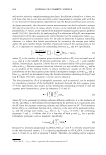
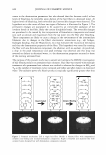
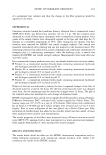
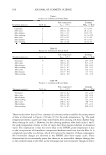
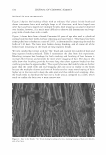
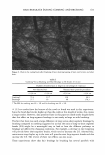
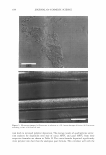
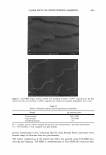
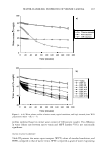
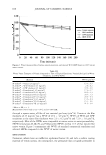
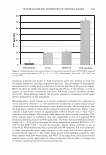
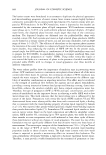
HAIR BREAKAGE DURING COMBING AND BRUSHING 633 Figure 3. Hair in the styling brush after brushing of hair, showing looping of hairs over bristles and other hairs. Combing* Brushing* Table I Combing Versus Brushing and Hair Breakage at 50 Strokes (15.2 cm) Number of broken hairs at length in cm (average of 3 replicas) Non-bleached hair 2.54 cm 72.3 37.7 2.54 cm 12.7 83 Bleached hair (peroxide-persulfate) 2.54 cm 118 49 2.54 cm 40.3 170.3 * The RH for combing was 60 ± 5% and for brushing was 50 ± 5%. A 15.2-cm stroke from the bottom of the comb or brush was used in this experiment. Since the brush has bristles higher up than the comb at this length of stroke, this creates a longer stroke. However, data presented later in this paper on comb stroke length shows that this effect on long-segment breakage is not nearly as large as with brushing. The fact that there was such a large difference in long-versus-short segment breakage by brushing compared to combing suggested to us that the ratio of long-to-short segment breaks (LIS) might be a meaningful way to look at how the different pathways to breakage are affected by changing conditions. For example, a decrease in end wrapping will provide fewer short segment breaks, which tend to decrease the LIS. Alternatively, more severe snags higher up in the tress will provide more long segment breaks and also increase the LIS. The reverse of these two effects can also occur. These experiments show that hair breakage by brushing has several parallels with

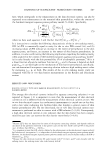
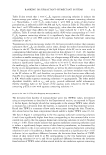
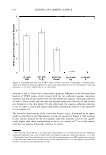
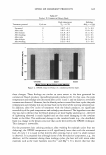
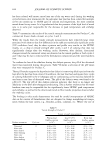
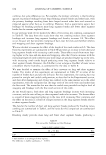
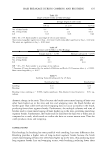
634 JOURNAL OF COSMETIC SCIENCE combing, but some differences too. For example, the primary similarity is that brushing appears to produce breakage by hair loops forming around bristles and other hairs, with the primary breakage resulting from hairs looped around other hairs and stressed or impacted against other hairs as in combing. However, from a quantitative aspect, hair breakage by brushing produces more long segment breaks and fewer short segment breaks for the reasons explained above. In our previous work (4) we showed the effect of wet-versus-dry combing, summarized in Table II. The data from this study show that wet combing reduces short segment breakage and increases long segment breakage and thereby increases LIS. This effect occurs because wet hair provides clumping of hairs near the ends and therefore inhibits end wrapping and short segment breakage. We next decided to examine the effect of the length of the comb stroke on LIS. The data from this experiment are summarized in Table III and show an increase in both short and long segment breaks with increasing comb stroke. These effects result from more loop ing higher in the tress and also more end wrapping. Also the LIS ratio increases with the increasing length of comb stroke because more snags are produced higher up in the tress, with increasing comb stroke length producing more long segment breaks relative to short segment breaks. However, this LIS effect is not as large as the effect of water versus a moderate relative humidity, as summarized by the data in Table II. We next decided to examine the effect of hair curvature on long and short segment breaks. The results of this experiment are summarized in Table IV in terms of the number of broken hairs and also the LIS ratio. For this experiment, the starting hair was permed in straight and curled configurations, as described in the Experimental section, and then after shampooing and drying was combed in the same manner as in the other experiments, with the exception that the large teeth of the comb were used rather than the fine teeth. The reason for this was that the curled tress provided too high a level of snagging and breakage with the fine-tooth section of the comb. As one would expect, both short and long segment breakage increase with increasing curvature, and the ratio of long-to-short segment breaks also increases. The former effect is a result of more snagging higher up in the tress with increasing fiber curvature, and the effect on the ratio is a result of a larger increase in the long segment breaks relative to short segment breaks. The data for the number of short and long segment breaks produced by brushing versus combing are summarized in Table I, and the ratios for this comparison are summarized in Table V. Brushing clearly provides more long and fewer short segment breaks, producing a Table II Wet-versus-Dry Combing and Hair Breakage Long-to-short segment ratios 60 ± 5% RH LIS* 0.18 * Each number is an average of three replicas. The difference is highly significant, p = 0.0003. Wet 0.99
Purchased for the exclusive use of nofirst nolast (unknown)
From: SCC Media Library & Resource Center (library.scconline.org)