HAIR BREAKAGE DURING COMBING AND BRUSHING 631 on the rods for another five minutes, the tress was removed from the rods and more neutralizer was added while massaging it through the hair. The tress was rinsed thor oughly with water and blotted dry with a towel before air drying. For straightening hair, the same process was applied as above, but the tress was squeezed between the forefinger and the thumb from top to bottom in order to form it into a straight configuration. This same process was applied for each addition of waving lotion, rinse, and neutralizer. Four weeks later (for convenience only) the tresses were shampooed, rinsed, and dried and used in the combing experiment testing for the curvature effect. The combing was for 25 strokes 15.2 cm long, using the wide-tooth spacings of the Ace comb described above. BRUSHING HAIR After experimenting with brushing variables, the following procedure was adopted for consistency. Three-gram tresses of the hair described above, both non-bleached "virgin" hair and bleached hair (using the bleaching procedure described in our former paper (4)) were brushed (15 .2-cm brush stroke) after shaking the tress three times and then brushing it 50 strokes, pausing to collect hairs at ten-stroke intervals. The tress was held lightly at the bottom of the brush with the thumb and engaged into the brush bristles at about a 45° angle. The brush was then pulled through the hair rapidly while the thumb continued to hold the hair at the bottom of the brush. COMBING HAIR Combing of hair and statistical analysis was as described in our previous paper (4), with the exception that in the case of the curvature experiment the comb teeth with wide spacings were used. Combing was for only 25 strokes, and only hair segments 2.54 cm or longer and those shorter than 2.54 cm were collected. For the length-of-comb-stroke experiment, the fine-tooth part of the comb was used with 50 comb strokes, and hair fragments were collected at 2.54 cm or longer and shorter than 2.54 cm. RESULTS AND DISCUSSION As indicated above, hair fibers break during combing by two primary pathways, pro viding for long (3) and short (4) segment breaks. Long segment breaks occur primarily by a hair fiber looping over another hair and impacting on it, and short segment breaks occur primarily by end wrapping via abrasion and deformation. Since we had already shown that bleaching increases both short and long segment breakage, and conditioning decreases both short and long segment breakage (4), for this paper we decided to examine other important variables involved in combing and also to look at brushing. In addition, we decided to look at the effect of the ratio of long-to-short segment breaks as a means to show how these two different pathways of breakage are affected by these variables.

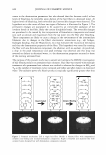
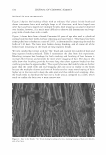
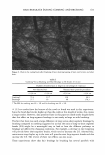
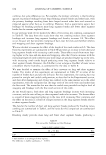
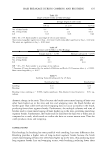
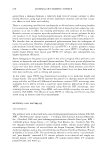
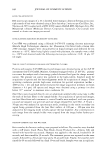
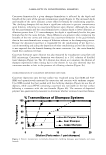
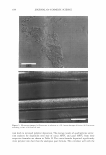
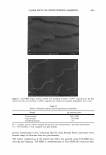
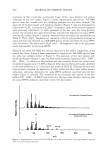
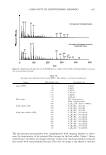
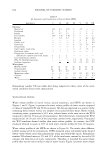
632 JOURNAL OF COSMETIC SCIENCE BRUSHING OF HAIR AND BREAKAGE Figure 2 depicts the brushing of hair with an ordinary "flat" plastic bristle brush and shows interwoven hairs with multiple loops in all directions, with hairs looped over other hairs and hairs looped over multiple bristles. End wrapping can also be observed over bristles however, it is much more difficult to observe and demonstrate end wrap ping with a brush than with a comb. Figure 3 shows hairs from a female Caucasian 66 years of age who used a cylindrical styling brush for three weeks without removing any hairs from it. These hairs have been either pulled out or broken at a ratio of 2.02/1, as determined by inspecting the ends for bulbs of 130 hairs. The hairs were broken during brushing, and of course all of the broken hairs remaining in the brush are long segment breaks. We next combed hair tresses with the "flat" brush and counted the number of short and long segment breaks produced. Table I summarizes the data from this experiment. Bleaching increases hair breakage for both combing and brushing of hair because it increases fiber friction and provides for more severe snagging of hair. The data in this table show that brushing provides for more long than short segment breaks but that combing provides the opposite effect. This is partly because the brush bristles are further apart than the comb teeth and end wrapping does not occur as readily in the brush because the multiple columns and rows of bristles tend to create more looping of hairs higher up in the tress and to keep the ends apart and thus inhibit end wrapping. Also, the brush tends to distribute the hair over a wider area as compared to a comb, which tends to confine the hairs over a more narrow area. Figure 2. Hair in the Goody "flat" brush during brushing of a tress, showing looping of hairs over bristles and other hairs.
Purchased for the exclusive use of nofirst nolast (unknown)
From: SCC Media Library & Resource Center (library.scconline.org)