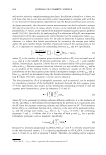
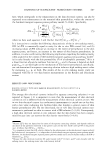
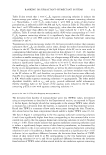
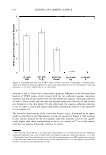
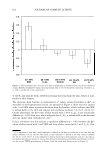
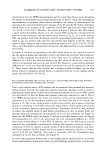
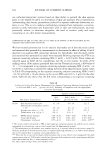
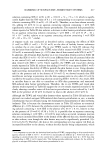
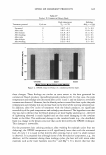
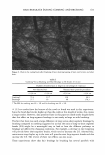
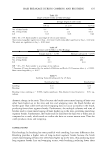
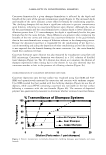
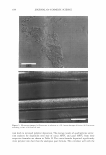
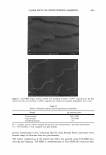
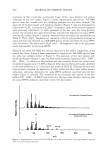
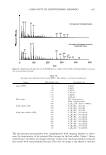
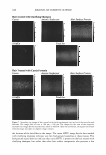
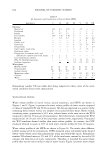
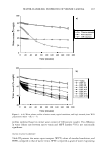
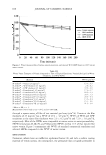
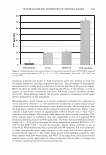
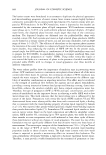
CASSIA HPTC IN CONDITIONING SHAMPOO 649 level of signal at the same masses used to identify the deposited cassia HPTC. The ToF-SIMS spectroscopy and imaging analyses (Figures 5-7) clearly show the deposition of cassia HPTC onto the hair surface from the cassia formula. The two anionic surfactant images indicate the deposition of anionic surfactant across the hair surface, shown for each of the hair treatments. Anionic surfactant and cassia HPTC were both detected across the hair surface, showing that two components were co-located on the hair surface, thus suggesting that cassia HPTC deposited as a coacervate with the anionic surfactant from the shampoo. Furthermore, as expected from the spectra shown in Figure 5, the intensities of the hair surface protein and 18-MEA decreased after treatment with the cassia formula, due to coverage of the cassia HPTC-anionic surfactant coacervate on the hair surface. INSTRON COMBING TEST RESULTS Conditioning shampoos lubricate the hair surface and decrease charge, both of which are benefits that can be determined by measuring the friction between hair and comb (1). The mean force used to pull a comb through hair treated with clarifying shampoo, cassia formula, and guar formula was measured using an Instron combing test (15). Hair treated with cassia formula required significantly less force to comb than did hair treated with either the guar formula or the clarifying shampoo. This easier combing indicates better conditioning performance by the cassia formula (Table IV). These findings cor relate well with the polymer deposition test: increased polymer/coacervate deposition yields increased combing ease, resulting in better conditioning performance. Even dis tribution of the cassia HPTC coacervate along the hair fiber, which was observed with ToF-SIMS, also factors into the combing force. CONCLUSIONS We have shown that cassia HPTC participates in the coacervate phase of a conditioning shampoo, by which it deposits onto hair to provide conditioning benefits. The high charge-density cassia HPTC led to improved deposition efficiency of the cassia HPTC compared to a traditional quarternized guar formula. Our results indicate that cassia HPTC offers benefits as an alternative to traditional cationic polymers or as an adjunct conditioner to decrease the amount of cationic polymer needed to achieve the desired conditioning performance. Formula Clarifying shampoo Guar formula Cassia formula Table IV Results of Instron Combing Test Mean comb force (g) 109.8 (19%) 105.5 (13%) 92.1 * (32%) N = 3 values reported are means. Percent relative standard deviation for each measurement is provided in parentheses. * p 0.05 (Fisher's LSD) compared with clarifying shampoo.

650 JOURNAL OF COSMETIC SCIENCE REFERENCES (1) C.R. Robbins, Chemical and Physical Behavior of Human Hair, 4th ed. (Springer-Verlog, New York, 2002), pp. 345-358, 460--462. (2) V. Shubin, Adsorption of cationic polymer onto negatively charged surfaces in the presence of anionic surfactant, Langmuir, 10, 1093-1100 (1994). (3) T. V. Drovetskaya, R. L. Kreeger, J. L. Amos, C. B. Davis, and S. Zhou, Effects of low-level hydro phobic substitution on conditioning properties of cationic cellulosic polymers in shampoo systems,]. Cosmet. Sci., 55, Sl95-S205 (2004). (4) P. Hassel, R. Dieing, R. Norenberg, A. Pfau, and R. Sander, Conditioning polymers in today's shampoo formulations-Efficacy mechanism and test methods, Int. J. Cosmet. Sci., 22, 1-10 (2000). (5) W. Wu, J. Alkema, G.D. Shay, and D.R. Basset, Quantitative methods for evaluating optical and frictional properties of cationic polymers, J. Cosmet. Sci., 52, 51-65 (2001). (6) J. A. Faucher and E. D. Goddard, Influence of surfactants on the sorption of a cationic polymer by keratinous substrates, Colloid Interface Sci., 5 5, 313-319 (1976). (7) S. V. Agarkar and D. R. Jadge, Phytochemical and pharmacological investigations of genus Cassia: A review, Asian J. Chem., 11, 295-299 (1999). (8) U. K. Patil, S. Saraf, and V. K. Dixit, Hypolipidemic activity of seeds of Cassia tora Linn, J. Ethno pharmacol., 90, 249-252 (2003). (9) I. S. Gilmore and M. P. Seah, Static SIMS: A study of damage using polymers, Surf Interface Anal., 24, 746-762 (1996). (10) C. A. Lepilleur and J. A. Fruscella, Hydrocolloids and process therefore, US Patent 2005/0129643 Al (2005). (11) M. Manuszak-Guerrini, L. Smith-Wright, R. Y. Lochhead, and W. H. Daly, Complexation of ami noalkylcarbamoyl cellulosics and oppositely charged mixed micelles,]. Soc. Cosmet. Chem., 48, 23--40 (1997). (12) T. M. Obey and P. C. Griffiths, "Polymer Adsorption: Fundamentals," in PrincijJles of Polymer Science and Technology in Cosmetics and Personal Care, E. D. Goddard and J. V. Gruber, Eds. (Marcel Dekker, New York, 1999), p. 51. (13) M. S. Wagner and D. G. Castner, Characterization of adsorbed protein films by time-of-flight sec ondary ion mass spectrometry with principal component analysis, Langmuir, 17, 4649-4660 (2001). (14) A. Harvey, C. M. Carr, and A. Pereira, Time-of-flight secondary ion mass spectrometry (ToF-SIMS) analysis of the application of a cationic conditioner to "clean" hair,]. Cosmet. Sci. 55, 265-279 (2004). (15) A. Franbourg, F. Leroy, and D. Bra'ida, "Evaluation of Product Efficacy," in The Science of Hair Care, 2nd ed., C. Bouillon and J. Wilkinson, Eds. (Taylor & Francis, New York, 2005), pp. 399-400.
Purchased for the exclusive use of nofirst nolast (unknown)
From: SCC Media Library & Resource Center (library.scconline.org)