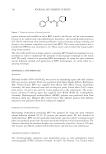
140 J. Cosmet. Sci., 73, 140–153 (May/June 2022) Address all correspondence to Thomas P. Dooley, tom@tomdooley.org Formulation Development of Sustained-Release Microencapsulated IR3535® with Long-Duration Mosquito Repellency EDUARD CASAS-TERRADELLAS, EMMA BEBBINGTON, TYCHO SPEAKER AND THOMAS P. DOOLEY LivFul Inc., Cheshire, United Kingdom (E.C.T., E.B., T.P.D.) Capsulent, Santa Cruz, California, USA (T.S.) Accepted for publication June 10, 2022. Synopsis Bites from pathogen-harboring insects (e.g., mosquitos and sandflies) and noninsect arthropod pests (e.g., ticks) can result in a variety of vector-borne pathogenic diseases. Numerous commercial repellent products containing DEET, IR3535® (Merck KGaA, Darmstadt, Germany), or other repellent active ingredients—but lacking sustained-release technology—are effective at repelling pests from human skin for several hours. To reduce or prevent the potential for arthropod vector-borne diseases, sustained release formulations of repellent active ingredients with long-duration benefits are needed to increase efficacy and user compliance. Here, the authors present the formulation development of a Lewis acid–Lewis base adduct encapsulated emulsion containing 20% w/w IR3535. Stability testing of the lotion was performed at ambient room temperature (20°–25°C) and 40°C. Repellency efficacy on human subjects was tested against Aedes aegypti mosquitos in laboratory arm-in-cage studies. Anti-infective properties were assessed against multiple bacterial species. A series of sustained-release lotions of microencapsulated IR3535 was prepared. During formulation development, chemical stability was problematic. However, chemical stability was achieved by buffering the lotion with sodium citrate–citric acid. The microencapsulated formulation manifested a long- duration efficacy of 12–13 hours against A aegypti mosquitos in laboratory arm-in-cage studies. The lotion also demonstrated anti-infective properties against multiple bacterial species. This sustained release formulation achieved a long-duration efficacy benefit superior to commercial repellent products, without the unpleasant odor or oily feeling that is customary for DEET-containing products. INTRODUCTION Insect-borne and non-insect arthropod pest-borne pathogenic diseases affect millions of people worldwide with acute and chronic conditions. Some of the prominent vector- mediated infectious diseases include malaria, dengue fever, Lyme disease (borreliosis), leishmaniasis, Chagas disease (trypanosomiasis), Zika fever, equine encephalitis, and yellow fever. In lieu of (or in addition to) eradication of, or physical separation from, insects and noninsect arthropod pests, prevention of vector-borne diseases or the symptoms thereof

141 MICROENCAPSULATED INSECT REPELLENT may be achieved by application to the skin, hair, and/or clothing of an effective long- duration sustained-release repellent formulation. The repellency efficacy of a topical formulation is a function of: (a) the active ingredient concentration on the skin at a particular time (b) the rate of skin penetration and (c) the rate of aromatic evaporation from the skin, in addition to the arthropod species and environmental conditions. An ideal sustained release formulation will reduce the rate of skin penetration and evaporation rate of the active ingredient maintain a residual concentration of the active ingredient and prevent the active ingredient from evaporating without entirely sequestering it. Thus, a formulation chemist seeks a “slow” rate of evaporation rather than “no” rate, whereas nonsustained-release conventional formulations exhibit rapid and high volatility without long-duration efficacy. Sustained-release formulations can fail during development for various reasons, including the three parameters mentioned previously, as well as chemical instability of the active ingredient and/or excipients and physical instability (phase separation, flocculation, viscosity variations, etc.). Achieving an effective topical sustained-release formulation can be challenging, as one must optimize the composition in conjunction with the manufacturing processes (e.g., the sequence of addition of the ingredients, temperatures, and mixing intensity). Microencapsulation of the common synthetic active ingredient DEET within a topical repellent formulation has been demonstrated to decrease the rate of skin (“transdermal”) penetration (1,2). Microencapsulation can also prolong evaporation rates of DEET, thus providing a sustained release mode of action (2). These publications, in conjunction with a related US patent T.J. Speaker, Microencapsulation product and process, US Patent 8,039,015 (2011), have disclosed the microencapsulation of an emulsion using Lewis acid–Lewis base adduct interactions. In the present work, the authors desired to use a similar Lewis acid– Lewis base microencapsulation approach, albeit using another active ingredient, IR3535®. This ingredient has several properties that make it more appealing than DEET to consumers. IR3535 has been known for more than 2 decades to be an effective and safe mosquito repellent active ingredient. This active ingredient has been included in multiple commercial consumer products in various countries. The efficacy of IR3535-containing topical formulations (e.g., sprays and lotions) against mosquitos has been ranked relative to DEET-containing formulations (3–10). Comparisons of the two active ingredients have also been made using the insect vectors of Chagas disease (trypanosomiasis), (11,12), lone star ticks (Amblyomma americanum) (13), and two species of sandflies (Phlebotomus mascittii and Phlebotomus duboscqi), which are the vectors of leishmaniasis (14). A third species of sandflies, Phlebotomus papatasi, has also been tested for IR3535 (15). In the context of typical commercial formulations, in repellency efficacy comparisons of the same or similar concentrations of active ingredients, IR3535 is less effective or comparable to DEET. For example, the mean complete protection time (CPT) for human subjects in a field trial in the Florida Everglades for 25% IR3535 in ethanol was 3.0 hours versus 5.6 hours for 25% DEET (4). The CPT is the number of minutes (or hours) elapsed between topical application and the first landing and/or probing (biting) of the biting insect. The CPT may be defined as the time of the confirmed first bite (CFB), which represents the first subject within a group of subjects experiencing his/her second bite or confirmatory bite. Although these publications disclose the duration of repellency efficacy for compositions containing IR3535, they do not present comparisons of standard formulations (e.g., in
Purchased for the exclusive use of nofirst nolast (unknown)
From: SCC Media Library & Resource Center (library.scconline.org)