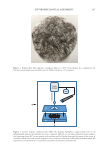
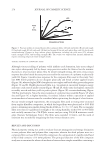
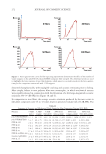
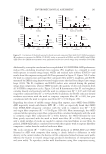
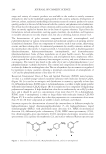
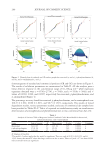
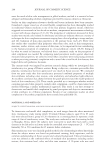
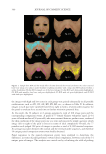
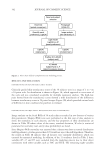
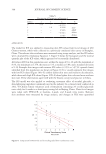
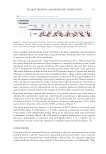
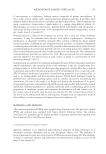
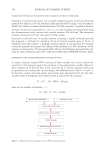
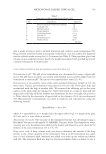
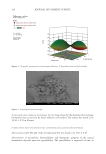
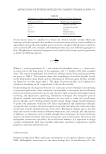
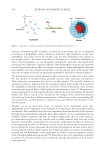
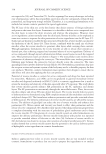
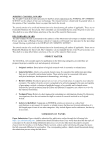
270 JOURNAL OF COSMETIC SCIENCE TENSILE TESTING OF COMPOSITE FILMS Although viscous yielding of polymer welds inhibits crack formation, hair tresses shaped into styles subsequently fail by slower creep processes unless the fixative has the intrinsic elasticity to resist excessive plastic flow. In tensile strength testing, the stress versus strain response describes brittle fracture processes and/or the resistance of a polymer to plastically yield (18). Figure 3 models stress responses for the composite films used in this study. Very low MW brittle polymers do not dissipate plastically and break at lower applied strains (Figure 3A), whereas higher MW elastoplastics are tougher and break after greater elongation (Figure 3C and E). Highly plasticized films (e.g., viscoplastics) excessively dissipate energy and more easily stretch under tension (Figure 3B and D), while some elastoplastic materials reversibly stretch and then yield via perfect plastic (Figure 3F) or strain-hardening (Figure 3G) flow mechanisms. Since the stress response of a polymer may resemble Figure 3A when dry and Figure 3G at higher humidity, viscoelastic balance within a spectrum of applied enviromechanical stresses must be considered when optimizing the design of a hair fixative. For our tensile strength experiments, the rectangular films used in testing were sectioned from surplus film-fiber composites, in which the larger films were plasticized at 90% RH prior to trimming into smaller oblong blocks of film (ca. 8 × 8 × 0.7 mm). The rectangular films were then re-equilibrated overnight at the testing humidity (either 50% or 90% RH) and carefully mounted in a TA.XTplus texture analyzer using TA-96-B miniature tensile grips (Texture Technologies Corp.). The films were extended 1.0 mm/s, and the work of extension was recorded by integrating the force-versus-distance curve. RESULTS AND DISCUSSION Physical property testing was used to evaluate fracture propagation and energy dissipation in neat polymer films and polymer-fiber composites, wherein the dried polymer mass in a composite film is at least 90% (w/w). By comparison, the composition of a rigidly styled head of hair likely contains 1% (w/w) polymer. The principal objective of the film composite study was to examine the release of mechanical stresses from simple assemblies containing a Force or Stress A E Elongation orStrain D B YS G F C UTS BS Figure 3. Fracture profiles of strained fixative-fiber composite films: (A) hard and brittle (B) soft and tough (C) hard and tough (D) soft and weak (E) hard and strong (F) ductile with plastic flow and (G) ductile with strain-hardening. Changes in slope indicate plastic deformation, including the yield stress (YS), ultimate tensile strength (UTS), and breaking strength (BS). The overlay was adapted from internal Ashland Inc. reports containing empirical tensile strength results.

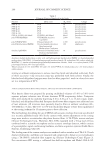
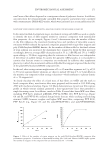
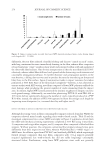
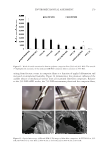
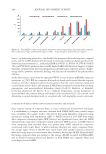
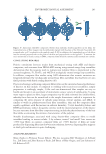
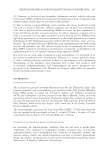
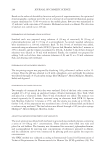
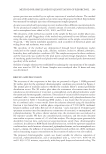
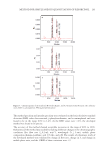
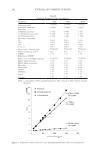
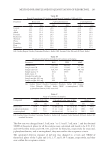
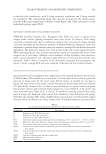
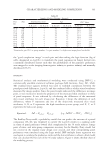
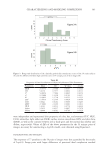
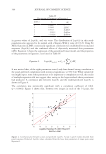
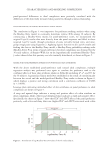
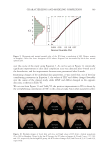
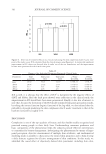
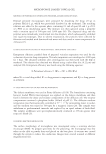
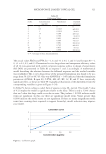
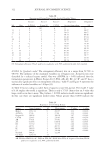
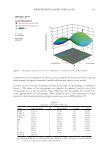
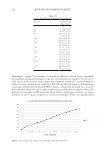
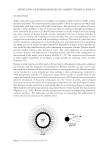
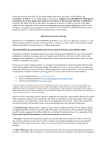
271 Enviromechanical Assessment small mass of hair fibers dispersed in a contiguous volume of polymeric fixative. In addition, outcomes from the environmentally controlled film property assessments were correlated with commensurate DHSA-AED results, which were presented in a recent publication (16). NEAT FILM VERSUS FIBER COMPOSITES: ANALYSIS OF INDUCED MECHANICAL FAILURE In the initial method development stages, mechanical testing with AED was used as a probe to identify the mass of fiber snippets needed to construct composites with reproducible film properties. As an example, Figures 4 and 5 demonstrate that the number of fibers in the film influences the maximum breaking force and numbers of detectable acoustic emissions (#AED) released by ruptured composites prepared with virgin fiber snippets and poly (OAA/Acrylates/BAEM) fixative. As the number of fibers added to the fixed volume of resin solution was increased, the maximum force required to break the film increased accordingly however, average AED values plateaued at 54 ± 2 dB-SPL and 170 ± 3 #AED upon adding ca. 50 fibers, suggesting that the resistance to film fracture was independent of the release of audible energy. To justify the apparent AED paradox, it is reasonable to surmise that fracture events in composites are moderated by additives that supplement plasticity, in which the incremental addition of flexible fiber snippets improved the ductility of the poly(OAA/Acrylates/BAEM) composite film. In the end, after testing various weight ratios of 5- to 15-mm fiber segments in 13 g of 3% to 5% (w/w) aqueous fixative solutions, we chose to include 100 mg of 5- to 9-mm fibers in the majority our comparative film testing evaluations—which amounts to a planar density of ca. 50 snippets/cm2. To clearly elucidate the effect of a fixed mass of hair fibers on #AED and the work to break composite films, neat fixative films were prepared and fractured at 50% RH using AED with mechanical analysis. Figure 5 (0 fibers) demonstrates a typical neat film-rupture profile in which texture analysis generated a force-against-time trace that presented a single fracturing event. In addition, trends in Table II reveal that lower MW neat films, including PVP K-15, imidized p(IB/MA), PVP K-30/PEG 400, PVP K-30 (e.g., Figure 6A and B), and PVP K-60, endured abrupt brittle fracture while cracking and releasing minimal #AED however, tougher and higher MW neat films, comprising PVP K-90, PVP K-120 (e.g., Figure 6C and D), poly(VP/MAPTAC), and poly(VP/DMAPMA), Figure 4. Effect of the number of virgin snippets on the poly(OAA/Acrylates/BAEM) composite film performance properties. Correlations of maximum breaking force (left) and liberated #AED (right) against the number of snippets in the composite film are demonstrated (50 ± 5% RH).
Purchased for the exclusive use of nofirst nolast (unknown)
From: SCC Media Library & Resource Center (library.scconline.org)